Why People Click “Learn More” but Don’t Buy: Understanding Customer Intent
8–10 min read · — Digital Marketing
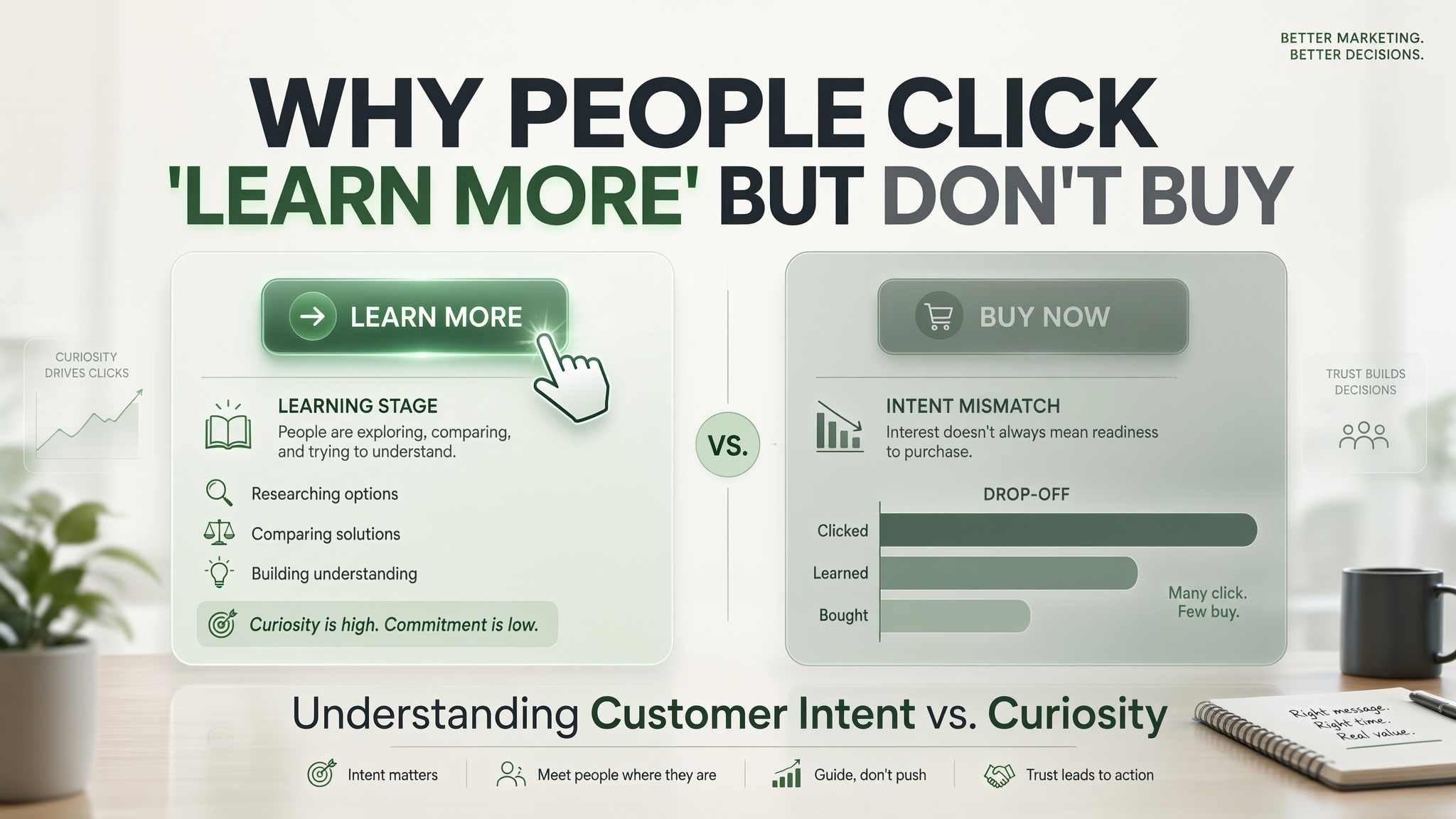
You see it in your analytics every week. Hundreds of clicks on “Learn More.” High interest. High curiosity. And yet, very few purchases.
The natural conclusion is that the offer is weak or the price is too high. But often, the real problem is simpler: the visitor was never at the buying stage. They were at the learning stage.
A click does not mean someone wants to buy. It means they want to know more. And knowing more is not the same as being ready.
What Is Customer Intent?
Customer intent is the reason behind an action. It is not what someone does—it is why they do it. Two visitors can click the same button for completely different reasons: one wants to buy, the other wants to understand, and a third is simply curious.
Intent is not visible in the click. It is hidden underneath. And that is why so many brands misread their traffic. They see interest and assume readiness. They see engagement and expect conversion. But interest and readiness are two very different states.
Understanding intent is the difference between pushing a visitor who is not ready and guiding a visitor who is.
Key idea
A click is not a promise to buy. It is a request for more information.
When someone clicks “Learn More,” they are saying, “I am interested, but I am not convinced yet.” They are still gathering, still comparing, still deciding whether this even matters to them.
The mistake most brands make is treating that click as a buying signal. They respond to curiosity with a sales pitch—and the visitor leaves. Because curiosity and readiness need different things.
A visitor who is learning is not the same as a visitor who is deciding.
Both can convert, but they need different pages, different tones, and different promises.
The 5 Stages of Customer Intent
Not all clicks come from the same place. Most visitors fall into one of five stages:
1. Unaware. They do not know they have a problem yet. They are not clicking to buy. They are scrolling.
2. Aware. They know a problem exists, but they do not know what solves it. Their click is exploratory.
3. Considering. They know the options. They are comparing. Their click is investigative.
4. Deciding. They have narrowed it down. They need reassurance. Their click is deliberate.
5. Ready. They want to buy. They need the path to be easy. Their click is intentional.
“Learn More” usually comes from stages 2 or 3. That is why the following page should not push for a sale. It should help the visitor move to the next stage.
Why Curiosity Rarely Leads to a Sale
Curiosity is a weak driver of purchase. It pushes people to look, not to act. Curiosity says, “I wonder what this is.” Purchase says, “I need this now.” These are two very different states.
Many brands chase curiosity because it produces clicks. But a page full of curious visitors is not a page full of buyers. Curiosity fills your analytics. Intent fills your revenue.
The goal is not to attract more clicks. It is to attract the right clicks—from people whose intent matches the offer.
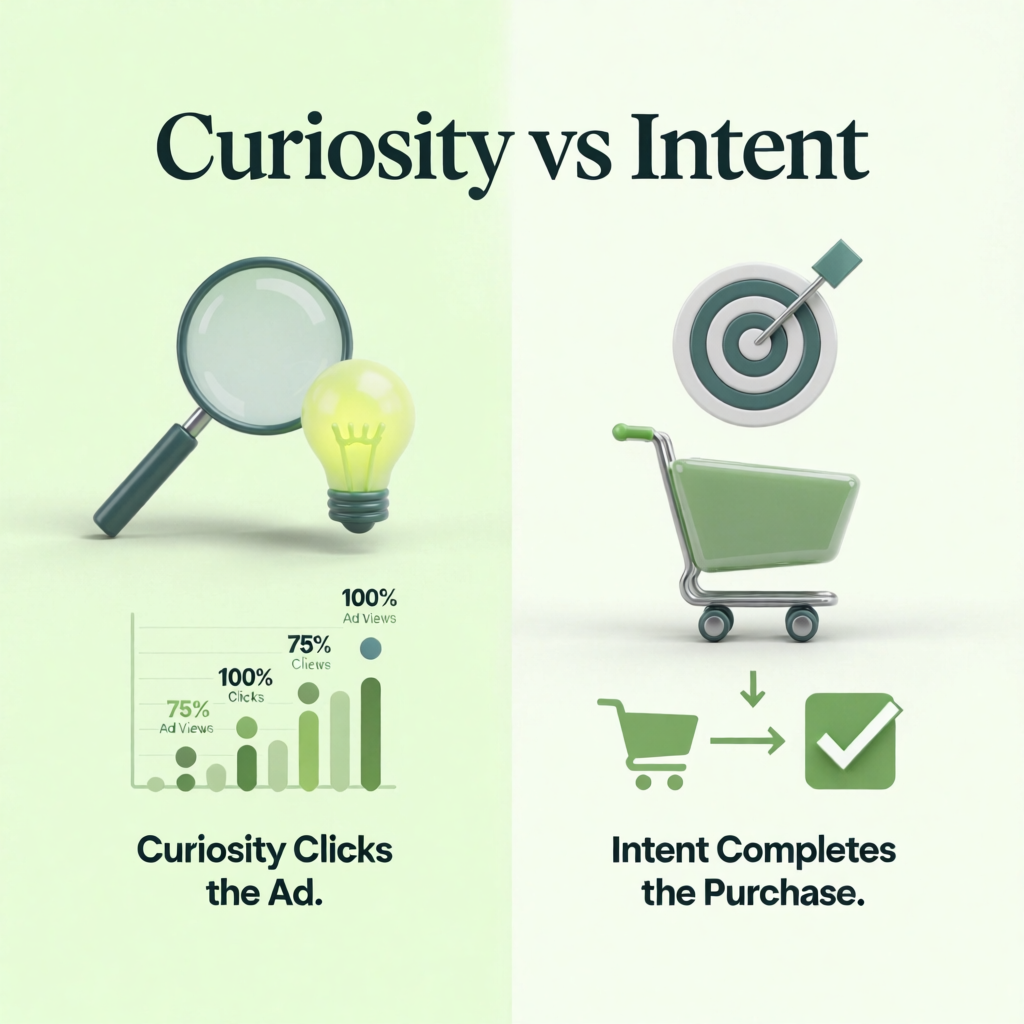
Curiosity clicks the ad. Intent completes the purchase.
A page should be built for both—but it must know which one is arriving.
The Real Reasons People Don’t Buy After Clicking
When someone clicks “Learn More” and then leaves, the reason is usually one of these six:
1. The next page did not continue the conversation. They wanted to learn, but the page pushed them to buy.
2. The page did not answer their real question. They asked “How is this different?” and got a generic feature list.
3. It asked for commitment too soon. Pop-ups, forms, or paywalls before any value was given.
4. The trust signals were missing. No reviews, no proof, no clarity about who is behind the brand.
5. The visitor was never ready to buy—only ready to learn. The brand expected a decision, but the visitor was still exploring.
6. The page assumed interest meant intent. It treated curiosity as a buying signal and skipped the steps that earn belief.
None of these are about price or product quality. They are about mismatched intent—the page doing one thing while the visitor was doing another.
How to Match Content to Intent
The fix is not a better landing page. It is a page that matches the visitor’s stage. Each stage needs a different kind of page.
For the aware visitor: Explain the problem. Show that you understand their world.
For the considering visitor: Compare, educate, clarify. Help them make sense of their options.
For the deciding visitor: Prove. Show reviews, results, and honest details.
For the ready visitor: Get out of the way. Make the purchase easy, fast, and clear.
A page does not need to close every visitor. It needs to meet them where they are.
When the content matches the intent, the visitor feels understood—and moves forward at their own pace.
The Ethical Line: Guiding vs. Pushing
Intent is not something to override. It is something to understand. Some brands try to force a visitor into a buying decision before they are ready—through aggressive pop-ups, false scarcity, or constant pressure.
This can produce a sale. But it often produces a customer who regrets it. And regret does not turn into loyalty.
Guiding respects the visitor’s stage. Pushing ignores it. The first builds relationships. The second spends them.
The TarkWorld Principle of Honest Intent
Guide the visitor forward—do not force them forward. Every page should help someone take the next honest step, not push them toward a decision they are not ready to make.
When you respect the visitor’s stage, the sale often comes on its own—and stays longer.
Practical Ways to Align Content With Intent
If visitors are clicking but not buying, these changes often make the biggest difference.
1. Read the click honestly. Ask, “What does this click mean?” Not “How do I convert it?”
2. Match the follow-up page to the stage. A learner needs information. A decider needs reassurance.
3. Answer the next question, not the last one. If someone clicked to learn about price, do not send them to a testimonial page.
4. Remove premature pressure. Pop-ups, countdowns, and sign-up walls before any value was given push visitors away.
5. Offer a smaller next step. If the visitor is not ready to buy, give them a sample, a guide, or a free trial. Let them continue learning in your world.
The question is not, “How do I get more clicks?” It is, “What does each click actually mean?”
When you answer that honestly, everything else—copy, layout, offers—starts to make sense.
A Tale of Two Landing Pages
Two landing pages. Same product. Same audience. Same traffic. Very different outcomes.
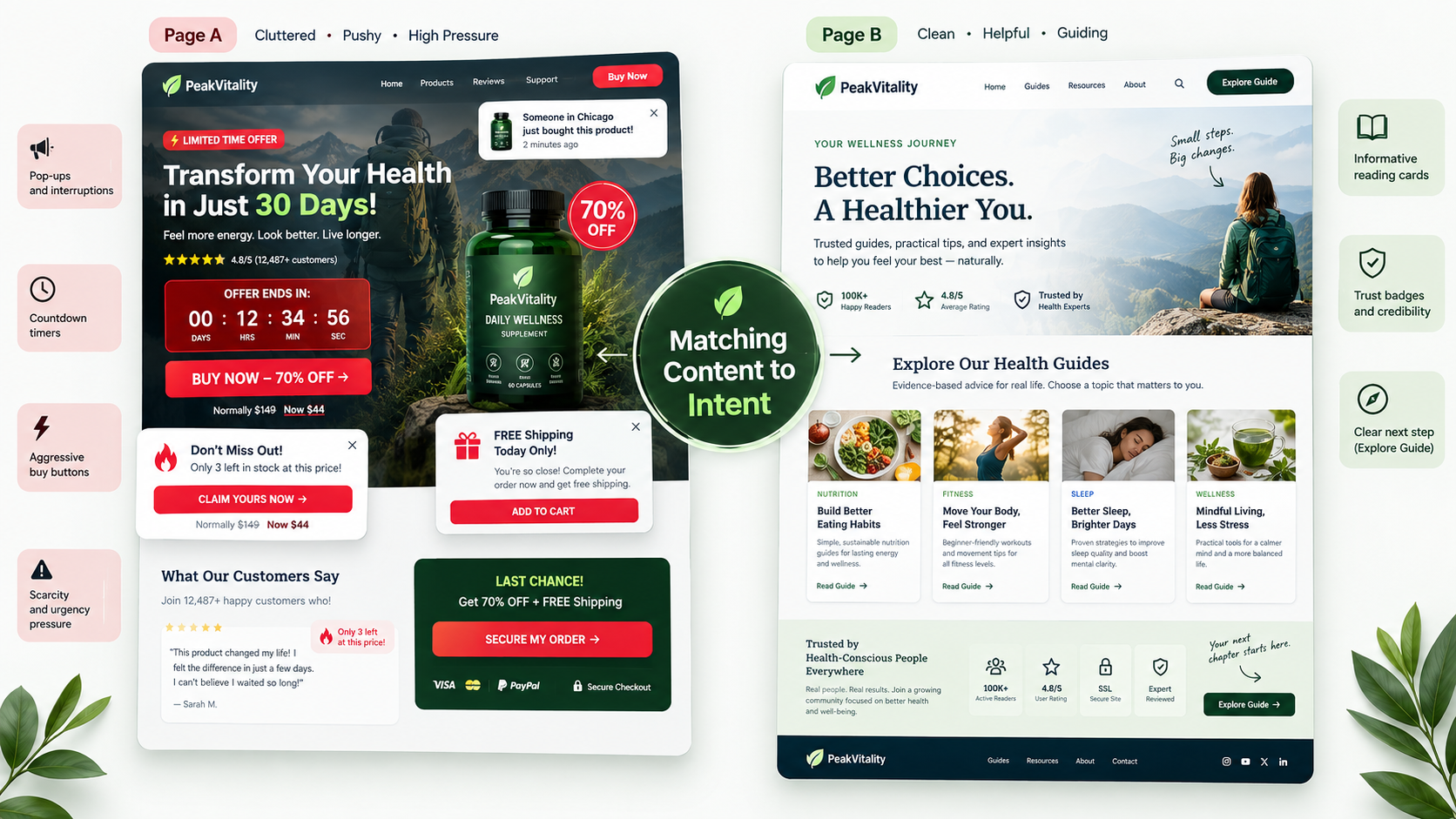
Below is a simple side-by-side. Neither is a rule. They show two ways the same page can meet a visitor who just clicked “Learn More.”
Page A
Opens with a pop-up. Pushes for a purchase immediately. Skips explanation. Assumes the visitor is ready. The visitor feels pushed and leaves—without ever learning why the product mattered.
Page B
Answers the visitor’s real question. Explains the how and why. Offers a guide or example. Gently offers the next step. The visitor feels understood, trusts the brand more, and comes back when they are ready.
HUMAN BEHAVIOR INSIGHT
People do not move from curiosity to purchase in a single moment. They move in stages. Each stage has a different question, a different worry, and a different need.
A “Learn More” click is not a rejection of the product. It is an invitation to keep talking. If the brand responds well, the visitor takes the next step. If the brand responds with pressure, the conversation ends.
The best pages do not chase the sale. They follow the visitor’s pace—and give them a reason to keep coming back.
HUMAN BEHAVIOR INSIGHT
Curiosity is a temporary state. If it is not nurtured, it fades within minutes. If it is met with the right information at the right pace, it grows into interest—and interest grows into intent.
This is why matching content to intent is not a marketing tactic. It is a form of patience.
The fastest way to lose a curious visitor is to push them. The easiest way to keep them is to teach them.
The Bigger Lesson: Follow Intent, Not Clicks
Clicks are easy to count. Intent is harder to read. But intent is what actually moves a visitor forward. A hundred clicks from people who are not ready will never outperform ten clicks from people who are.
The brands that succeed online are not the ones that chase the most clicks. They are the ones that understand what each click means—and meet it with the right response at the right moment.
That is not a marketing trick. It is a form of respect for the visitor’s time, attention, and pace.
And respect, over time, becomes the strongest conversion strategy of all.
A Final Thought for Marketers and Founders
Every click is a small question. “Learn More” means “I am interested—tell me something that makes this worth my attention.” When that question is answered honestly, the visitor takes the next step on their own.
The job of marketing is not to force people to buy before they are ready. It is to help them arrive at the moment of readiness—with clarity, honesty, and patience.
That is what it means to follow intent, not clicks.
That is the version of conversion that lasts.
Frequently Asked Questions
Why do people click "Learn More" but never buy?
Because clicking “Learn More” means the visitor is curious, not ready to buy. They are still gathering information and deciding whether the product even matters to them. If the next page pushes for a sale too early, the visitor leaves without ever feeling understood.
How do I know what stage of intent a visitor is in?
Look at the language of the click. “Learn More,” “How It Works,” or “See Pricing” all signal different stages. Read the page they came from. Look at how they moved. Then match the next page to that stage, not to the stage you wish they were in.
Is it wrong to push for a sale on a landing page?
No—if the visitor is ready to buy. But if the visitor clicked “Learn More,” they are not ready yet. Pushing for a purchase too soon feels like pressure and breaks trust. Landing pages should match the intent of the traffic that arrived.
How do I move a curious visitor toward buying?
Teach them first. Answer their real question. Show them proof, examples, and small next steps. Let them move at their own pace. Curiosity becomes interest when the brand keeps the conversation honest—and interest becomes intent when the visitor feels safe making a decision.
Should every page be written for the ready-to-buy visitor?
No. Different pages serve different stages. A blog post is for the aware. A comparison page is for the considering. A product page is for the deciding. A checkout page is for the ready. Writing every page as if the visitor is ready pushes most of them away.
Read the intent. Meet the moment.
Good digital communication is not about adding more information. It is about making the important information easier to notice, understand and evaluate.