Why Personalization Makes People More Likely to Engage With a Brand
8–10 min read ·— Digital Marketing
Think about the last email you actually opened. Or the last ad you stopped to read. Or the last recommendation you clicked.
Chances are, it felt like it was meant for you. Not for “customers” or “users” or “our audience.” For you—with your problem, your taste, your moment.
That is the quiet power of personalization. It does not just make content more relevant. It makes the reader feel seen. And feeling seen is one of the fastest ways to earn engagement.
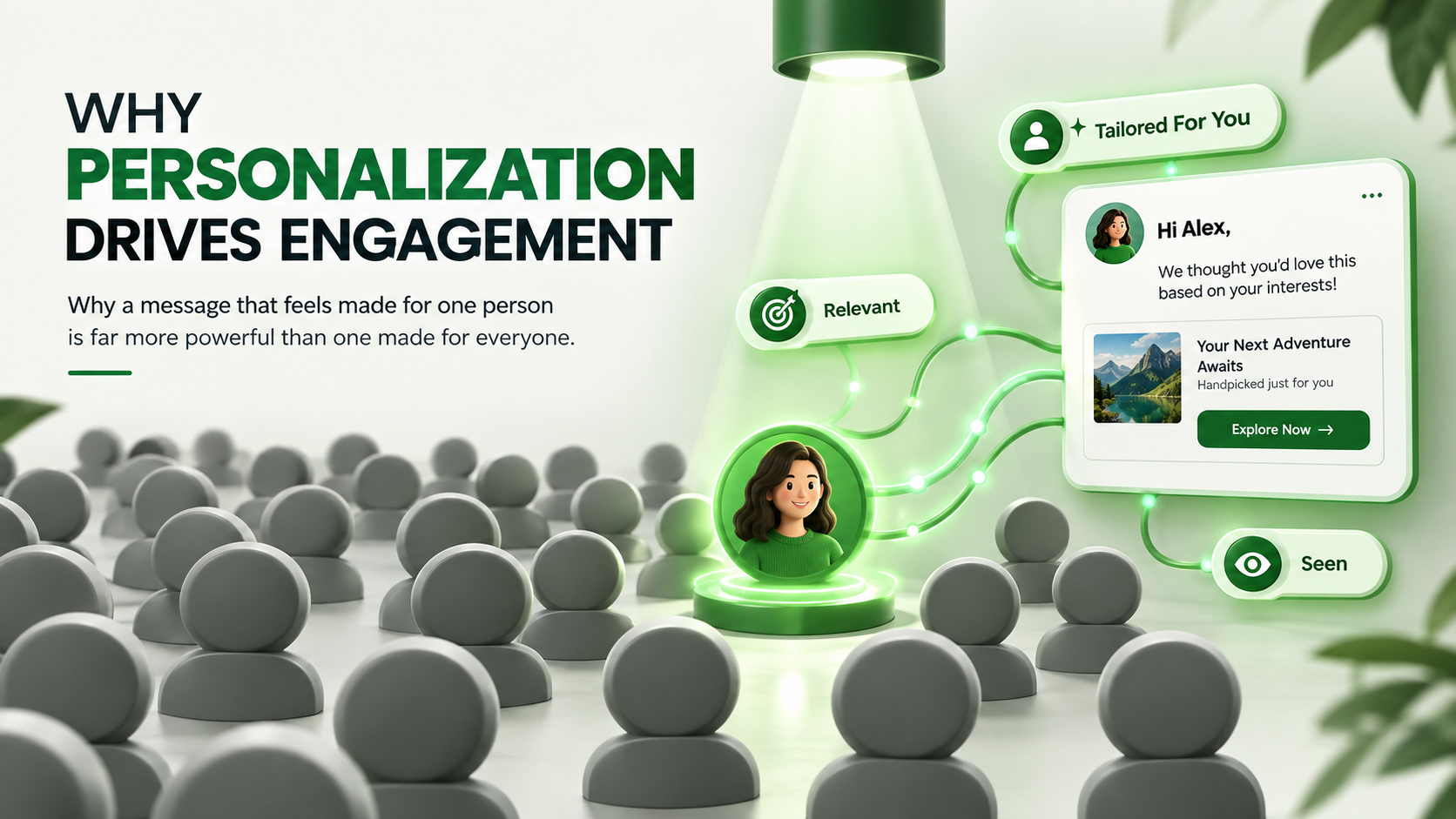
What Is Personalization?
Personalization is the practice of tailoring a message, product, or experience to a specific person or group. It goes far beyond using someone’s first name. Real personalization considers context, behavior, history, and intent.
A generic email says, “Here are our latest offers.” A personalized one says, “You left these running shoes in your cart—here is a size guide, and here is what other runners said about them.”
The first one is a broadcast. The second one is a conversation. That difference is why personalization consistently outperforms mass messaging.
Key idea
People do not engage with brands. They engage with moments that feel relevant to them.
A generic message asks the reader to do the work of figuring out why it matters. A personalized message does that work for them. It meets the reader where they are—and that meeting is what earns attention.
Personalization is not about knowing everything about someone. It is about removing the small distance between the message and the person reading it.
Personalization is not about being clever. It is about being close.
When a message feels close, it feels relevant. When it feels relevant, it earns the click.
Why the Brain Responds to Personalization
The brain is wired to pay attention to what concerns it directly. Personalization works because it triggers three fast, automatic responses:
1. Self-reference. Information about “me” is processed more deeply than information about “people in general.” It sticks.
2. Relevance. The brain does not waste energy on things that do not seem related to its goals or needs.
3. Recognition. Seeing something that reflects our own situation creates a small sense of connection—almost like being understood.
This is why a personalized message often wins even when a generic message carries the same information. The brain is not just reading it. It is responding to it.
The 5 Levels of Personalization
Personalization is not one thing. It works on a spectrum, from simple to deeply contextual.
1. Name personalization. “Hi Priya” instead of “Dear customer.” Basic, but surprisingly effective.
2. Segment personalization. Different messages for different audience groups—new vs. returning, city vs. small town.
3. Behavioral personalization. Messages shaped by what someone did: pages viewed, items added, emails opened.
4. Contextual personalization. Adjusting to the moment—time of day, device, location, or current situation.
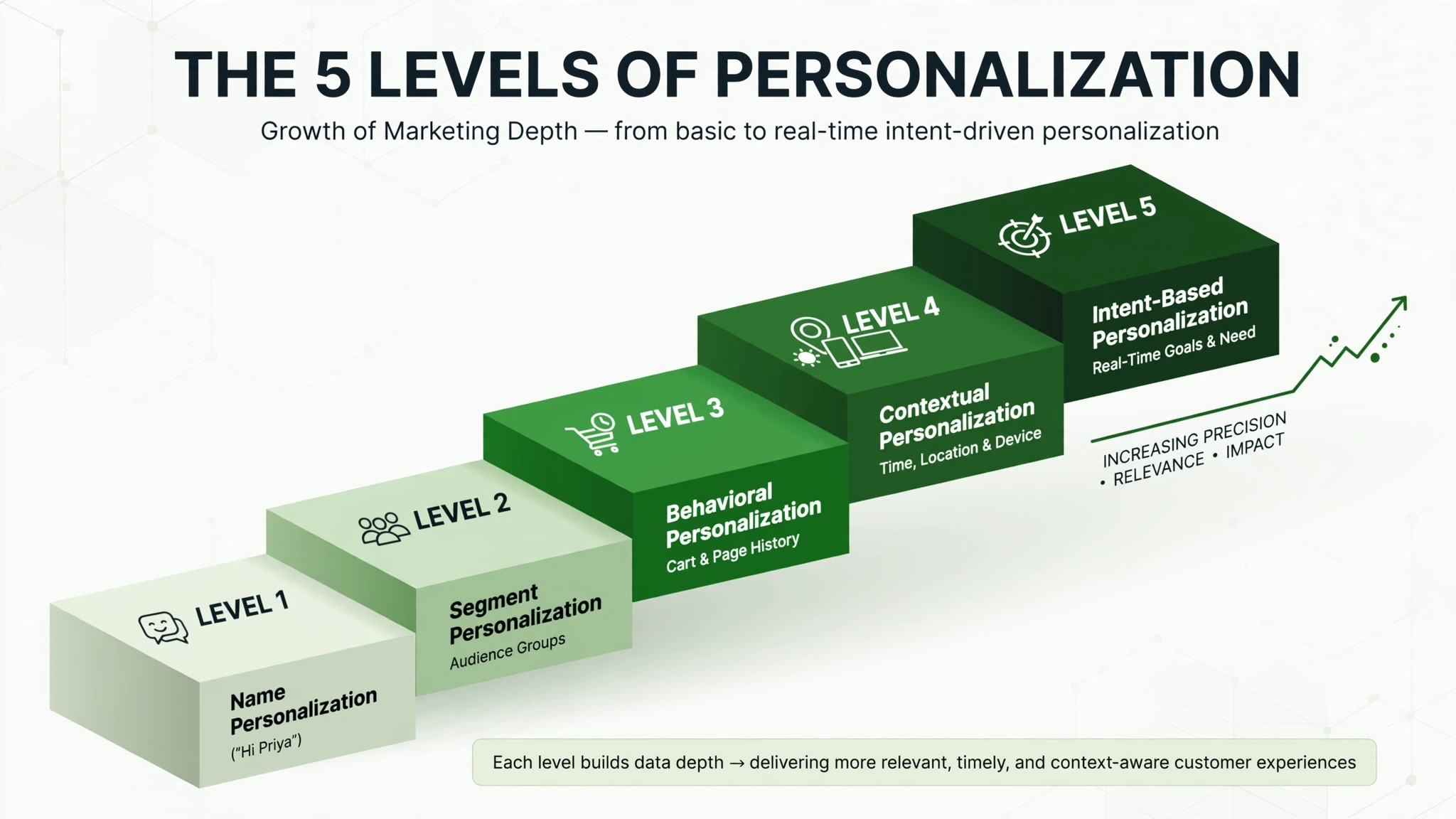
5. Intent-based personalization. Meeting the person’s real goal in the moment—whether they are researching, comparing, or ready to buy.
Most brands do not need to start at level five. Even level one or two—done honestly—can lift engagement significantly. The point is not sophistication. It is fit.
Why Personalization Increases Engagement
Engagement is not just a metric. It is a small decision the reader makes to give attention, time, or action. Personalization increases engagement for four reasons:
1. It reduces effort. The reader does not have to figure out why the message matters. It already does.
2. It increases relevance. Relevant messages are less likely to be ignored or forgotten.
3. It creates a sense of recognition. Being seen is a small but powerful emotional reward.
4. It builds reciprocity. When a brand shows attention to us, we are more likely to pay attention back.
Personalization does not just improve the message. It improves the relationship.
The reader feels less like a target and more like a person the brand is speaking to.
When Personalization Feels Wrong
Personalization is powerful—but it has a line. When a brand uses data the customer did not knowingly share, or when the personalization feels invasive, intrusive, or creepy, engagement drops fast.
For example: a retail email that says, “We noticed you looked at the same sweater three times last week.” That is not personalization. That is surveillance.
The difference between helpful and creepy is not the data itself. It is whether the customer would feel comfortable if they knew exactly what was being used—and why.
Good personalization is never surveillance. It is service.
It uses information the customer would be happy to know the brand is using—because it clearly helps them.
The Ethical Line: Personalization vs. Privacy
Personalization works best when it respects boundaries. Customers are happy for brands to use what they have shared—on their own terms. They are not happy when they feel watched, tracked, or manipulated.
Honest personalization is transparent. It tells the customer what is being used and why. It gives them control. It never uses information in a way that would surprise them.
When personalization is honest, it builds trust. When it is hidden, it erodes it—often without the brand ever knowing.
The TarkWorld Principle of Honest Personalization
Personalize to serve, not to spy. Use data the customer would be comfortable sharing. If you would not be comfortable explaining it out loud, do not use it silently.
Personalization should make the customer feel seen—not watched.
How to Personalize Without Losing Trust
If you are using personalization in marketing, these principles keep it effective and respectful.
1. Start with relevance, not data. Ask, “What does this person need right now?”—not “What can I do with this information?”
2. Use data the customer shared knowingly. Preferences, past purchases, and on-site behavior are fine. Silent tracking is not.
3. Be transparent. “Because you bought this, we thought you might like…” builds trust. “We know what you looked at…” does not.
4. Give the customer control. Let them adjust preferences, opt out, or change how they are talked to.
5. Keep it useful, not cute. Personalization should help someone, not just impress them.
Personalization is not just a tactic. It is a form of respect.
It tells the reader: we noticed you, we listened, and we made something that fits your situation.
A Tale of Two Emails
Two emails. Same product. Same offer. Different level of personalization. Very different response.
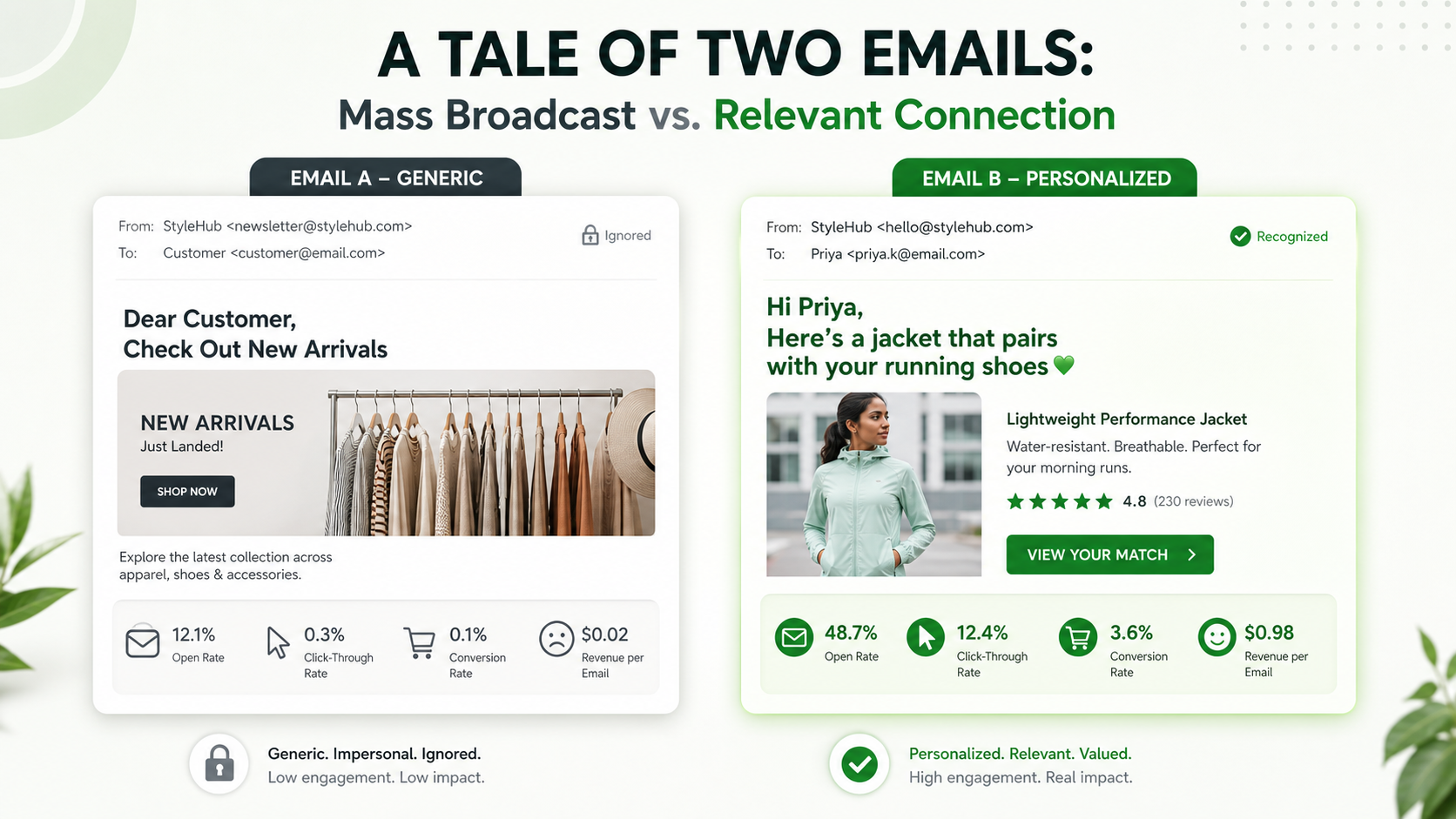
Below is a simple side-by-side. Neither is a rule. They show two ways the same message can meet the reader.
Email A
“Dear Customer, check out our new arrivals this week!” Generic, forgettable, easy to ignore. The reader has no reason to open it—and does not.
Email B
“Hi Priya, since you loved those running shoes, here’s a jacket that pairs well with them—and a review from another runner in Delhi.” Relevant, specific, and useful. The reader opens it, reads it, and clicks.
HUMAN BEHAVIOR INSIGHT
Humans are wired to notice what concerns them personally. This is not vanity. It is survival. Information about “me and mine” matters more than information about “people in general.”
Personalization works because it speaks to that instinct. It transforms a message from something the reader could ignore into something the reader has to at least notice.
The goal is not to know everything about someone. It is to make the message feel like it was written with them in mind—because it was.
HUMAN BEHAVIOR INSIGHT
Self-referential information is processed more deeply than general information. When a message includes a detail that directly relates to the reader’s situation, the brain treats it as more important—and remembers it longer.
This is why personalization is not just a nice touch. It is a memory advantage.
Small personalization can have a big effect. A relevant sentence often outperforms a perfect design.
The Bigger Lesson: Personalization Is a Form of Listening
Personalization is not just a technology. It is a posture. It is the brand saying: we are paying attention. We noticed what you did, what you care about, what you might need next.
That posture is what earns engagement. Not because the message is clever, but because it feels like a real answer to a real situation. The reader is not just seeing your brand. They are seeing themselves reflected in it.
And when a brand reflects the customer back to themselves, engagement stops being a metric and becomes a relationship.
That relationship is what grows. Not the message itself.
A Final Thought for Marketers and Founders
Every brand wants higher engagement. Most try to get it by shouting louder or posting more. The brands that actually succeed do something quieter and far more powerful: they listen more carefully.
Personalization is not a feature you install. It is a habit of paying attention to the person on the other side of the screen—and showing that attention back through your message. When you do that, engagement stops being something you chase. It becomes something the customer gives willingly.
That is the version of personalization that lasts.
Frequently Asked Questions
Why does personalization increase engagement?
Because it makes the message more relevant, easier to process, and more personal. The brain pays more attention to information about itself, and it responds more strongly when a brand shows it has noticed the reader’s situation.
Is personalization just using someone's name?
No. Name personalization is the most basic form. Real personalization considers context, behavior, and intent. A message can be deeply personal without ever using the reader’s name—if it speaks to their exact situation.
Can personalization feel creepy?
Yes—when it uses data the customer did not knowingly share, or when it reveals that the brand knows too much. Helpful personalization feels like service. Creepy personalization feels like surveillance. The line is transparency and consent.
How can small brands personalize without big data?
By using simple, honest signals: what someone bought before, what they asked in a support email, what page they visited. Small brands actually have an advantage here—they often know their customers personally. That personal knowledge is more valuable than any algorithm.
Does personalization work in every industry?
In most. The degree varies. B2C brands often use it heavily in emails and product recommendations. B2B brands personalize sales conversations and account-based messaging. Even service businesses personalize by remembering client history and preferences. The principle—make it relevant—works everywhere.
Listen first. Personalize second.
Good digital communication is not about adding more information. It is about making the important information easier to notice, understand and evaluate.