Why Emotional Marketing Often Works Better Than Purely Logical Marketing
8–10 min read — Digital Marketing
Two product pages. Same product. Same price. Same features.
One lists every specification in precise detail. The other shows a father teaching his daughter to ride a bicycle for the first time.
The first one is accurate. The second one sells.
This is not because people are irrational. It is because the brain is wired to remember what it feels, not just what it reads. Emotional marketing is not a shortcut around logic. It is how logic gets heard.
What Is Emotional Marketing?
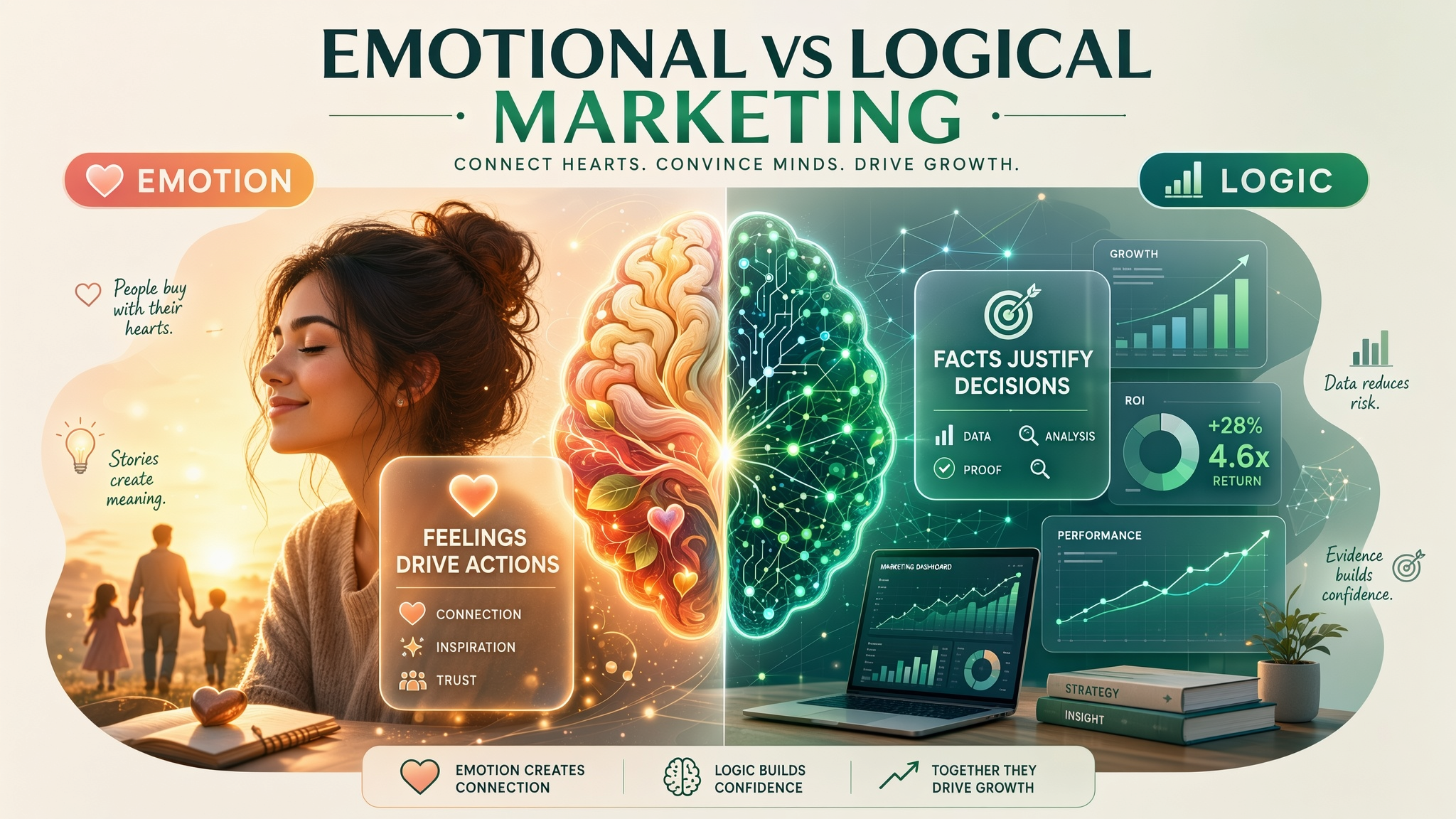
Emotional marketing is the practice of connecting a product or message to a feeling. Not to manipulate, but to make the meaning memorable. Logic tells us what something does. Emotion tells us why it matters.
A car has features: engine size, safety ratings, fuel efficiency. But people do not buy cars for features. They buy the feeling of freedom, safety, status, or the memory of a family road trip. The logic supports the decision. The emotion drives it.
Emotional marketing simply acknowledges what the brain already does: it uses feeling to decide, and uses logic to justify.
Key idea
People do not make decisions the way they think they do.
They feel first and justify second. A logical argument can change what someone knows. An emotional experience can change what someone does.
This is why the same product can fail with a list of features and succeed with a story. Same facts. Different feeling. The brain remembers the feeling and files the facts underneath it.
Logic makes a decision reasonable. Emotion makes it happen.
Both are needed—but emotion usually comes first.
Why the Brain Feels First and Justifies Second
The brain processes emotion long before it processes logic. Emotional signals travel faster than rational thought—almost before we are aware of them.
Three things happen in that quick moment:
1. The feeling arrives first. Interest, distrust, comfort, excitement—before any analysis.
2. The brain forms a fast conclusion. “I like this” or “something feels off.”
3. Logic is invited afterward. Only then does it search for reasons to support the feeling.
This is why a strong emotional impression can survive a weak logical argument, but a strong logical argument rarely survives a bad feeling.
The 5 Emotions That Drive Decisions
Not all emotions work the same way. Some move people toward action. Some pull them away. The most persuasive emotional marketing draws on five core emotions:
1. Belonging. “This is for people like you.” A feeling of group identity.
2. Relief. “Finally, something that works.” The release of a small burden.
3. Pride. “Look what I did.” A feeling of personal progress or status.
4. Trust. “I feel safe here.” A quiet confidence in the brand.
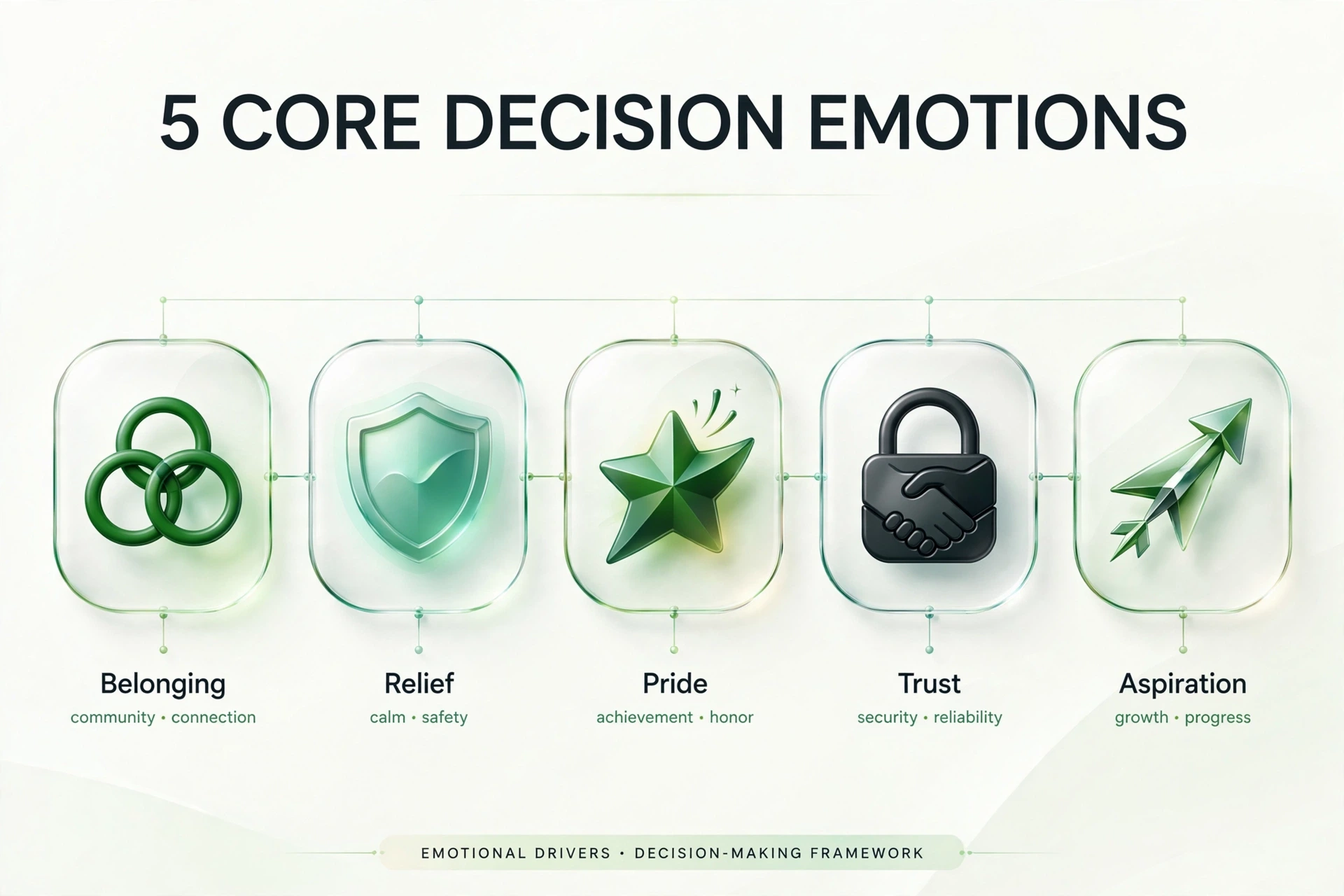
5. Aspiration. “This is who I want to become.” A vision of a better self.
Notice that none of these emotions are extreme. They are not anger, fear, or outrage. They are quiet, personal, and constructive. The most effective emotional marketing tends to draw on these, not on shock.
Why Facts Alone Rarely Persuade
Facts are necessary. But facts alone are surprisingly weak at changing behavior. People can know all the reasons to exercise and still not start. They can know all the reasons to save money and still spend. They can know all the reasons a product is good and still not buy.
Facts give people information. Emotions give people motivation. And without motivation, information often sits unused.
This is why the most successful campaigns do not replace facts with feelings. They wrap facts inside feelings—so the facts are remembered.
Facts explain. Feelings decide.
The best marketing does not choose between the two—it uses each to support the other.
When Logic Should Lead
Emotional marketing is not always better. There are times when logic should lead and emotion should follow.
1. High-risk purchases. For expensive, technical, or long-term decisions, buyers want detailed information first. Emotion supports, but logic confirms.
2. B2B environments. Professional buyers often need to justify decisions to others. Facts help them defend the choice.
3. Regulated industries. Health, finance, and legal products need to be accurate and careful. Emotion without evidence can be risky.
The real answer is not emotion or logic. It is emotion and logic—each in the right place.
Emotion opens the door. Logic walks the buyer through it.
Without emotion, the buyer never approaches. Without logic, the buyer never trusts the approach.
The Ethical Line: Emotion vs. Manipulation
Emotional marketing becomes manipulation when it uses feeling to hide the truth—not to reveal it. Fear, guilt, outrage, and shame can drive clicks, but they often leave a residue of resentment. The customer buys once and does not return.
The difference between honest and manipulative emotional marketing is not the intensity of the emotion. It is the intent.
Honest emotion helps the customer see something real: relief, pride, belonging, hope. Manipulative emotion invents a problem or exaggerates a fear to force action.
One builds a relationship. The other spends one.
The TarkWorld Principle of Honest Emotion
Use emotion to make the truth easier to feel—not to make the truth easier to hide. If the product is good, the feeling should match the promise.
Manipulation borrows trust. Honest emotion earns it.
How to Blend Emotion and Logic
Great marketing does not choose one side. It builds a bridge between them. Here is how.
1. Start with the feeling. Begin with a story, an image, or a moment that makes the reader lean in.
2. Support with facts. Once the emotion has opened attention, facts confirm and reassure.
3. Use emotion in the headline, logic in the body. A headline earns the click. The body earns the trust.
4. Show, then prove. Let the reader feel the benefit first—then show why it is real.
5. Close with confidence, not pressure. The final line should help the reader decide, not force them to.
The best marketing feels human, and proves useful.
It moves the reader emotionally and then gives them every reason to trust what they feel.
A Tale of Two Campaigns
Two campaigns. Same product. Same price. Same audience. Different structure. Very different response.
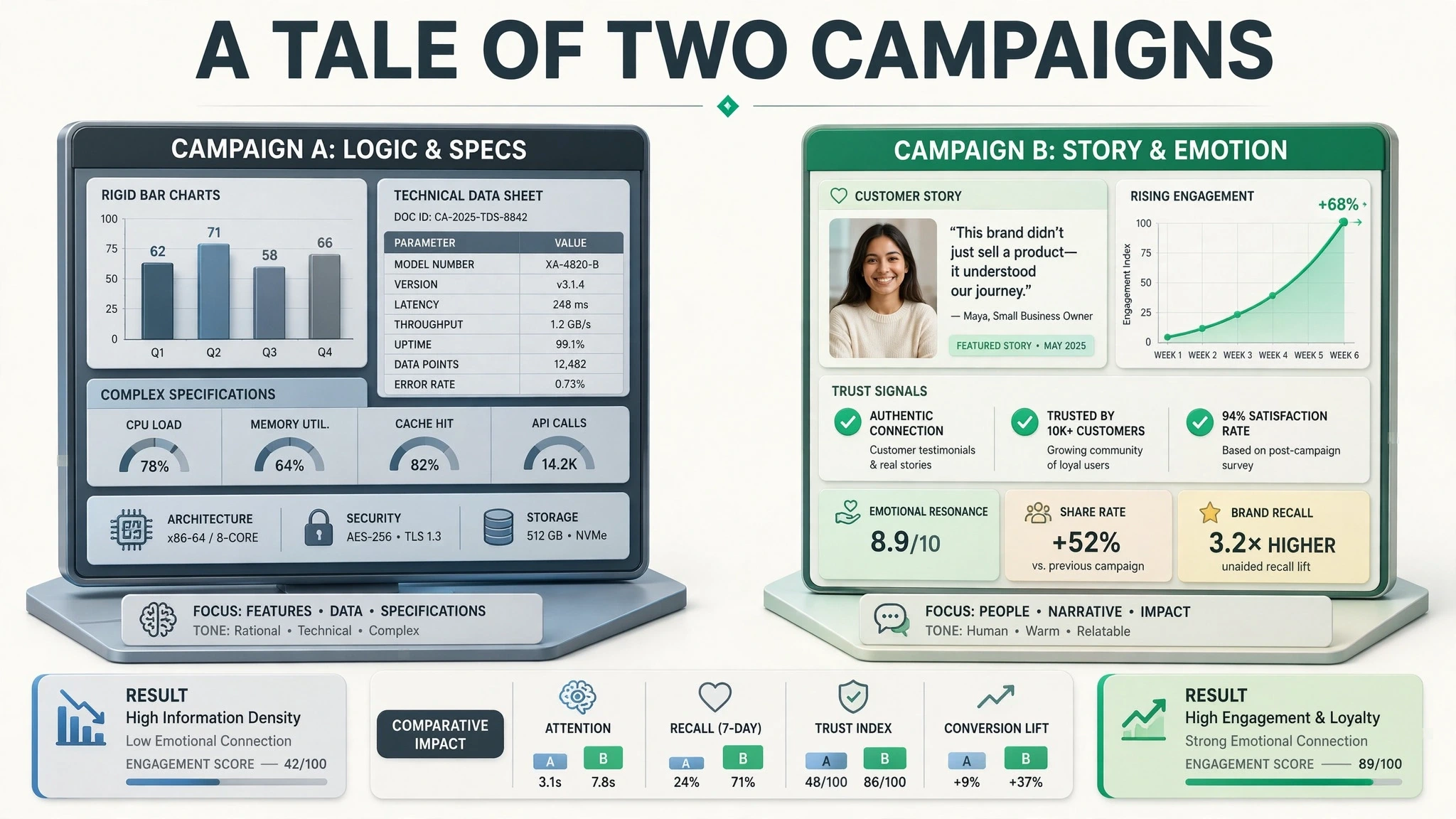
Below is a simple side-by-side. Neither is a rule. They show two ways the same message can meet the customer.
Campaign A
A wall of features. Technical specifications. Bullet lists. Accurate but cold. The reader understands the product but feels nothing about it. Clicks are low. Conversions are lower.
Campaign B
Opens with a real story—one customer, one moment, one small change. Then, quietly, the facts confirm what the reader already felt. Clicks grow. Conversions grow. And, importantly, so does trust.
HUMAN INSIGHT
Humans are emotional first and rational second. This is not a flaw. It is how we survived—by reacting quickly to danger, warmth, and belonging before logic had time to catch up.
Modern marketing is not exempt from this instinct. The buyer feels the brand before they analyze it. The best brands understand this and design their message accordingly.
This does not mean every message must be sentimental. It means every message should consider how it makes the reader feel—before assuming the facts will do the work alone.
HUMAN INSIGHT
Feelings are stored in memory alongside facts. But the feeling is usually the index. We remember what we felt long after we forget the details. A strong emotion can anchor a memory for years—even when the specifics fade.
That is why the most memorable brands are not the ones with the longest feature lists. They are the ones with the clearest feelings.
Facts tell us what happened. Feelings tell us why it mattered.
The Bigger Lesson: Feelings Are the Fastest Path to Memory
Logic and emotion are not opposites. They are partners. Logic gives the buyer a reason to believe. Emotion gives them a reason to care. Both are necessary—but emotion usually arrives first, and is what the buyer remembers last.
Brands that understand this stop choosing between facts and feelings. They design messages that carry both: the feeling that makes someone stop, and the facts that make them stay.
That combination is what makes marketing not just convincing, but memorable.
A Final Thought for Marketers and Creators
If you write only for logic, you will inform people who never act. If you write only for emotion, you will move people who never trust. The best writers and marketers use both—drawing the reader in with a feeling, then giving them every reason to believe it.
Emotion is not a trick. It is the way humans decide what is worth remembering. When you honor that, you are not just marketing. You are communicating the way the human mind was always meant to listen.
That is the version of marketing that lasts.
Frequently Asked Questions
Why does emotional marketing work better than logical marketing?
Because the brain feels before it reasons. Emotion arrives first and shapes how the buyer sees the facts that follow. Even if logic supports a decision later, it is usually emotion that makes the decision happen in the first place.
Does that mean facts and logic don't matter?
They matter—after the emotion has opened the door. Facts justify the decision, build trust, and reduce risk. Without emotion, buyers do not care enough to look at the facts. Without facts, buyers do not trust the emotion. Both are needed.
Is emotional marketing manipulative?
Not by itself. Emotion becomes manipulation when it is used to hide the truth—like fear or guilt used to force action. Emotion used to reveal something real—relief, pride, belonging—is honest marketing, not manipulation.
How do I add emotion to my marketing without overdoing it?
Start small. Open with a real moment instead of a feature. Replace one bullet point with a specific customer story. Use a line that sounds like a person, not a press release. Emotion does not need to be dramatic—it only needs to be honest.
Which emotions work best in marketing?
Constructive emotions tend to build the strongest, longest-lasting relationships: belonging, relief, pride, trust, and aspiration. Fear, outrage, and guilt may drive short-term action, but they usually erode loyalty over time.
Move with emotion. Prove with logic.
Good digital communication is not about adding more information. It is about making the important information easier to notice, understand and evaluate.