The Psychology of Free: Why “FREE” Is So Powerful
8–10 min read — Digital Marketing
Picture two offers on a table.
One says: “Buy one, get one at 90% off.” The other says: “Buy one, get one FREE.”
The cost is nearly identical. The reaction is not. The second one feels exciting. The first one feels like math.
This is the strange, stubborn power of the word FREE. It does not just change the price. It changes the way the brain sees the offer—and often, whether it buys at all.
What Makes “Free” So Powerful?
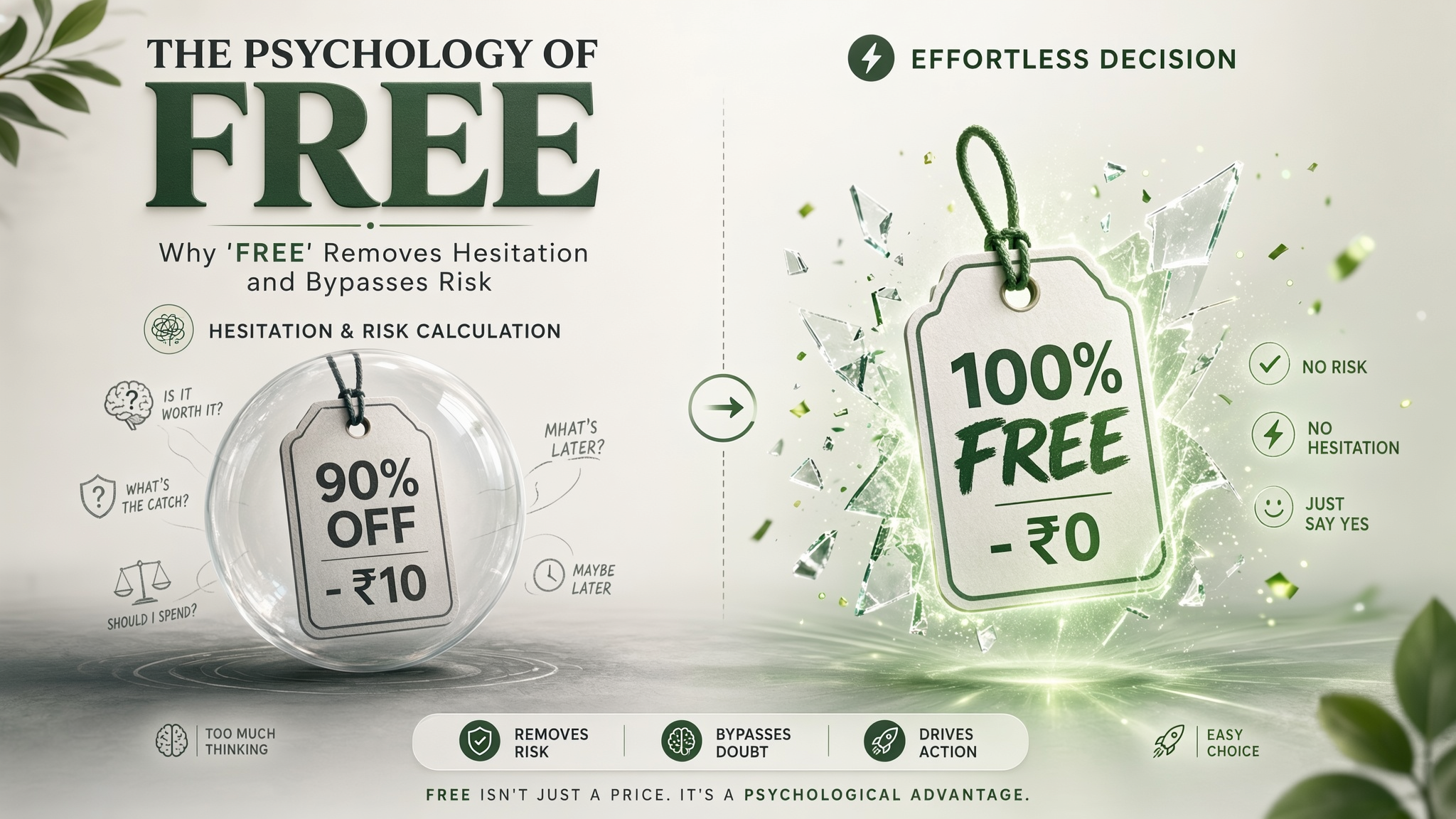
“Free” removes a barrier in a way no discount can. A discount reduces the cost. “Free” eliminates it. And in the brain, eliminating a cost is not just a slightly better deal—it is a different category of offer.
When something costs even one rupee, the brain activates a risk calculation. Is this worth it? What am I giving up? But when something is free, that calculation often disappears entirely. The offer feels like a gift.
That shift—from transaction to gift—is what makes “free” so unusually persuasive.
Key idea
“Free” is not powerful because of the number zero. It is powerful because of what zero means.
Zero feels like no risk. No loss. No decision to justify. It feels like permission to try.
That is why a free sample often leads to a paid purchase, and why a paid trial at ₹1 often converts less than a free plan at ₹0. The brain treats these as completely different offers—even when the cost is nearly the same.
“Free” does not remove cost. It removes hesitation.
And hesitation is often the only thing standing between a curious visitor and a loyal customer.
Why the Brain Treats Zero Differently
When the brain sees a price, it runs a small calculation: is this worth the money? When the brain sees zero, it skips the calculation entirely.
Three things happen in that moment:
1. The risk disappears. Nothing can be lost if nothing is paid.
2. The value feels positive. Zero cost with any benefit is, mathematically, an infinite return.
3. The decision feels easy. There is no trade-off to consider, so the brain defaults to yes.
This is why “free” bypasses the careful, logical mind and speaks directly to the emotional one.
The 5 Ways “Free” Changes Behavior
“Free” is not a single effect. It shows up in different ways, depending on how it is used.
1. Free samples. They remove the risk of trying, and often create a sense of reciprocity.
2. Free trials. They let the product build familiarity and ownership before a payment is asked for.
3. Free shipping. It converts a paid extra into a feeling of care. Removing shipping fees can lift sales more than a bigger discount.
4. Buy one, get one free. It reframes a discount as a gift—making the second item feel like a reward rather than a purchase.
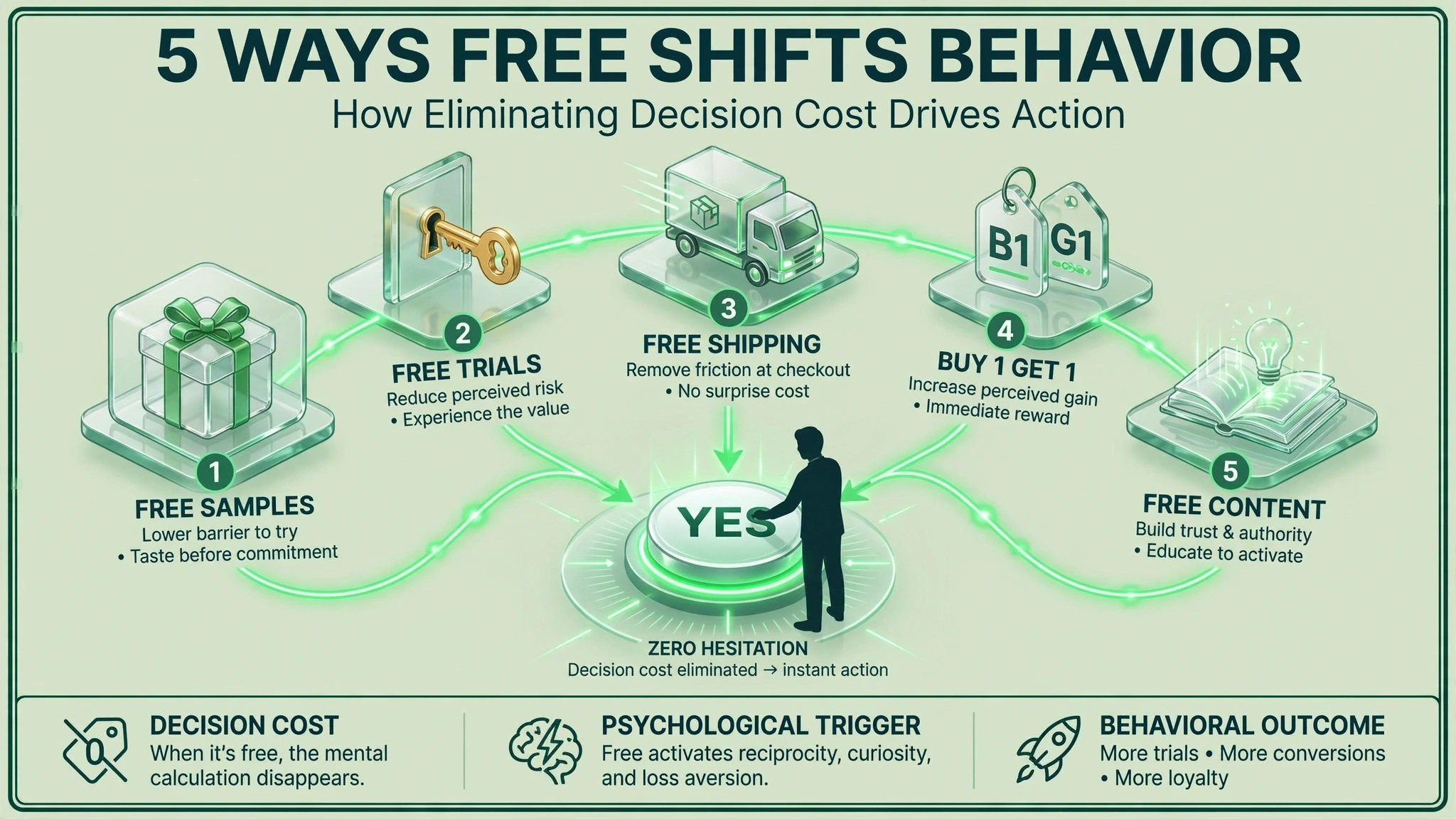
5. Free content. It builds trust and gives the reader a reason to keep returning—without asking for anything first.
Each form of “free” works for the same reason: it lowers the emotional cost of saying yes. Not the financial cost—the decision cost.
Why ₹1 Feels So Different From ₹0
One rupee is almost nothing. But that almost-nothing changes everything.
When something costs ₹1, the brain still has to weigh the trade-off. It has to make a decision. It has to cross a small threshold of “should I or shouldn’t I?” When something costs ₹0, that threshold disappears—and with it, the hesitation.
This is why free trials convert so well, and why ₹1 trials often convert worse. The price is nearly identical. The psychological distance is enormous.
One rupee is not a small price. It is a small risk.
And risk, even tiny risk, is enough to make the brain pause. Zero removes the pause. That is the entire trick.
The Hidden Cost of Free
“Free” is powerful, but it is not always honest. Sometimes the cost has simply moved somewhere else—out of sight.
A free app that sells your data. A free trial that requires a credit card and auto-renews. A free sample that commits you to a subscription. A free event that ends with a heavy sales pitch.
In each case, the offer is technically free. But the real cost was never on the price tag. It was hidden in the terms, the timing, or the trap at the end.
This is why people are increasingly cautious about “free.” They have learned that free often means “free for now, expensive later.”
A price tag is not the only cost. The real price is often paid in attention, data, or freedom.
Honest brands say this clearly. Dishonest ones let the customer discover it later.
The Ethical Line: Generosity vs. Manipulation
Offering something free is not inherently ethical or unethical. It depends on what the customer knows and what the brand intends.
Free becomes generous when the customer keeps something valuable even if they never buy. Free becomes manipulative when the “free” is a trap designed to extract money, data, or attention through confusion.
The difference is not in the price. It is in the transparency.
The TarkWorld Principle of Honest Free
If you offer something free, make the terms as clear as the offer itself. The customer should always know what they are getting—and what they are giving up.
Free should feel like a gift. Not like a door that locks behind the customer.
How to Use “Free” Without Losing Trust
If you use “free” in your marketing, these principles keep it effective and honest.
1. Be clear about the terms. Say what is free, for how long, and what happens after.
2. Give something genuinely useful. A free offer that teaches or helps builds more trust than one that only teases.
3. Do not hide the cost. If a purchase is required later, say so up front.
4. Avoid subscription traps. Auto-renewals hidden in fine print damage trust more than they earn revenue.
5. Let free be free. If the free version is genuinely valuable, the paid version will sell itself.
“Free” is not a loophole. It is a promise.
When it is honest, it opens a door. When it is not, it closes one—permanently.
A Tale of Two Free Offers
Two offers. Same word: free. Very different experiences.
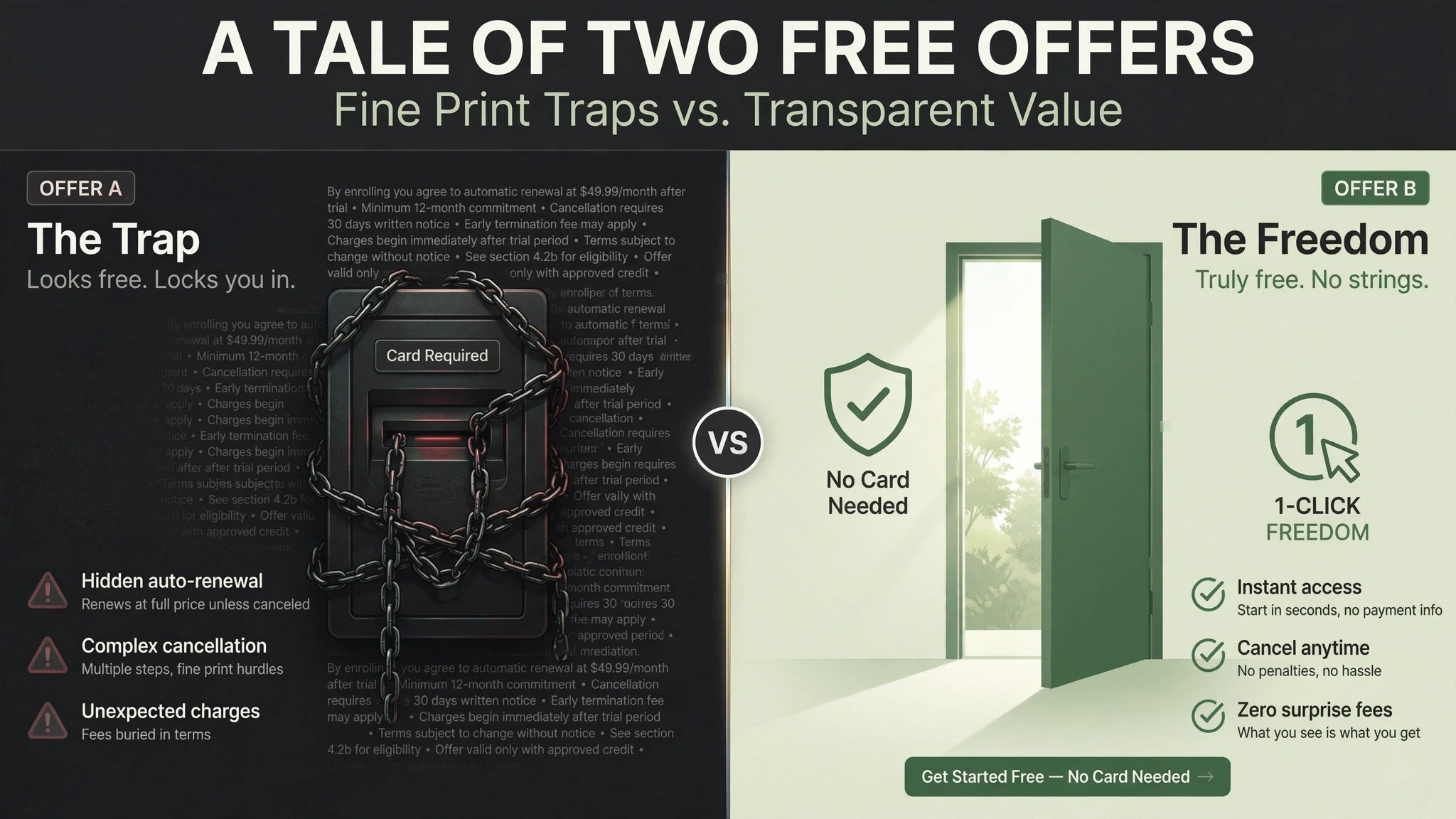
Below is a simple side-by-side. Neither is a rule. They show two ways the word “free” can be used.
Offer A
“Free 30-day trial—card required. Auto-renews at full price. Cancel anytime, but only through a support email that takes three days to reply.” Technically free. Feels like a trap.
Offer B
“Free 30-day trial—no card required. When the trial ends, you choose. Cancel with one click, any time.” Also free—but the free feels honest. The customer stays because they want to, not because they forgot to leave.
HUMAN INSIGHT
Humans are wired to notice losses and trade-offs. A price—even a tiny one—triggers a small calculation of what might be lost. Zero removes that calculation. That is why free feels so different from cheap.
It is not the money. It is the risk.
This is why free samples, free trials, and free content work so well. They do not convince the buyer to accept a risk. They remove the risk entirely—and let the value speak for itself.
HUMAN INSIGHT
Free also triggers reciprocity. When someone gives us something, we feel a small pull to give back. That is why a free sample often leads to a purchase, and a free piece of content often leads to following the creator.
The gift creates a bond. The bond creates the sale.
Free does not need to be big to be powerful. It only needs to be genuine.
The Bigger Lesson: Free Opens Doors, Trust Keeps Them Open
“Free” is one of the fastest ways to get someone’s attention. It removes hesitation, triggers curiosity, and often creates a small sense of gratitude. But it is not enough on its own.
The real job is what happens after. If the free experience is honest and useful, it earns trust. If it is thin, misleading, or a trap, it loses it. The word “free” can open a door—but only a genuine experience keeps it open.
Free is not the end of the deal. It is the beginning of the relationship.
A Final Thought for Marketers and Founders
Free is a tool. Used honestly, it builds bridges—between curiosity and purchase, between stranger and customer, between try and trust. Used dishonestly, it burns those bridges faster than any price ever could.
The brands that use free well do not just give something away. They give something worth keeping. And in return, they earn something worth having: a customer who came for the gift and stayed for the value.
That is the version of free that lasts.
Frequently Asked Questions
Why is the word “free” so powerful?
Because it removes risk and hesitation. Any price—even a tiny one—activates a decision in the brain. Zero skips that decision entirely. The offer feels like a gift, not a transaction.
Why does ₹1 feel so different from ₹0?
Because any price, no matter how small, requires the brain to weigh a trade-off. Zero removes that trade-off. The decision becomes emotionally easier, even though the financial difference is almost nothing.
Can free offers be manipulative?
Yes. Free becomes manipulative when the real cost is hidden—auto-renewals buried in fine print, data collection that is not clearly explained, or free trials that are almost impossible to cancel. The problem is not the free offer. It is the deception around it.
How do brands use free content to grow?
By giving away something genuinely useful: guides, tools, tutorials, templates, or insights. The goal is not to give away the product—it is to give away enough value that the audience trusts the brand and wants more. Free content builds the relationship that paid offers later rely on.
Does “free” ever hurt a brand?
Yes—if it trains customers to expect everything for free, or if the free version is so good that no one upgrades. The key is to make the free offer genuinely useful while keeping the paid offer clearly more valuable. Free should open a door, not replace the product.
Give real value. Earn real trust.
Good digital communication is not about adding more information. It is about making the important information easier to notice, understand and evaluate.