Why Consistency Builds Trust in Digital Marketing
8–10 min read — Digital Marketing
Think about the last brand you trusted without thinking twice.
It probably was not because of one great ad or one perfect post. It was because that brand kept showing up the same way, again and again. Same tone. Same look. Same promises. Same quality.
Consistency feels boring to the brand and reassuring to the customer. That is the paradox of trust—it is built through repetition, not through brilliance.

What Is Consistency in Digital Marketing?
Consistency is the alignment of a brand’s voice, visuals, and values across every touchpoint. It is not just using the same colors or logo. It is showing up with the same personality, the same standard, and the same promise—whether a customer sees you on Instagram, your website, an email, or a customer service call.
When these things match, something quiet happens in the customer’s mind. They stop bracing for surprises. They start relaxing. That relaxation is the beginning of trust.
Key idea
Trust is not built in a moment. It is built in repetition.
The brain looks for patterns. When a brand behaves the same way over time, the brain files it as safe. When a brand keeps changing its tone, its look, or its promises, the brain files it as uncertain—and uncertainty is the opposite of trust.
This is why consistency is not a marketing tactic. It is the foundation of every other tactic. Without it, even great campaigns feel unstable.
A brand is not what it says once. It is what it keeps saying, the same way, over and over.
The customer is not judging the campaign. They are judging the pattern.
Why the Brain Trusts Patterns
The brain is a pattern-recognition machine. It is constantly scanning for things it can predict, because predictability saves energy and reduces risk.
Three things happen when a brand is consistent:
1. Recognition speeds up. The customer knows it is you before reading the name.
2. Prediction becomes easier. They know what to expect from your tone, quality, and message.
3. Safety increases. Predictable things feel less risky than unpredictable ones.
This is why trust grows slowly, quietly—and then suddenly. The brain accumulates small moments of sameness until it decides: this brand can be relied on.
The 5 Areas Where Consistency Matters Most
Consistency is not one thing. It is a set of repeated choices across every part of the brand.
1. Visual identity. The same colors, fonts, and design language across every channel.
2. Voice and tone. The same personality in an ad, an email, a support reply, and a product page.
3. Frequency. Showing up regularly instead of disappearing for weeks and reappearing loudly.
4. Values. Standing for the same principles across campaigns, partnerships, and customer interactions.

5. Quality. The same standard of experience, product, or service, no matter how often the customer returns.
Break consistency in any one of these areas, and the customer feels it—even if they cannot explain why. The brand suddenly feels a little less like itself.
Why Inconsistency Feels Like a Warning Sign
The brain treats inconsistency as a small risk. It does not always know why, but something feels off.
A brand that posts playful content on Monday and serious, corporate content on Tuesday feels unstable. A website that looks premium but sends support emails that feel careless creates a quiet doubt. A brand that promises quality but delivers inconsistency teaches the customer not to trust the promise.
None of these are obvious mistakes. But together, they slowly erode trust. And trust, once lost, is very expensive to rebuild.
Inconsistency does not feel like a mistake. It feels like a question: can I trust this?
Customers do not want to keep asking that question. So they leave.
Consistency Does Not Mean Sameness
Some brands fear consistency because they think it means repeating the same thing forever. It does not. It means being recognizably yourself, even as you evolve.
A person can grow and change while still feeling like the same person. Brands can do the same. Consistency is not stagnation—it is continuity.
The tone can mature. The product can expand. The visual identity can refresh. But the underlying personality should feel like it has stayed.
Consistency is not about doing the same thing. It is about being the same thing.
The customer should be able to recognize you, even when you surprise them.
The Ethical Line: Consistency vs. Performance
There is a difference between consistent values and consistent performance. Some brands perform a personality that does not match who they really are. They sound caring in ads and dismissive in support. They promise simplicity and deliver complication.
This kind of inconsistency is worse than changing tone. It signals that the brand’s voice is a costume, not a character.
Real consistency is when what a brand says and what it does come from the same place.
The TarkWorld Principle of Honest Consistency
Be consistent with who you actually are, not with who you pretend to be. A brand that keeps a promise it never meant to keep is not consistent—it is unreliable.
Consistency should come from the inside out. Not from the outside in.
How to Build Consistency Without Burning Out
Consistency sounds heavy. But it is easier when it is built into the brand’s system, not just its effort. Here is how to make it practical.
1. Document your brand. Colors, tone, values, do’s and don’ts—in one place everyone can access.
2. Create templates. For posts, emails, and ads, so the format is easy to repeat.
3. Batch your work. Create content in sets so the voice stays steady.
4. Review before publishing. One quick check: does this sound and look like us?
5. Train everyone who touches the brand. Consistency is not just the marketer’s job. It belongs to support, sales, and product too.
Consistency is not a talent. It is a system.
When the system supports the voice, the brand does not have to rely on inspiration to sound like itself. It just does.
A Tale of Two Brands
Two brands. Same product. Same price. Different levels of consistency. And a very different experience for the customer.
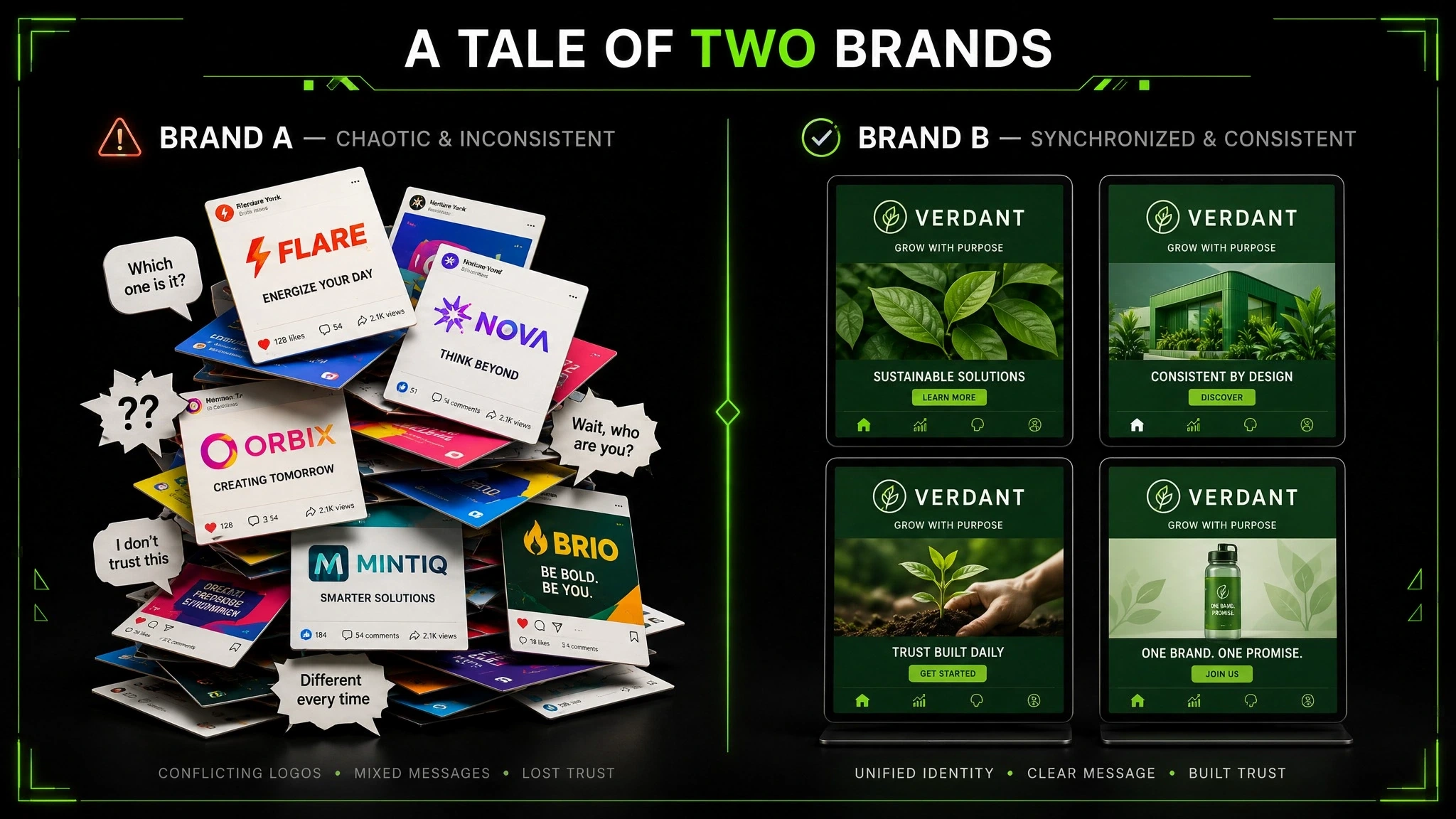
Below is a simple side-by-side. Neither is a rule. They show two different patterns of brand behavior.
Brand A
Posts in four different tones. Colors change every month. Promises shift with the trend. Customers keep asking: is this still the same brand?
Brand B
Same voice on every channel. Consistent color and layout. Promises that stay the same. Customers stop wondering—and start trusting.
HUMAN INSIGHT
Humans trust what they can predict. This is not a marketing insight—it is a survival instinct. Predictable things used to mean safety. Unpredictable things used to mean danger.
That instinct still runs in the background every time a customer interacts with a brand. Consistency tells the brain: this is familiar, this is safe, this is worth coming back to.
In a world where everything else is changing fast, a brand that stays the same quietly becomes a place of rest.
HUMAN INSIGHT
The brain stores brand experiences as patterns, not as individual moments. It remembers the shape of the brand more than any single interaction. If the shape stays steady, the brain builds familiarity. If it keeps shifting, the brain never learns what to expect—and trust struggles to form.
Consistency gives the brain something to hold on to.
Familiarity is not the same as trust. But it is what trust is built on.
The Bigger Lesson: Trust Is a Pattern, Not a Promise
Trust is not created by big gestures. It is created by the small fact that you keep showing up in the same way. Customers do not trust the promise. They trust the pattern behind the promise.
A brand that is consistent, even boringly consistent, feels more reliable than a brand that keeps reinventing itself every few weeks. Consistency is quiet. But quiet things are often what last.
That quietness is not a weakness. It is the whole point.
A Final Thought for Marketers and Founders
Every day you show up, you are giving the customer another small piece of evidence. Another proof of who you are. Another reason to believe—or to doubt.
The brands that last are not the ones that shout the loudest. They are the ones that quietly behave the same way, again and again, until the customer stops checking whether they can be trusted.
That is when trust stops being a question and becomes a default.
And a brand that has become the default is very hard to replace.
Frequently Asked Questions
Why does consistency build trust?
Because the brain trusts what it can predict. When a brand behaves the same way over time, it becomes familiar. Familiarity reduces perceived risk, and reduced risk is the foundation of trust.
Does consistency mean never changing?
No. Consistency is not stagnation. It means being recognizably yourself even as you evolve. The tone can mature, the product can grow, and the visuals can refresh—as long as the underlying personality stays steady.
Where does inconsistency hurt the most?
Between the promise and the experience. A brand can be visually consistent and still lose trust if the actual service, product, or support feels different from what the marketing suggested. The gap between the promise and the delivery is where trust breaks fastest.
Can small businesses stay consistent?
Yes—and they need it more than larger brands do. Big brands can rely on memory. Small brands must build it. Simple systems, templates, and a documented brand voice make consistency easier than trying to remember everything from scratch.
How long does it take for consistency to build trust?
There is no fixed timeline. Trust builds in small increments—often over weeks or months—as the customer has repeated positive, consistent experiences. Consistency shortens that timeline. Inconsistency restarts it.
Show up the same. Earn the trust.
Good digital communication is not about adding more information. It is about making the important information easier to notice, understand and evaluate.