Why Customers Read Reviews Before Buying—and What They're Really Looking For
8–10 min read — Digital Marketing
You are about to buy something. A pair of shoes. A course. A phone. A skincare product.
Before you click, you do what most people do: you scroll down to the reviews.
You are not just looking for stars. You are looking for someone who sounds like you—someone who had your exact concern, your exact doubt, your exact question. You are looking for permission to trust.
This is what most brands misunderstand about reviews. They treat them as ratings. Customers treat them as reassurance.
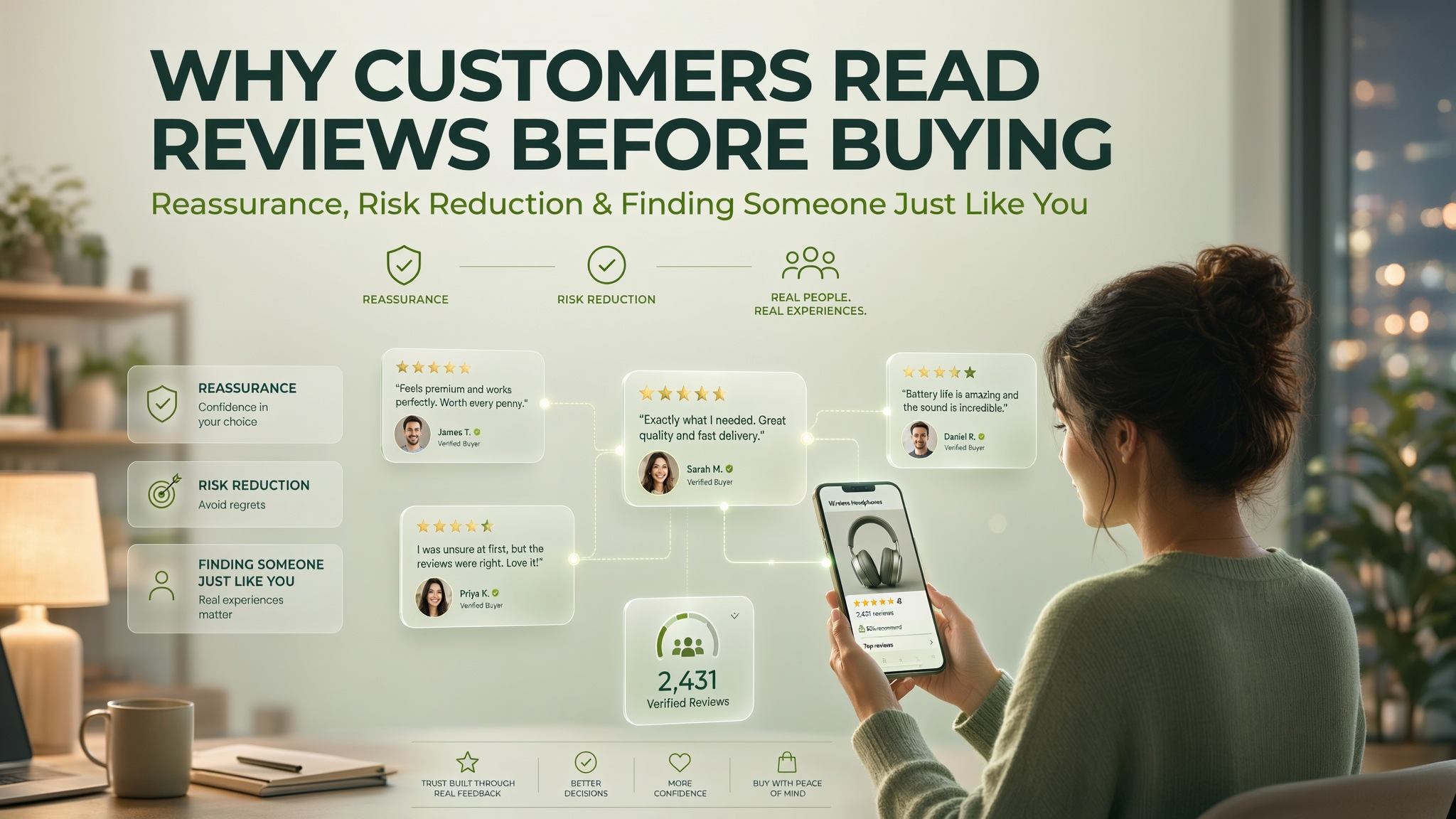
What Reviews Really Do for a Buyer
Reviews reduce risk. That is their real function. Not to inform, not to entertain—but to make an uncertain decision feel safer.
Buying online means trusting a description, a photo, and a brand you may not know. Reviews replace the missing experience with someone else’s experience. They let a stranger borrow confidence from another stranger.
This is why even people who “know” reviews can be fake still read them. The instinct to check is stronger than the awareness that some signals are unreliable.
Key idea
Customers are not reading reviews to find out if a product is good. They are reading them to find out if it is good for someone like them.
That is the entire job of a review. It is not proof of quality. It is proof of relevance.
A five-star review from someone with different needs is less convincing than a four-star review from someone who sounds exactly like the reader.
The best review is not the most positive. It is the most recognizable.
When a reader sees themselves in the reviewer, the review stops being information and starts being permission.
The 5 Things Customers Look For in a Review
When a customer opens a review section, they are not reading randomly. They are scanning for specific signals.
1. Similarity. Does this person have my problem, my body, my budget, my lifestyle?
2. Specificity. Are they describing real details or just saying “great product”?
3. Honesty. Do they mention any downside, even a small one?
4. Outcome. Did the product actually do what it promised?
5. Repetition. Are multiple people saying the same thing?
If a review hits three or four of these, it feels trustworthy. If it only hits one, it feels like noise.
Why a 4-Star Review Can Beat a 5-Star Review
Perfect reviews can feel suspicious. When everything is five stars with no downside, the reader’s brain quietly asks: What are they not saying?
A four-star review that says, “Great product, but the battery could last longer,” feels more honest than a five-star review that says, “Amazing! Love it!”
The small criticism does something powerful. It signals that the reviewer is not just being polite. It gives the reader a reason to believe the rest of the review.
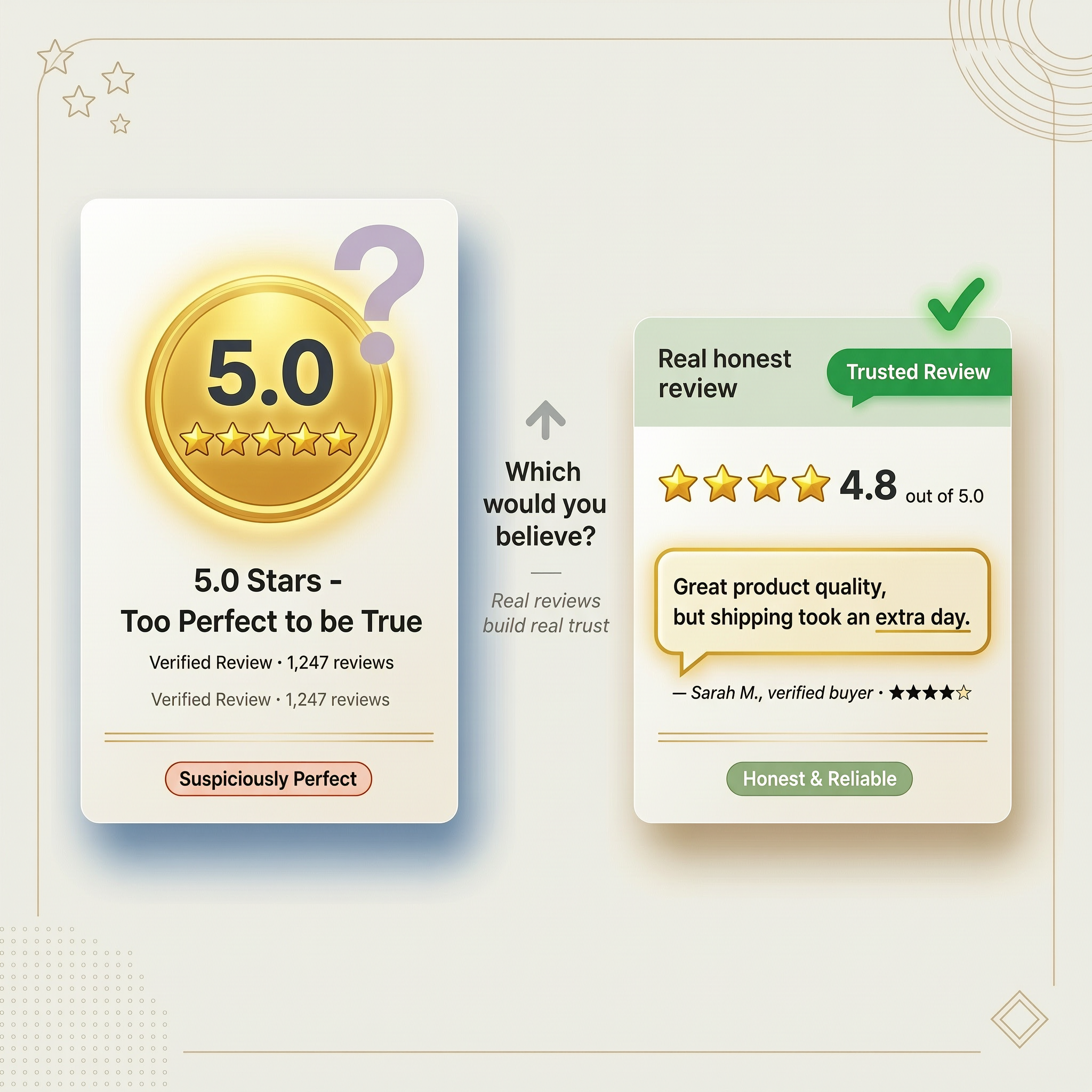
Imperfection is a trust signal. It tells the reader the review was written by a person, not a marketing team.
The Power of a Specific Detail
Specific details make reviews believable. Not because they prove anything, but because they sound like lived experience.
“This chair saved my back during long workdays” is stronger than “great chair.”
“The material is soft but a little warm in summer” feels more real than “very comfortable.”
The brain trusts texture. Vague praise feels rehearsed. Specific experience feels human.
Specificity is not proof. It is presence.
When a reviewer describes a small moment, the reader feels like they are standing in that moment too—and that feeling is what builds trust.
Why Negative Reviews Often Help Sales
Brands fear negative reviews. But research consistently shows that a small number of critical reviews can increase trust and even conversion.
Why? Because a product with only perfect reviews looks edited. A product with a mix of praise and realistic complaints looks genuine.
The negative review also helps the right customer self-select. Someone who would have hated the product reads the complaint and leaves. That is not a loss. It is a filter.
A negative review is not always a wound. Sometimes it is a filter that protects both the brand and the buyer.
The Ethical Line: Reviews vs. Manufactured Trust
Fake reviews are a growing problem. Some brands buy them, generate them with AI, or pressure customers into leaving positive ones. In the short term, this can inflate ratings. In the long term, it damages the very thing reviews were meant to build: trust.
Customers can often sense a fake review even if they cannot prove it. The phrasing feels too smooth. The timing feels too clustered. The praise feels too generic. And when they suspect one review is fake, they start doubting all of them.
The TarkWorld Principle of Honest Reviews
Let reviews reflect reality. Real praise, real complaints, real customers. A believable mix always beats a perfect wall of five stars.
Trust cannot be purchased. It can only be earned, one honest review at a time.
How to Use Reviews Well as a Brand
Reviews are not just a feature of your product page. They are one of the most persuasive parts of the buying journey.
1. Ask for specific feedback. “How did it help you?” beats “Please leave a review.”
2. Show real names and details. Anonymous glowing reviews feel less trustworthy.
3. Do not delete criticism. Address it. That response builds more trust than the criticism removes.
4. Place reviews near the decision. Put them next to the buy button, not buried at the bottom.
5. Reply like a human. A brand that responds honestly earns more than a brand that only collects stars.
Reviews are not decoration. They are evidence.
When they are honest, specific, and varied, they do more to build trust than any headline or badge could.
A Tale of Two Product Pages
Two products. Same quality. Same price. Different reviews. Different outcomes.
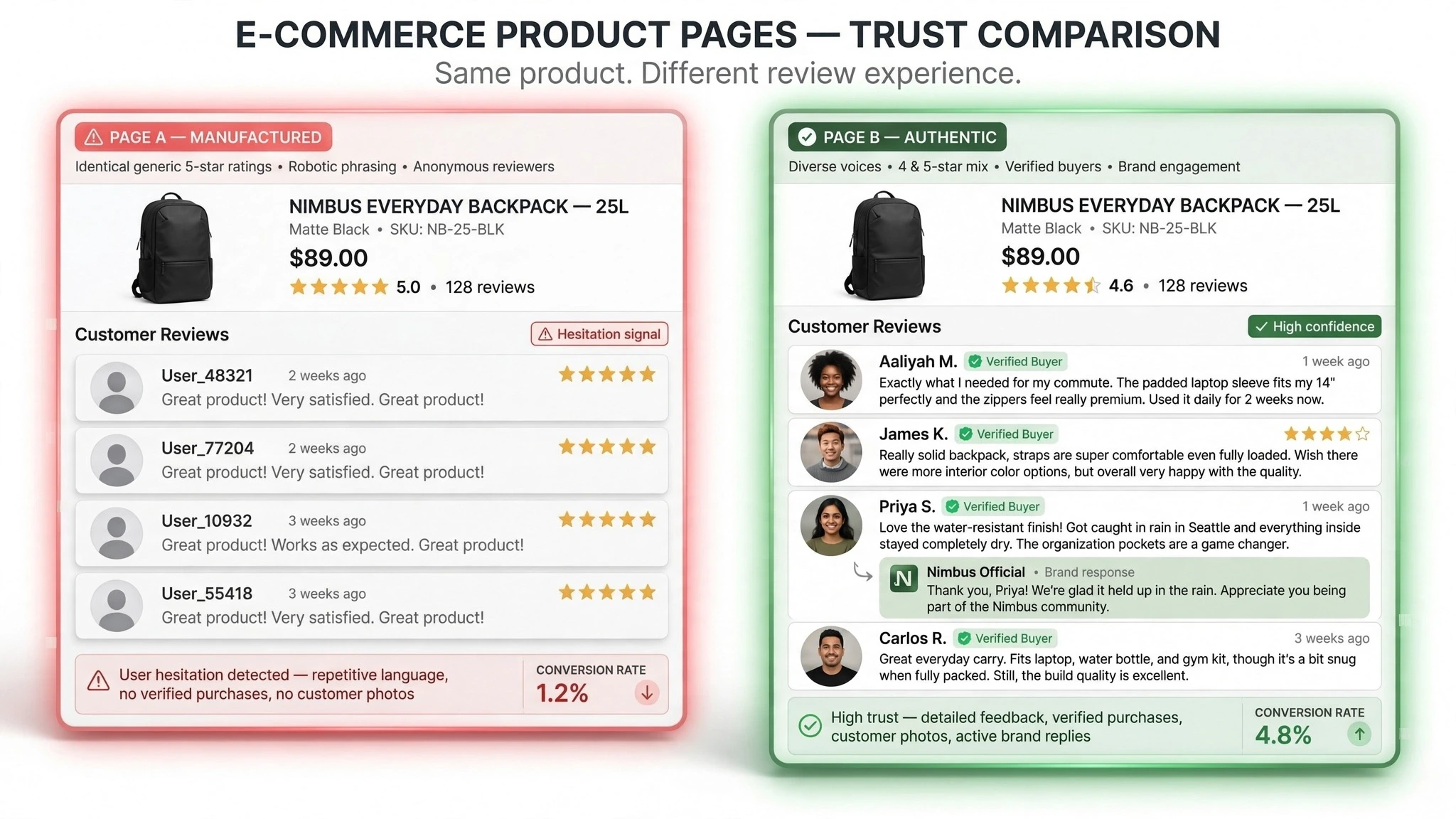
Below is a simple side-by-side. Neither is a rule. They show two ways reviews can shape the same buying decision.
Page A
Five perfect reviews. Same tone. Same phrasing. No names, no details, no criticism. Every review feels written by the same person. The reader hesitates.
Page B
Mixed reviews. Different voices. Real details. One honest complaint. A brand reply that addresses it. The reader sees themselves and feels safe enough to buy.
HUMAN INSIGHT
Customers do not read reviews to be convinced. They read them to be reassured.
They are not asking, “Is this product good?” They are asking, “Will this product be good for me?” And only other people—real people with real experiences—can answer that question.
This is why reviews are not just about stars. They are about recognition. When a reader sees someone like them, with their concern, choosing the product and being fine—that is the moment trust begins.
HUMAN INSIGHT
Humans are social learners. We look to others when we are uncertain. Reviews are a modern version of an ancient instinct: before trying something new, check what happened to the people who went first.
That instinct is not going away. It is only getting faster.
Understanding this changes how you write reviews, how you ask for them, and how you present them.
The Bigger Lesson: Reviews Are Recognition, Not Ratings
A five-star rating is a summary. A review is a story. And customers trust stories more than summaries—because stories carry texture, emotion, and the small details that only real experience can produce.
The best product pages do not just show ratings. They show voices. Voices that sound different. Voices that describe real moments. Voices that admit small flaws. Voices that let the reader say, “That sounds like me.”
That recognition is what turns a browsing visitor into a buyer—not the stars themselves.
A Final Thought for Brands and Marketers
Reviews are not something you collect after the sale. They are something you earn through the experience you give.
If you want honest reviews, build an honest product. If you want specific reviews, give people specific things to love. If you want trust, let real voices speak—imperfect, textured, and human.
Brands that understand this stop chasing five stars and start building real relationships. And those relationships are what actually convert.
That is the version of reviews that lasts.
Frequently Asked Questions
Why do customers read reviews before buying?
To reduce risk. Buying online means trusting a description and a brand. Reviews let buyers borrow confidence from other people who already took that risk.
What do customers look for in a review?
Similarity, specificity, honesty, outcome, and repetition. A review that hits several of these feels trustworthy. One that hits only one feels like noise.
Can a 4-star review sell better than a 5-star review?
Often yes. A four-star review with a small honest criticism feels more believable than a perfect five-star review. The imperfection signals that the reviewer is real.
Are negative reviews bad for a brand?
Not always. A few honest negative reviews increase overall trust and help filter out customers who would not have been a good fit. The problem is not negativity. It is a wall of fake positivity or a pattern of unresolved complaints.
How can brands get more authentic reviews?
By asking specific questions, making it easy to leave feedback, replying to reviews honestly, and never pressuring customers to leave only positive ones. Authenticity grows when reviews are treated as a conversation, not a scoreboard.
Earn trust. Show real voices. Respect the buyer.
Good digital communication is not about adding more information. It is about making the important information easier to notice, understand and evaluate.