Social Proof: Why We Trust a Product More When Other People Like It
8–10 min read –· Digital Marketing
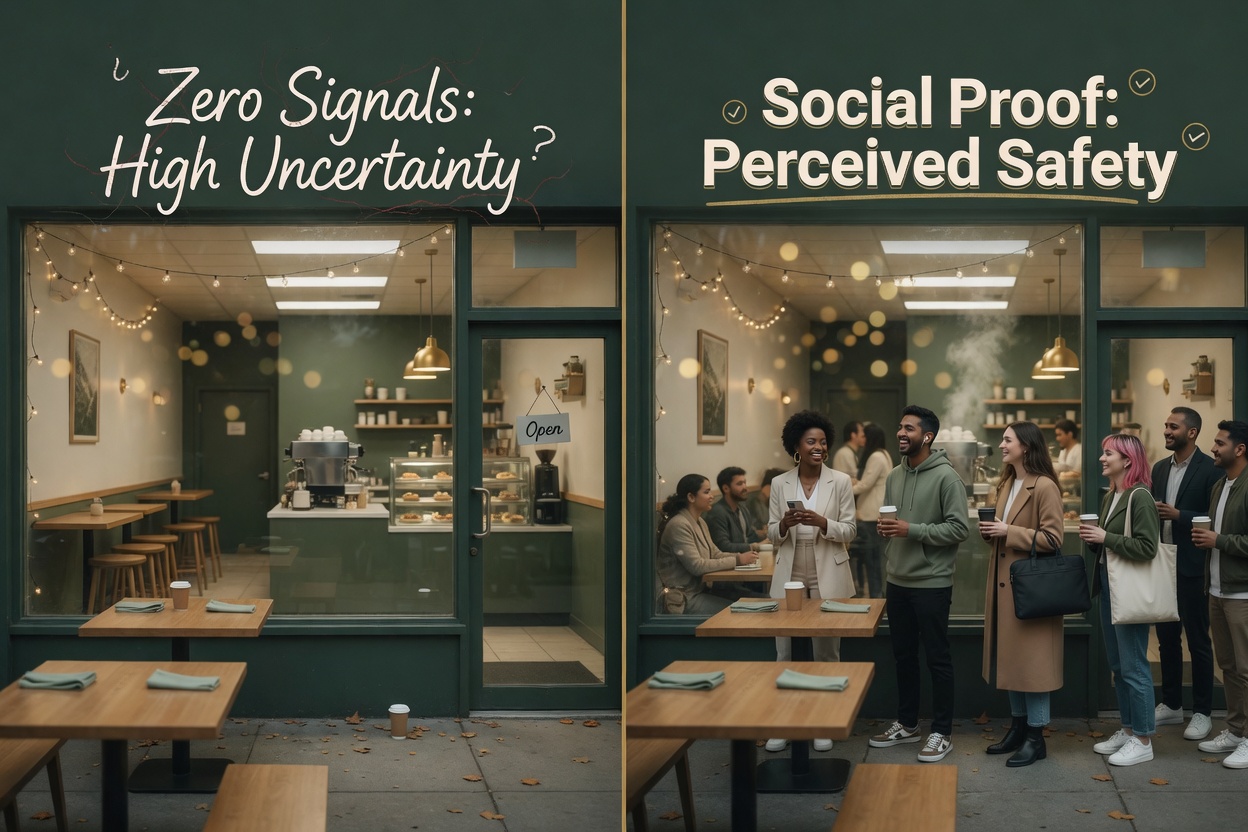
You are standing in a new city, looking for a place to eat. Two restaurants sit side by side. One is empty. The other has a small line outside.
You have no other information. No menu, no reviews, no recommendation. Yet most people choose the one with the line.
Nothing about the food changed. What changed was the presence of other people. Their choice became your evidence.
This is social proof: the quiet, powerful tendency to trust what others seem to trust.
What Is Social Proof?
Social proof is a mental shortcut. When we are uncertain, we look at what other people are doing to decide what is correct, safe, or valuable.
It is not weakness or laziness. It is an efficient strategy in a world where we cannot personally test every option.
Other people’s choices become a signal. Their behavior becomes our evidence.
Key idea
Social proof is not about truth. It is about perceived safety.
When we see others choosing something, our brain reads it as: This is probably safe. This is probably good. I am probably not making a mistake.
That is why social proof works even when the evidence is weak, and why it fails when it feels fake, paid, or staged.
We do not just buy products. We buy reduced uncertainty.
And uncertainty is reduced fastest when other people seem to have already made the same choice.
Why the Brain Leans on Other People
When we are unsure, our brain has two options: analyze everything carefully, or follow the group.
Careful analysis takes time and energy. Following the group is fast and usually safe enough. So under uncertainty, the brain defaults to what others are doing.
This is why social proof is strongest when:
1. The decision feels risky or unfamiliar.
2. The outcome is hard to judge alone.
3. The people doing it seem similar to us.
4. The number of people feels large or growing.
Remove any one of those, and social proof loses power.
The 6 Types of Social Proof
Social proof is not one thing. It appears in different forms, and each one speaks to a different kind of uncertainty.
1. Expert proof. A trusted authority endorses the product.
2. Celebrity proof. A famous person uses or supports it.
3. User proof. Regular customers share reviews and results.
4. Crowd proof. Numbers show that many people have chosen it.
5. Friend proof. People we know and like use it.
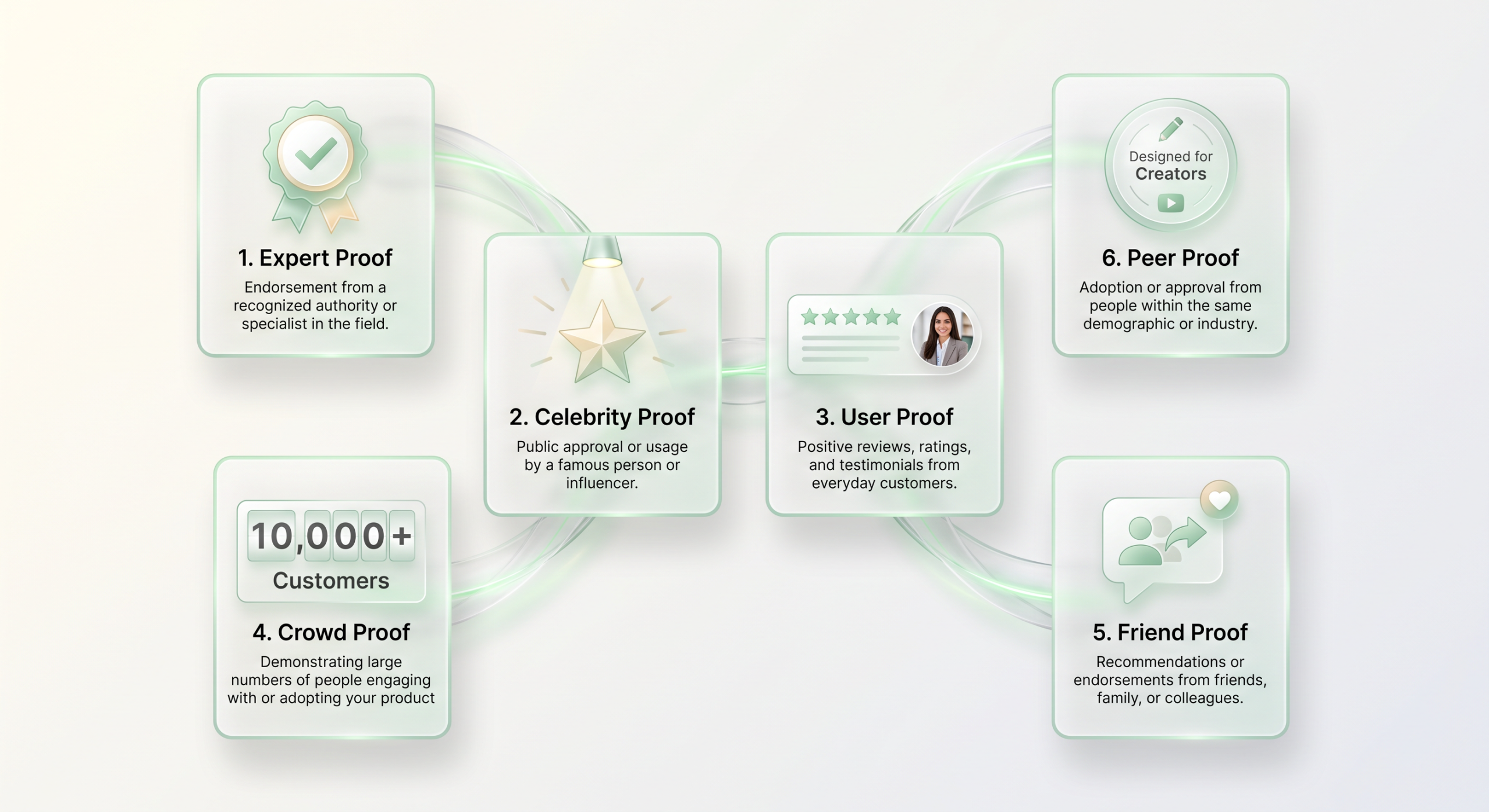
6. Peer proof. People who feel similar to us—same age, same job, same problem—choose it.
Notice that these types work in different situations. Celebrity proof may impress on a fashion page but feel out of place in a serious medical product. Peer proof may feel weak in luxury but extremely strong in productivity tools.
Why Reviews Work Better Than Ads
A brand can say its product is great. The brand has something to gain, so the claim feels less certain. A stranger writing a review has no obvious reason to lie—especially if the review is detailed, imperfect, and specific.
This is why a slightly critical review can feel more trustworthy than a glowing one. The criticism signals that the writer is being honest, not promotional.
Believability does not come from perfection. It comes from texture.
The best social proof sounds like a human, not a marketing team.
Specificity builds trust. “This saved me two hours on my weekly report” is stronger than “Amazing product, highly recommend.”
The Number Effect: When Many People Choose the Same Thing
Numbers carry weight. “10,000 customers” feels safer than “10 customers”—even if both are true.
The brain reads large numbers as evidence that the choice has already been tested by many people and survived.
But numbers alone are not enough. If the number feels exaggerated, the effect reverses. “Over 5 million happy customers” on a new website raises suspicion, not trust.
The number should feel real, not impressive.
A specific number—”1,247 customers this year”—can feel more honest than a rounded, boastful one. Specificity signals that someone actually counted.
Similarity: We Trust People Like Us
Social proof works best when the other people feel similar to us. A testimony from a corporate executive may matter less to a freelancer than one from another freelancer.
This is why “people like you” is such a powerful phrase. It closes the psychological distance between the reader and the proof.
If the people in the proof feel too different—too rich, too famous, too foreign—the signal weakens. The brain quietly says: That worked for them, but I am not them.

For marketers, this means the strongest proof is not always the most impressive one. It is the most recognizable one. A reader should be able to see themselves in the person giving the proof.
When Social Proof Backfires
Social proof is not magic. It can fail, and it can even work against you.
1. When it feels fake. Fake reviews, suspicious testimonials and identical phrasing reduce trust.
2. When it feels too polished. Perfect profiles and perfect photos feel staged.
3. When the numbers feel impossible. Claims that sound exaggerated trigger skepticism.
4. When the proof is irrelevant. A famous name in the wrong category adds nothing.
5. When it contradicts the product. Strong social proof paired with a poor experience creates long-term damage.
Social proof amplifies trust, but it cannot replace it.
If the underlying experience is weak, proof only makes the disappointment louder.
The Ethical Line: Proof vs. Manipulation
Social proof uses real human psychology. It becomes unethical when it is used to simulate trust that does not exist.
Fake reviews, invented customer counts, paid testimonials dressed as organic ones—these do not create trust. They borrow it, temporarily, from the reader’s instinct to believe.
When the reader eventually discovers the truth, the loss is bigger than any short-term gain.
The TarkWorld Principle of Honest Proof
Social proof should reflect reality, not replace it. If the product is good, real proof will always outperform invented proof—because real proof is durable.
Trust is not something you can fake into existence. It can only be earned, one honest signal at a time.
Practical Ways to Use Social Proof Well
If you are using social proof in marketing, these principles make it stronger and more honest at the same time.
1. Show specific reviews. Detailed, imperfect reviews feel more real than generic praise.
2. Match the audience. Show proof from people who look and live like your reader.
3. Place proof near the claim. If you say a product saves time, put the review about saved time right next to it.
4. Use real numbers. Specific, verifiable counts beat inflated ones.
5. Let people speak naturally. Real voices are more convincing than polished brand language.
Social proof is not decoration. It is a bridge between a claim and a belief.
When it is honest, it helps people feel safe enough to try something new. When it is fake, it borrows trust it never earned—and eventually loses it.
A Tale of Two Products
Two products. Same quality. Same price. Different social proof.
The one that communicates trust clearly is the one people choose—even when the underlying product is identical.
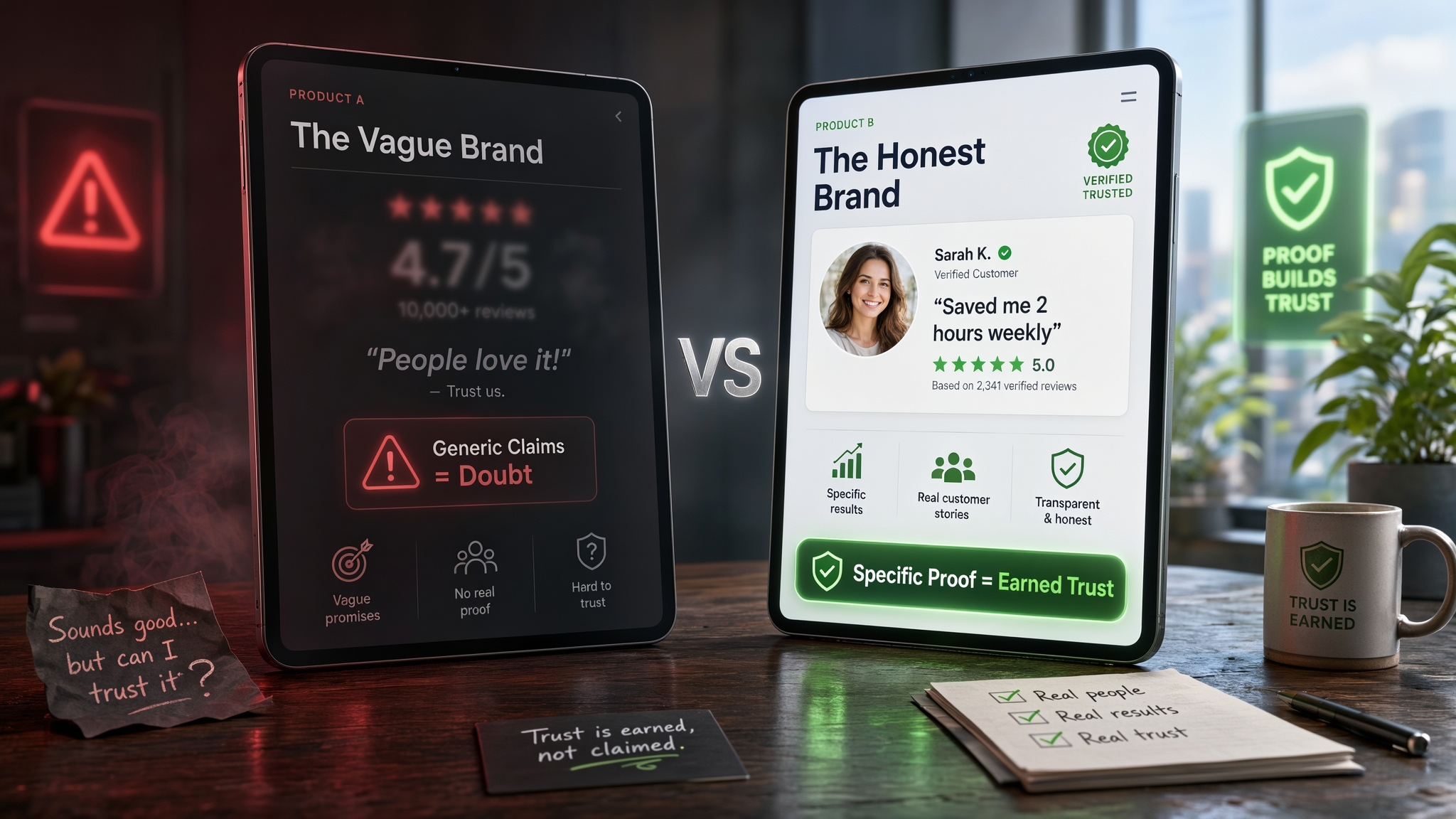
Below is a simple comparison. Neither example is a rule. They show two ways social proof can appear on a page.
Product A
Strong product. Weak signals. Generic reviews. No names. No details. Numbers that feel inflated. The visitor has to guess whether the product is safe.
Product B
Strong product. Specific reviews. Named customers. Real photos. A believable number. The visitor feels safe enough to try—even without prior experience.
HUMAN INSIGHT
We like to think of ourselves as independent thinkers. But the human brain is deeply social. It treats the group as a source of information, not just as a crowd.
That instinct is not a flaw. It is a survival tool that has been carried into the digital world—where it now shapes which products we trust, which brands we follow, and which decisions feel safe.
Understanding social proof is not about manipulating people. It is about recognizing how trust is actually built—and how easily it can be damaged.
HUMAN INSIGHT
Social proof does not remove doubt. It makes doubt feel smaller than the fear of missing out.
That is why a customer with low confidence will still buy when they see that many others have—and why a customer with high confidence will buy even without any proof.
The strongest proof does not shout. It quietly reassures.
The Bigger Lesson: Trust Is Borrowed Before It Is Earned
Every customer begins as a stranger. Before they can trust a product, they must first trust the people who already do.
That is the role of social proof: it lends trust temporarily, so that the first experience has a chance to earn it permanently.
When the product delivers, the borrowed trust is paid back. When it does not, the trust collapses—and the proof that once helped now feels like a betrayal.
This is why honest social proof is not just an ethical choice. It is a strategic one.
A Final Thought for Marketers and Founders
Social proof is not something you add to a page. It is something you earn from real people and then present honestly.
If the product is good, the proof will be good. If the product is weak, no amount of proof will fix it for long.
Marketers who understand this stop chasing impressive numbers and start collecting meaningful ones—stories, names, results, and words that sound like people, not campaigns.
That is the version of social proof that actually lasts.
Frequently Asked Questions
Why do we trust products more when others like them?
Because other people’s choices reduce uncertainty. When we are unsure, the brain treats the group as evidence that the choice is safe, correct, or worth the risk.
Which type of social proof is most powerful?
It depends on the decision. Peer proof works well for everyday purchases. Expert proof works well for technical or high-stakes decisions. Friend proof is often strongest of all when available.
Can social proof be faked?
It can be imitated, but it rarely works for long. Audiences are skilled at spotting fake reviews, inflated numbers, and staged testimonials. When trust breaks, it breaks hard.
What makes social proof feel believable?
Specificity, imperfection, and similarity. A detailed review with mild criticism feels more real than perfect praise. Proof from people who resemble the reader feels more relevant.
Should small businesses invest in social proof?
Yes—starting small. One honest review, one real testimonial, one specific number, one named customer story. Quality matters more than quantity, especially early on.
Earn trust. Show proof. Respect the audience.
Good digital communication is not about adding more information. It is about making the important information easier to notice, understand and evaluate.