Why People Change Their Minds After Seeing What Others Are Doing
8–10 min read · — · Digital Marketing
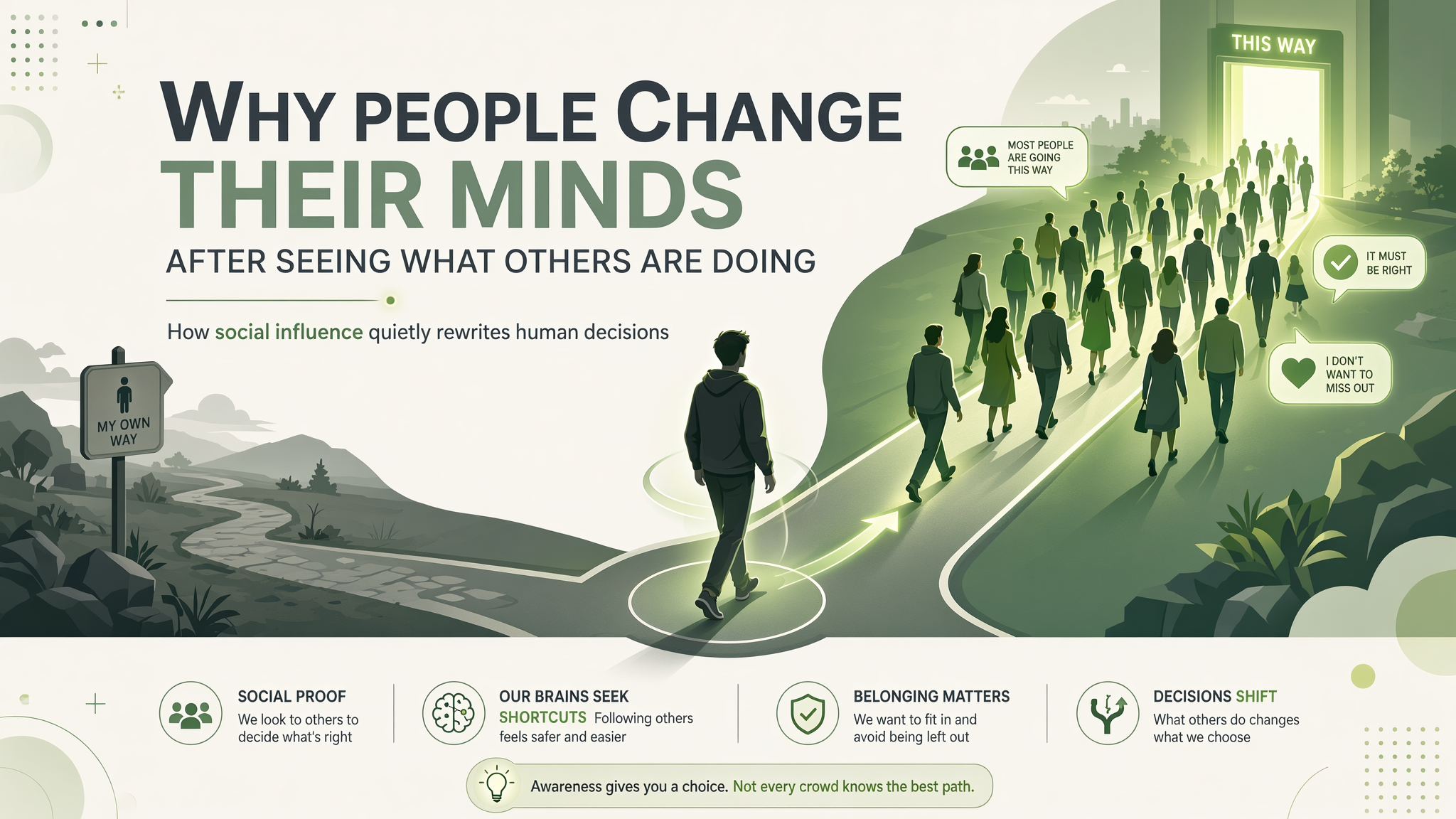
You were sure. Then you saw someone else do something different. And quietly, without noticing, your mind shifted.
This happens constantly. A person says they would never buy a certain brand—until a friend recommends it. A business owner insists they will not raise prices—until they see competitors doing it. A reader swears they do not care about trends—until everyone they trust starts talking about one.
The change rarely feels dramatic. It feels like adjusting. But underneath, something powerful is happening: social influence is reshaping the mind.
What Is Social Influence?
Social influence is the way other people’s behavior shapes what we believe, choose, and do. It is not always conscious. In fact, most of it is invisible. We absorb signals from the people around us and adjust our thinking to match the world we see.
This is why a person’s opinions can shift simply because they spend time around different people. It is why brands grow through word of mouth, why trends spread through social feeds, and why one honest review can change a stranger’s mind.
Social influence is not a weakness. It is how the brain saves energy in a world too complex to analyze alone.
Key idea
People rarely change their minds because of an argument. They change them because of a crowd.
When we see other people acting, our brain quietly updates its sense of what is normal. If everyone is doing it, it must be safe. If no one is doing it, it must be risky. The shift is not logical—it is social.
That is why information alone rarely changes behavior. The brain trusts people more than it trusts data. And when people move, minds move with them.
We do not change our minds when the facts change. We change them when the crowd changes.
The facts may already be there. It is the social signal that finally makes them feel real.
Why the Brain Updates When Others Act
The brain treats the behavior of others as evidence about reality. If many people are doing something, the brain assumes they know something we do not. This shortcut saves time and reduces risk.
Three things happen when we see others act:
1. We update our sense of normal. What others do becomes what is expected.
2. We reduce our uncertainty. Their behavior feels like proof that the choice is safe.
3. We feel pressure to align. Going against the group feels riskier than joining it.
This is not a flaw. It is a feature. The brain is designed to learn from the crowd—and most of the time, it works.
The 5 Forces That Change a Mind
Mind changes are not random. They follow a handful of social forces that shape what feels safe, correct, or expected.
1. Social proof. If many people are doing it, it feels right.
2. Similarity. If people like me are doing it, it feels even more right.
3. Momentum. If more people are joining, the choice feels inevitable.
4. Authority. If trusted people are doing it, resistance drops.
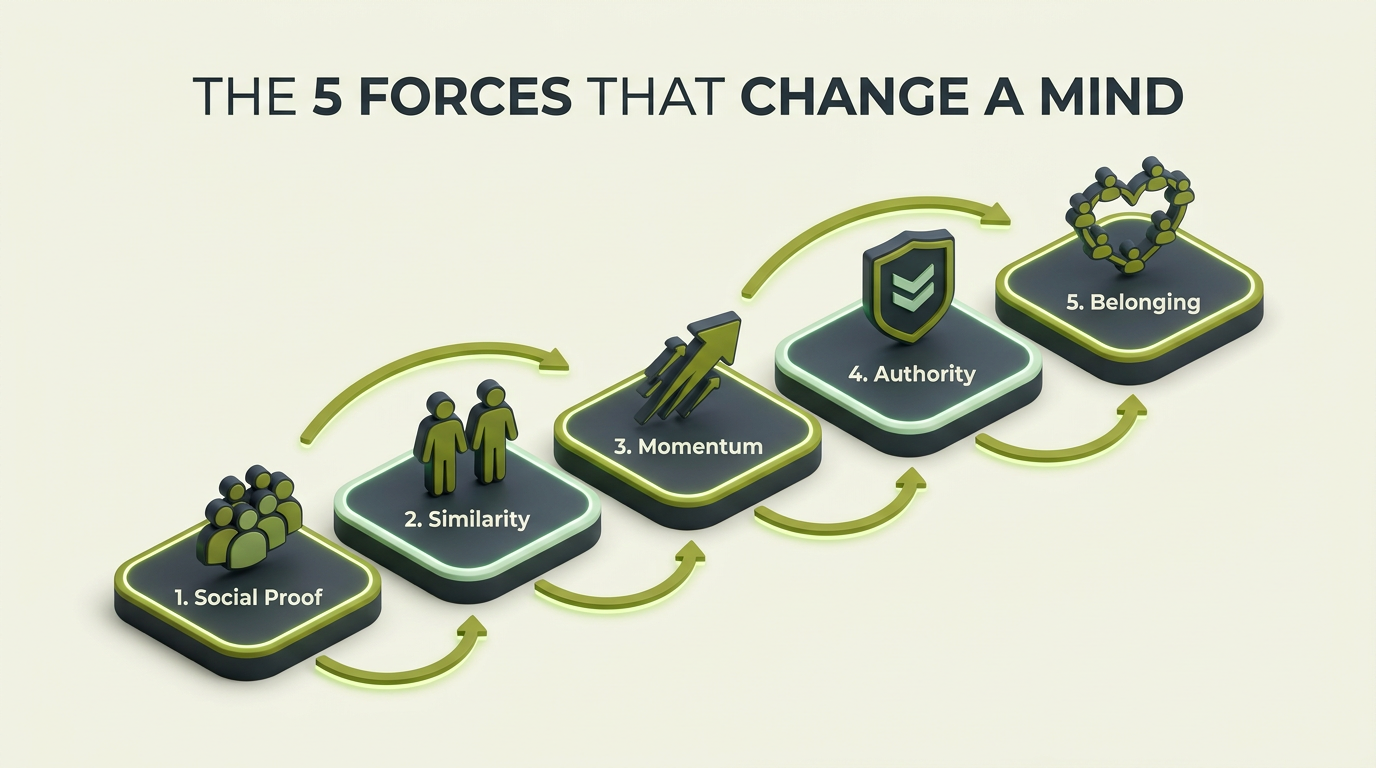
5. Belonging. If joining feels like being part of a group, the choice becomes personal.
Notice that none of these forces require convincing. They work through the person’s own sense of what is normal. That is why changing someone’s mind is rarely about arguing. It is about shifting what they see around them.
Why Facts Alone Rarely Change a Mind
If facts changed minds, the world would be a very different place. People would stop believing things that have been disproven, start saving when told to save, and change habits the moment new information arrives.
But that is not how humans work. Facts can update knowledge. They rarely update behavior on their own. It takes a social signal to make the facts feel real—someone we trust living the thing we were told.
This is why campaigns that rely only on data often fail. They are trying to change minds with evidence. But the mind was never waiting for evidence. It was waiting for permission—and permission comes from people.
Facts inform the mind. Other people move it.
That is the quiet truth behind every trend, every recommendation, and every change we make because of what we saw others doing.
The Role of Peers and Identity
We do not just follow any crowd. We follow crowds we feel part of. That is why peer behavior is so powerful. When someone sees friends, colleagues, or people they admire doing something, it stops being a choice about the product. It becomes a choice about identity.
Do I want to be the kind of person who does this too?
That question is stronger than any argument. It is why the most effective marketing does not just show what people are doing—it shows who they are. The choice becomes about belonging, not just buying.
When a choice becomes part of identity, it becomes very hard to reject.
People do not just defend products. They defend the group they belong to.
The Ethical Line: Influence vs. Manipulation
Social influence is powerful—and easy to misuse. A brand can honestly show what people are doing, or it can manufacture the appearance of a crowd. Fake reviews, fake user counts, and fake “everyone is switching” claims are all forms of manipulation.
Honest influence reflects real behavior. Manipulative influence invents it. The first builds trust. The second borrows trust—and eventually spends it.
When people discover the crowd was not real, they do not just distrust the brand. They become more skeptical of crowds everywhere. That skepticism spreads—and makes every honest signal harder to send.
The TarkWorld Principle of Honest Social Proof
Show what people are actually doing. Never manufacture a crowd to make a choice feel safer than it is. If the proof is real, let it speak. If it is not, do not invent it.
A real crowd is slow to build. A fake one is fast to lose.
How to Use Social Influence Honestly
If you want to use social influence in your marketing, these principles keep it effective and honest.
1. Show real behavior. Real reviews, real numbers, real people. Not invented ones.
2. Match the peer group. Proof from people like your audience works best. A generic user count is weaker than a specific one.
3. Explain why people are choosing it. The crowd matters less than the reason behind their choice.
4. Do not fake momentum. Nothing loses trust faster than an invented crowd.
5. Let people move on their own. Influence works best when it is offered, not pushed.
Social influence should make the truth easier to see—not make a lie feel safer.
When the crowd is real, it is powerful. When it is invented, it becomes a warning sign.
A Tale of Two Choices
Two situations. Same choice. Different social signals. Very different outcomes.
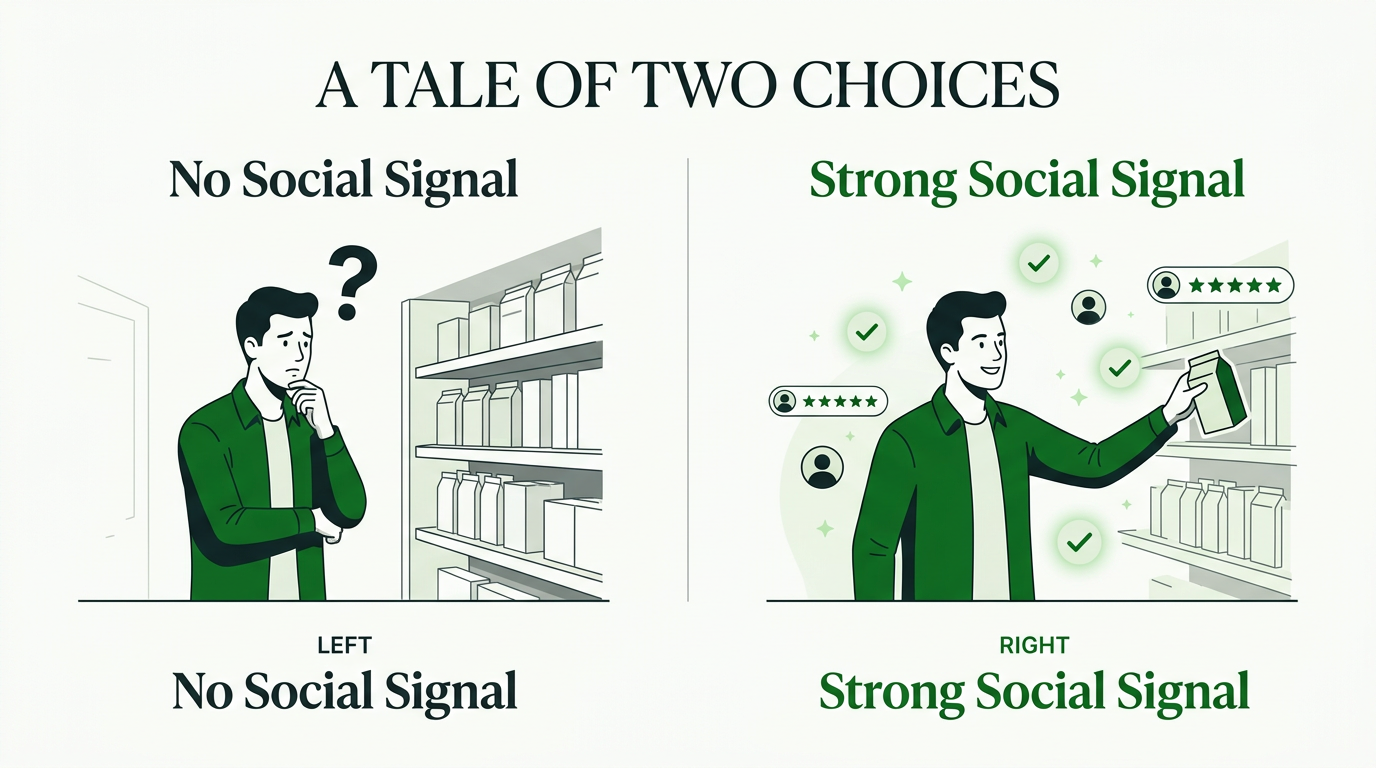
Below is a simple side-by-side. Neither is a rule. They show two ways social signals can shape the same decision.
No Social Signal
The product is good. The price is fair. But no one they know is using it. The customer hesitates. They are not sure it is safe. They leave to think about it—and probably never come back.
Strong Social Signal
Same product. Same price. But the customer sees someone like them using it. A colleague. A friend. A trusted voice. The hesitation disappears. The choice now feels normal—and they buy.
HUMAN BEHAVIOR INSIGHT
Humans are social learners. We look to others when we are uncertain, and we copy what seems to work. This instinct is not a weakness—it is how we survived for thousands of years and how we still make sense of a complicated world.
That is why people change their minds when they see others act. The change is not caused by the argument. It is caused by the crowd. The argument only makes sense after the social proof has arrived.
Understanding this changes how we market, how we sell, and how we try to change minds. Not with louder claims, but with visible behavior. Not with arguments, but with peers.
HUMAN BEHAVIOR INSIGHT
The brain treats group behavior as a shortcut for what is correct. If many people are doing something, it assumes they know something we do not. This is why social proof is so powerful—and why a crowd can change a mind faster than any argument ever could.
That instinct is not going away. It is only getting faster as more of our decisions are shaped by what we see on screens.
People do not change their minds because the facts changed. They change them because the people around them changed first.
The Bigger Lesson: Minds Move With Crowds
If you want to change what someone believes, do not start with the argument. Start with what they see. A peer doing something new. A crowd moving in a direction. A social signal that quietly says: this is now normal.
That signal does more than a hundred facts ever could. It gives the mind permission to shift without feeling foolish. When the people around us move, our beliefs follow—not because we were convinced, but because we were included.
That inclusion—not the argument—is what truly changes a mind.
A Final Thought for Marketers and Leaders
Brands are not just selling products. They are shaping what feels normal. Every time a customer sees someone like them using your product, that choice becomes a little more acceptable for everyone else.
The most persuasive brands are not the loudest. They are the ones that quietly help their customers feel part of something. When the group moves together, the individual decision becomes almost effortless.
That quiet movement is what changes minds—and what builds movements.
Lead the group honestly. The rest follows.
Frequently Asked Questions
Why do people change their minds after seeing what others do?
Because the brain uses other people’s behavior as a signal for what is safe, normal, or correct. When we see others acting, our sense of reality updates automatically. This is social proof in action—not a conscious decision, but a built-in shortcut.
Is social influence always a good thing?
No. Social influence is neutral in itself. It becomes harmful when it pushes people toward choices that do not serve them—through fake urgency, manufactured trends, or manipulated numbers. The tool matters less than the intention behind it.
Can brands use social influence honestly?
Yes—by showing real behavior and real people. Real reviews, real users, real outcomes. The proof must reflect reality, not manufacture it. Honest social proof helps people make decisions. Manufactured proof only tricks them.
How do I know if social proof is honest?
Ask one question: would the customer feel respected if they knew exactly how this proof was gathered? If yes, it is honest. If it would make them uncomfortable, then the proof is likely manufactured rather than earned.
What's the difference between influence and manipulation?
Influence informs. Manipulation deceives. Influence shows people real behavior and lets them decide. Manipulation creates fake behavior to push a decision. The first respects the person. The second uses them.
Show what is real. Let minds move honestly.
Good digital communication is not about adding more information. It is about making the important information easier to notice, understand and evaluate.