The Psychology of Testimonials: Why Someone Else’s Experience Influences Us
8–10 min read · — · Digital Marketing
You are reading about a product. The description is good. The price is fair. You are interested—but not convinced.
Then you scroll down and see a review. A real person, with a real name, describing exactly the problem you have. They say the product fixed it. And something shifts. You are now more likely to buy.
Nothing about the product changed. What changed was belief. That shift is the quiet power of testimonials.
Why Testimonials Work So Well
A testimonial is social proof in its most personal form. Instead of a brand making a claim, another customer confirms it. The message stays the same—but the messenger changes everything.
When a brand says a product works, the buyer wonders if the brand is biased. When a customer says the same thing, the buyer assumes they have nothing to gain. That shift from self-interest to experience is what makes a testimonial feel believable.
Testimonials work because they reduce uncertainty in a way that only other people can. They let the buyer borrow someone else’s experience before committing to their own.
Key idea
Testimonials do not convince. They permit.
They do not create desire—they remove the doubt that stands between the buyer and what they already wanted. That is why the strongest testimonials are not the most enthusiastic ones. They are the most recognizable ones. The reader sees themselves in the reviewer and quietly thinks: if it worked for them, it could work for me.
That single thought is where every good testimonial lands.
A testimonial is not a praise. It is a mirror.
When a reader sees their own situation reflected in another person’s words, trust begins.
Why We Trust Someone Else’s Experience
Humans are social learners. When we are uncertain, we look to other people’s choices to decide what is safe. This is not a modern habit—it has kept us alive for thousands of years.
Testimonials activate three mental responses at once:
1. Social proof. If many people say it works, it probably does.
2. Similarity. If the reviewer is like me, their experience is relevant to mine.
3. Reduced risk. Someone else has already tried it, so I am not going in blind.
Together, these three responses quietly reduce uncertainty—and reduced uncertainty is the real reason testimonials work.
The 5 Things That Make a Testimonial Believable
Not every testimonial carries weight. The strongest ones share five qualities.
1. Specificity. “This saved me two hours a week” beats “great product.”
2. Real names and faces. Anonymous praise feels written, not lived.
3. Similarity to the reader. People trust proof from someone who looks like them.
4. Honest imperfection. A small criticism makes the praise feel real.
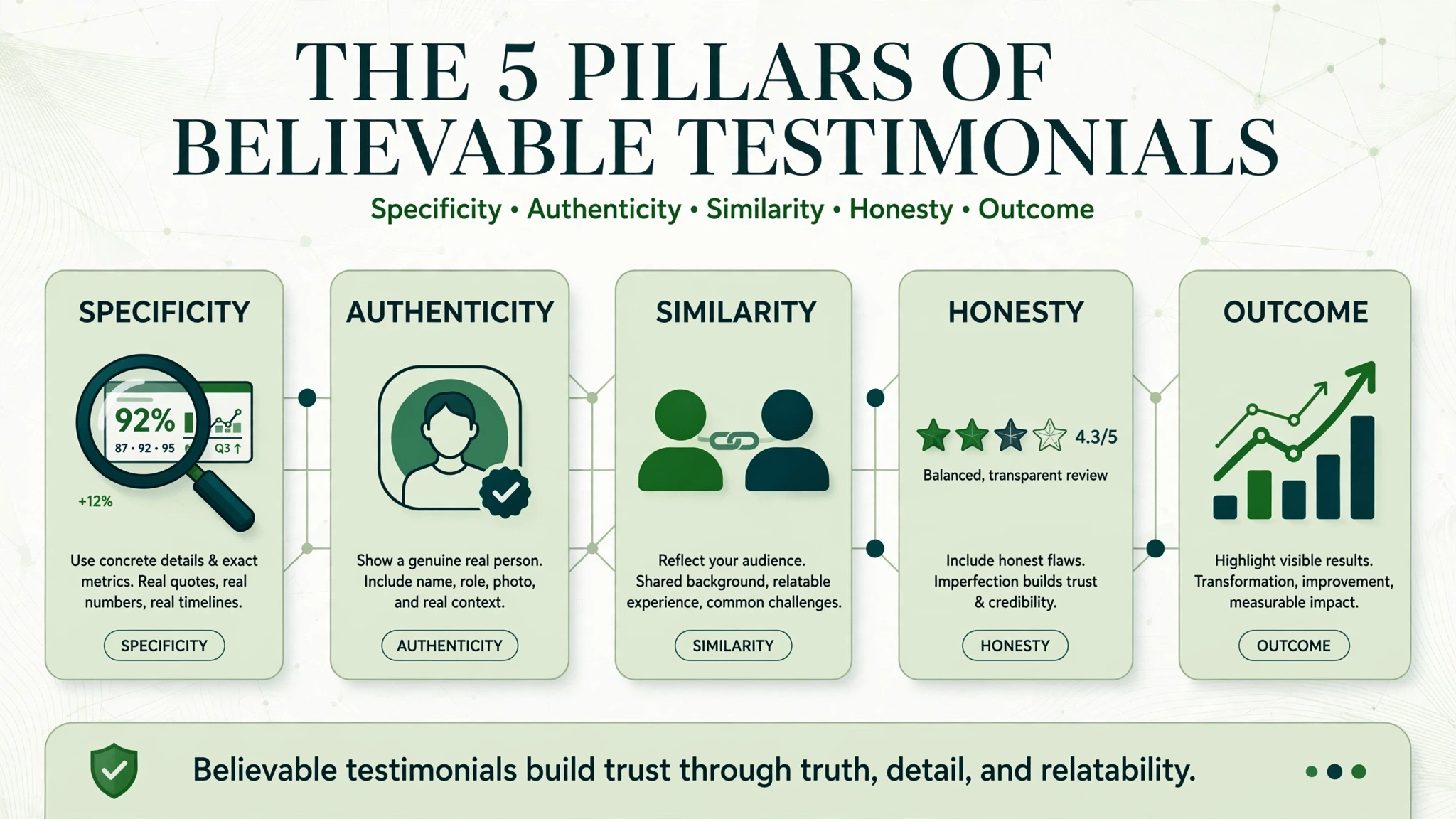
5. A visible outcome. The testimonial should show what changed, not just how the person felt.
When a testimonial has most of these, the reader stops treating it as marketing and starts treating it as information. And information is what they came for.
Why a Slightly Imperfect Testimonial Feels More Real
Perfect testimonials often feel written by the brand. Real ones are messier. They mention trade-offs. They describe the product as “useful, but I wish it had one more feature.” And that small note of criticism does something powerful—it makes everything else in the testimonial feel true.
The brain reads imperfection as honesty. When a review admits a flaw, the reader believes the rest of it more. A completely glowing testimonial, on the other hand, triggers a small internal alarm: this feels too polished.
Honesty is not weaker evidence. It is stronger evidence.
Perfect praise feels like a pitch. Imperfect praise feels like a person.
And people, unlike pitches, are believable.
The Role of Similarity
People trust testimonials from people who feel like them. A freelancer trusts another freelancer more than a corporate executive. A student trusts a student. A mother trusts a mother.
This is why generic testimonials often fail. They come from someone who feels too different, too polished, too distant. The reader cannot imagine themselves in the reviewer’s story.
The strongest testimonial is not the most impressive one. It is the most recognizable one. It sounds like a version of the reader’s own life.
We do not trust reviews. We trust reviewers who feel like us.
That is why similarity is not a small detail. It is the whole mechanism.
The Ethical Line: Testimonials vs. Manufactured Trust
Fake testimonials are one of the easiest ways to damage a brand. Some businesses write them, buy them, or use actors to film them. In the short term, they look convincing. In the long term, they collapse.
When a customer eventually discovers that a testimonial was fake, they do not just stop trusting that one review. They stop trusting every review the brand has ever shown. Trust, once broken, is difficult and expensive to rebuild.
The strongest testimonials are not the most flattering. They are the most truthful.
The TarkWorld Principle of Honest Testimonials
Only show testimonials from real customers. Never edit them to sound better than they were. Let the flaws stay. Honesty is not a weakness in testimonials—it is the entire reason they work.
Real proof beats perfect proof. Every time.
How to Collect and Use Testimonials Well
Great testimonials are not collected. They are earned. But how you ask for them matters just as much as how you show them.
1. Ask specific questions. “How did the product help you?” produces better answers than “Please leave a review.”
2. Ask at the right moment. Right after a win—not weeks later when the feeling has faded.
3. Use real names and photos. Anonymous praise is weaker evidence.
4. Keep the rough edges. Do not edit the customer’s voice into brand language. Let it sound human.
5. Place them near the decision. Not buried at the bottom of the page. Next to the buy button, next to the price, next to the claim.
Testimonials are not decoration. They are evidence.
Treat them with the same care you treat the product itself. Real proof is the most valuable thing a brand can show.
A Tale of Two Testimonials
Two testimonials. Same product. Same price. Very different levels of trust.
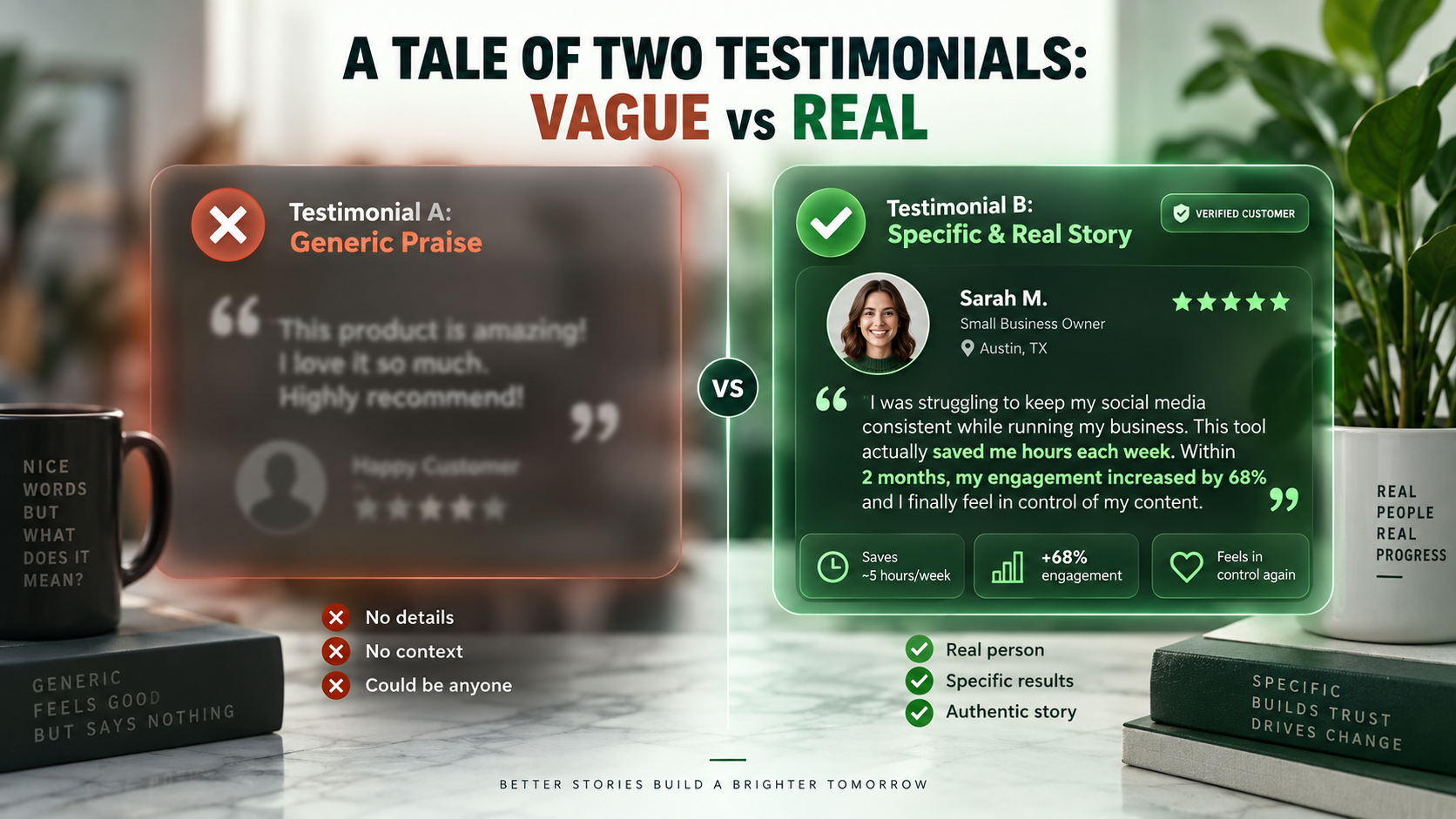
Below is a simple side-by-side. Neither is a rule. They show two ways the same proof can be presented.
Testimonial A
“Amazing product! Highly recommend! Five stars!” No name, no detail, no story. The reader skims past it—because it sounds like every other review.
Testimonial B
“I used to spend two hours on client reports every Friday. Now it takes thirty minutes. The only downside is I wish the export included a chart option.” Specific, honest, useful. The reader sees themselves in it—and believes it.
HUMAN BEHAVIOR INSIGHT
Testimonials are not powerful because they are persuasive. They are powerful because they are borrowed experience. The reader takes someone else’s trial run and uses it as a safety signal for their own decision.
That is why testimonials that feel real convince more than testimonials that sound impressive. The brain is not looking for perfect praise. It is looking for recognition—someone who has stood where the reader stands now.
Understanding this changes how you collect reviews. You stop asking for praise. You start asking for truth. And truth is what actually sells.
HUMAN BEHAVIOR INSIGHT
People trust people. It is that simple. When a claim comes from a company, it feels strategic. When a claim comes from a customer, it feels lived. The same fact, from a different source, carries completely different weight.
This is why the most successful brands build their reputation on real voices—not on clever copy. Voice is what makes evidence feel real.
Evidence is not a brand’s version of events. It is the customer’s.
The Bigger Lesson: Proof Feels Stronger When It Comes From People
Brands will always say good things about themselves. That is expected. But the voice that actually changes behavior is the voice of another customer. Not because it is louder—because it is different.
Testimonials are not a marketing feature. They are proof that someone else already took the risk the reader is considering. When that proof feels real, the reader feels safer. And safety is what makes the decision possible.
Every brand should ask: is my proof the kind a customer would trust—or the kind a brand would write?
The difference between those two is the entire story.
A Final Thought for Brands and Marketers
Every customer who has a great experience with a brand becomes a potential testimonial. The question is not whether they will talk—it is whether the brand will listen, ask, and share honestly.
Real testimonials do not just sell products. They tell the story of how the brand actually behaves in the world. That story, told by the people who lived it, is the most persuasive thing a brand can ever present.
Let customers speak. Their voices will carry further than any campaign.
Frequently Asked Questions
Why do testimonials influence us so strongly?
Because they reduce uncertainty through social proof. When a real person confirms a product works, the buyer borrows that experience as a safety signal. The claim stays the same—but the messenger changes everything.
What makes a testimonial believable?
Specificity, real names and faces, similarity to the reader, honest imperfection, and a visible outcome. Testimonials that include most of these feel like real information rather than marketing.
Should testimonials always be five-star?
No. Testimonials with a small, honest criticism often feel more believable than perfect praise. The brain reads imperfection as a sign of authenticity. What matters is that the testimonial is honest, not that it is flawless.
Are written testimonials better than video ones?
Both work. Video adds tone and presence, which makes it harder to fake. Written testimonials are easier to scan and can be placed near the decision point. The most effective pages often use both—text for scanning, video for depth.
Can small brands collect testimonials quickly?
Yes—by asking early and asking specifically. A single detailed review from a real customer can do more than ten generic ones. Small brands often have an advantage: they know their customers personally and can ask for feedback in a way that feels warm and human.
Let real voices earn real trust.
Good digital communication is not about adding more information. It is about making the important information easier to notice, understand and evaluate.