The Psychology of Headlines: What Makes People Stop Scrolling?
8–10 min read — Digital Marketing
You are scrolling. Your thumb moves. Your eyes skim past dozens of words a second. Nothing stops you.
Then, suddenly, something does. One line catches you. You pause. You read it again. You click.
That moment—the pause in the scroll—is where every piece of content lives or dies. And it is almost never about the whole article. It is about the first line. The headline.
Headlines are not just introductions. They are the decision point where the reader silently asks: Is this worth my time?
Why Headlines Matter More Than Anything Else
A headline is not a summary. It is a promise. It tells the reader what they will get, why it matters, and whether it is worth their next ten seconds. When a headline works, the reader invests attention. When it fails, everything underneath it is invisible—no matter how good it is.
This is why writers can spend hours on a single line. The headline is not 10% of the work. It is the decision that determines whether the other 90% is ever seen.
Most people read headlines. Very few read articles. The headline is the only chance to earn the difference.
Key idea
A headline is not read. It is scanned and judged.
The brain does not stop to analyze headlines carefully. It filters them in a fraction of a second, using two simple questions: Is this relevant? Is this worth the effort?
If the answer is no—or unclear—the scroll continues. If the answer is yes, the reader pauses. That pause is the entire job of the headline.
Headlines are not judged by quality. They are judged by relevance.
A clever headline that fails to speak to the reader is worse than a simple one that does.
What the Brain Checks in the First Second
The brain runs a fast checklist on every headline it meets:
1. Relevance. Does this concern me or someone like me?
2. Clarity. Can I understand it in a single glance?
3. Value. Is there a clear reason to keep reading?
4. Emotion. Does it trigger curiosity, surprise, or recognition?
5. Trust. Does it feel honest—or like clickbait?
If any of these fail, the reader keeps scrolling. Not because they consciously rejected the headline. Because they never noticed it at all.
The 6 Psychological Triggers of Strong Headlines
Strong headlines are not built from clever wording. They are built from the way the brain decides what matters. Six triggers do most of the work.
1. Curiosity. A small gap between what is known and what is unknown. Not a mystery—an open question.
2. Specificity. Numbers, names, details. “3 ways” is stronger than “some ways.”
3. Relevance. Speaking to the reader’s situation, not to a general audience.
4. Emotion. Surprise, relief, recognition, or quiet concern.
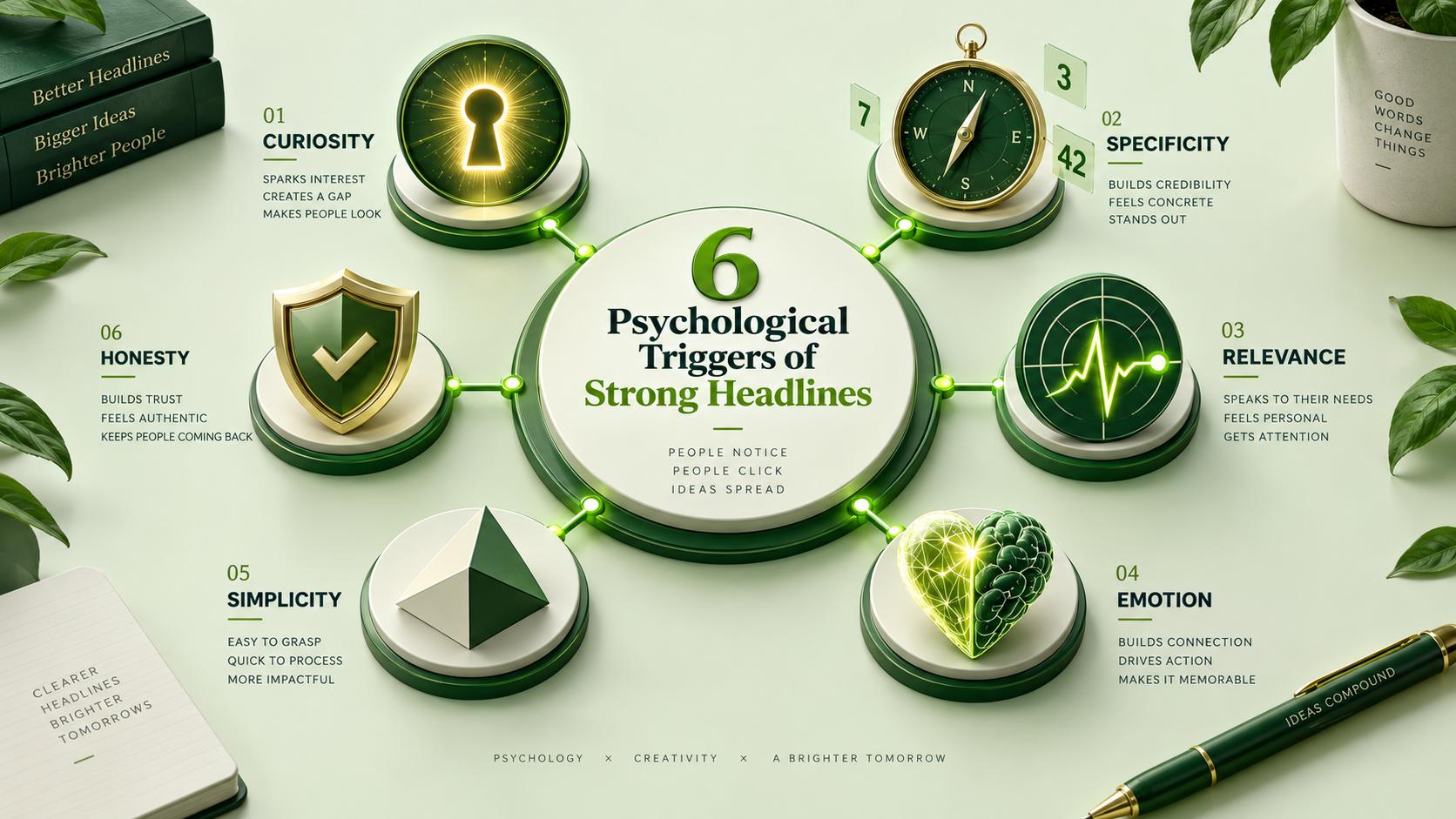
5. Simplicity. Short, clear language. No jargon, no clutter, no ambiguity.
6. Honesty. The headline matches what the content actually delivers. No exaggeration, no bait.
Notice that none of these are tricks. They are the qualities the brain looks for in a message worth its time. When a headline has two or three of these, it earns the pause. When it has none, it disappears.
Why Clever Headlines Often Fail
Many writers aim for cleverness. They want the headline to sound smart, witty, or unexpected. But cleverness often gets in the way of clarity.
The reader does not slow down to appreciate a clever phrase. They skim past it, because the meaning is not obvious. A witty pun that requires three seconds of thought is already gone.
The best headlines are almost always plain. They are not clever. They are clear. They say something specific in a way that feels easy to understand.
Clever headlines impress other writers. Clear headlines earn readers.
If you have to choose between clever and clear, choose clear every time.
The Two-Second Rule
A headline has about two seconds to do its job. In those two seconds, the reader must understand three things:
1. What is this about? The topic must be instantly clear.
2. Who is it for? The reader must see themselves in it.
3. Why should I care? There must be a visible reward for reading.
If any of the three is unclear, the headline fails. It does not matter how good the article is. The reader never reached it.
Write the headline as if the reader has only two seconds—because they do.
Read it aloud. Show it to someone else. If they hesitate, the headline has failed.
The Ethical Line: Curiosity vs. Clickbait
Clickbait works—briefly. It uses curiosity gaps that never close, exaggerations that do not match the content, and emotional manipulation that leaves the reader feeling tricked. It earns clicks. It spends trust.
Honest headlines do the opposite. They create curiosity that is paid off in the article. They promise something real—and deliver it. That makes the reader want to come back.
The difference is not the intensity of the headline. It is whether the headline tells the truth about what is inside.
The TarkWorld Principle of Honest Headlines
Every headline should promise something the content actually delivers. If the reader feels misled once, they will not trust your next headline—or the one after that.
A headline is not a trick. It is a first impression. Make it an honest one.
How to Write Headlines People Actually Stop For
Headline writing is not inspiration. It is craft. These principles work across articles, emails, ads, and product pages.
1. Write the headline last. Knowing what the piece actually says makes the promise easier to keep.
2. Lead with the reader’s benefit, not the writer’s idea. “How to save time” beats “The value of automation.”
3. Use concrete words. “Three ways” beats “several strategies.”
4. Cut every unnecessary word. The shorter the headline, the faster it lands.
5. Test it aloud. If it sounds hard to say, it will be hard to read.
6. Make one promise, not three. A headline that tries to say everything says nothing.
7. Keep it honest. The best headline is the one the content can actually deliver.
A strong headline is not the loudest one. It is the clearest one. It is the one that makes the right reader feel, for a moment, that the article was written specifically for them.
A Tale of Two Headlines
Two headlines for the same article. Same content. Same writer. Very different outcomes.
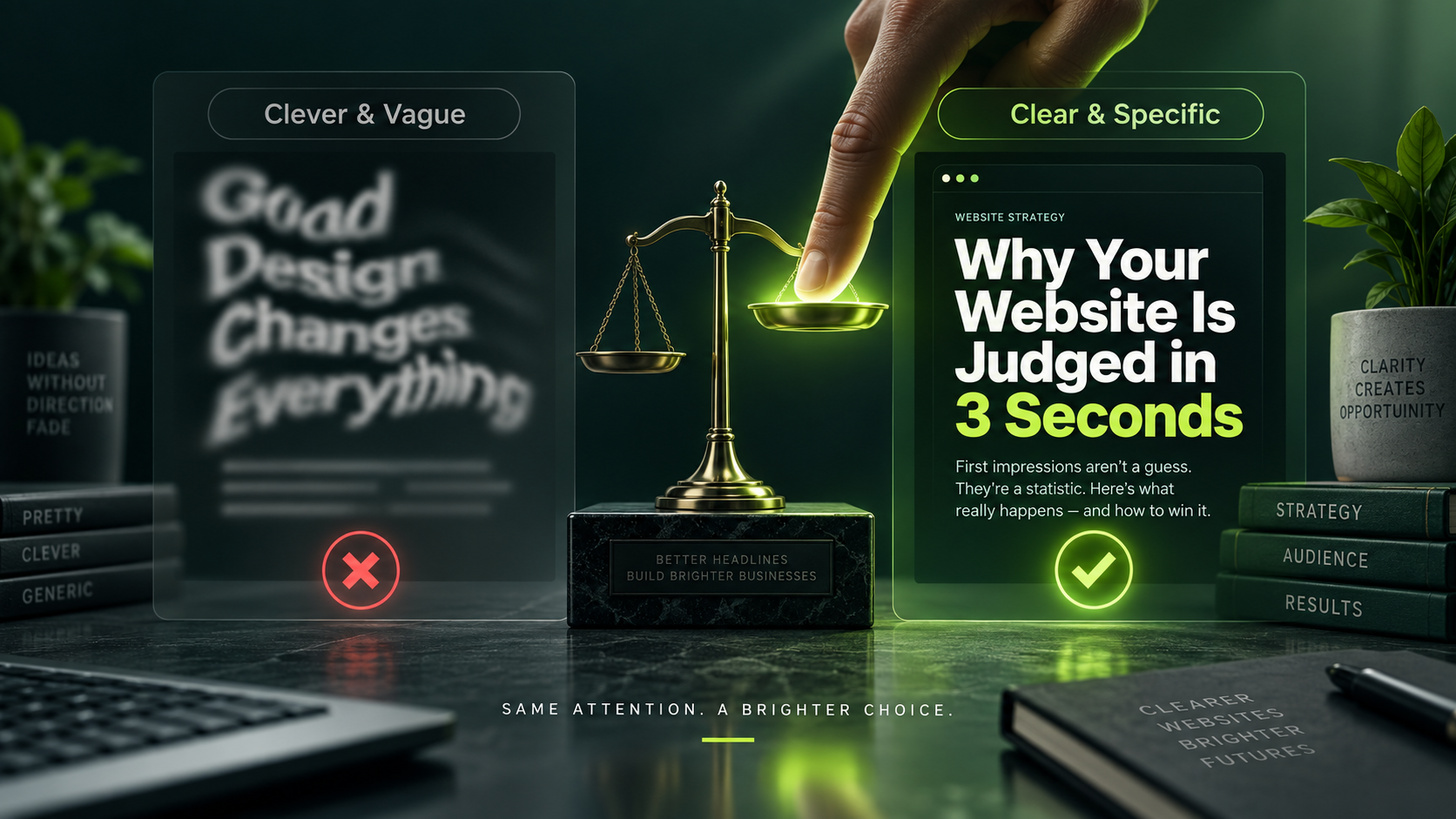
Below is a simple side-by-side. Neither is a rule. They show two ways the same article can greet a reader.
Headline A
“The Psychology of First Impressions in Digital Marketing.” Accurate, professional, vague. The reader has to guess what they will get—and scrolls past.
Headline B
“Why Your Website Is Judged in the First 3 Seconds—and What to Fix.” Clear, specific, and useful. The reader knows exactly what they will get—and pauses.
HUMAN BEHAVIOR INSIGHT
Attention is limited. The brain cannot read everything, so it filters aggressively. A headline is not a barrier to be crossed. It is a doorway that either opens or stays closed.
Every time a reader pauses on your headline, they are quietly deciding that the next few minutes of their life are worth spending with you. That is not a small thing. It is the entire relationship beginning.
The headline is not a summary of what comes next. It is the reason the reader decides to find out.
HUMAN BEHAVIOR INSIGHT
The brain treats the first line of a message the way it treats the first few seconds of a conversation. If nothing in the opening feels worth continuing, the conversation ends—without the reader even noticing they ended it.
That is why headlines are so important. They are not decorations on top of content. They are the doorway the reader either walks through or walks past.
A good headline is not clever. It is a fair exchange: a real promise for a few moments of attention.
The Bigger Lesson: Headlines Are Hospitality
A headline is not a sales pitch. It is a welcome. It says, “Here is what you will find, and here is why it might matter to you.” The best headlines feel less like marketing and more like being introduced to a person who understands your situation.
That is why clear, specific, honest headlines win—over time and across every format. They open the door gently and let the reader walk through on their own terms. And when the reader enters, the rest of the content has its chance.
A headline is the first act of respect. Everything else follows from it.
A Final Thought for Writers and Marketers
The quality of a piece is invisible until the headline earns the reader’s attention. This is why writers should spend more time on the first line than on any other sentence in the piece.
A strong headline does not fight for attention. It earns it by making a specific, honest, relevant promise—and trusting the reader to recognize that the promise matters to them. That quiet confidence is what separates headlines that feel pushy from headlines that feel respectful.
That is the version of headline writing that lasts.
Frequently Asked Questions
What makes a headline stop the scroll?
Clarity, relevance, and a visible reward. The reader must instantly understand what the headline is about, who it is for, and why it might matter. If any of these are unclear, the scroll continues.
How long should a headline be?
As short as it can be while still being clear. Some headlines work in six words; some need twelve. The rule is not length—it is whether the promise lands before the reader’s attention moves on.
Is clickbait always a bad idea?
Clickbait works once and damages trust. When the content does not deliver what the headline promised, the reader feels tricked and rarely returns. The strongest headlines combine curiosity with honesty—so the reader gets exactly what they were led to expect.
Do numbers and lists always work?
No. They work when they are honest and useful. “7 mistakes to avoid” is specific and clear. “7 shocking things” with nothing shocking inside is a broken promise. Numbers only help when they match the value of the content.
Can a small brand write headlines that compete with big ones?
Yes—often better. Small brands can be more specific, more human, and more direct than large brands that write for everyone. One honest, specific headline written for a real person often outperforms a polished headline written for an audience of millions.
Earn the pause. Earn the read.
Good digital communication is not about adding more information. It is about making the important information easier to notice, understand and evaluate.