Why People Follow the Crowd: Understanding the Bandwagon Effect
8–10 min read — Digital Marketing
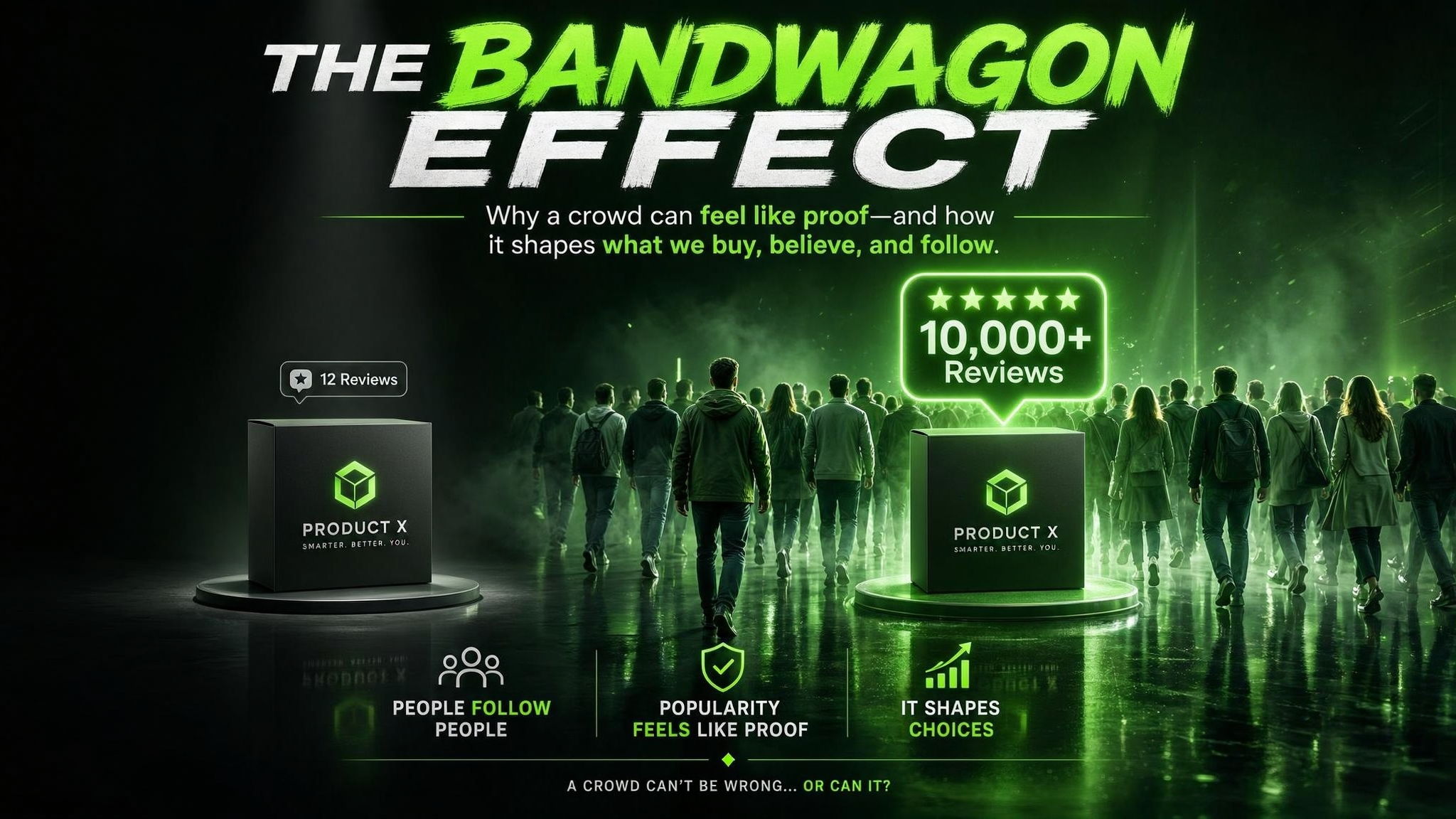
You are scrolling through a feed. Two products sit side by side. One has a handful of reviews. The other has thousands.
You have no other information. Same price, same description, same photo. Yet most people pick the one with thousands.
Nothing about the product changed. What changed was the presence of a crowd. Their choice became evidence. Their numbers became trust.
This is the bandwagon effect: the quiet, powerful pull of following what other people are already doing.
What Is the Bandwagon Effect?
The bandwagon effect is the tendency to adopt a belief, behavior, or product because other people already have. It is not about whether something is right or wrong. It is about how popular it appears to be.
The name comes from the image of a bandwagon—a parade float with musicians on it. As the wagon moves, more people jump on. The music gets louder, the crowd gets bigger, and joining feels easier because everyone else is already there.
This is not weakness or laziness. It is an efficient mental shortcut in a world full of uncertainty.
Key idea
The bandwagon effect is not about being right. It is about feeling safe.
When we see a crowd moving in a direction, our brain reads it as a signal: they must know something I do not. Following them feels lower risk than going alone. Even if the crowd is wrong, being wrong together feels less uncomfortable than being right alone.
This is why popularity can feel like proof—even when it is not.
We do not just follow the crowd. We use the crowd to decide what is true.
That instinct served us well for thousands of years. In the modern world, it can still help—or quietly mislead.
Why the Brain Leans Toward the Crowd
The bandwagon effect is powered by three mental forces working together:
1. Informational influence. When we are unsure, we assume others have information we do not.
2. Normative influence. We want to belong. Going against the group feels socially risky.
3. Social proof. Popularity itself becomes evidence. If many people chose it, it must be good.
Remove any one of these, and the bandwagon loses power. Together, they create a pull that is very hard to resist.
Where the Bandwagon Effect Shows Up
The bandwagon effect is not limited to shopping. It influences almost every type of human decision.
1. Products. Best-seller labels, high review counts, and “trending now” tags all trigger it.
2. Content. Viral posts feel more credible simply because they are viral.
3. Opinions. A widely held view often feels more correct than a minority one—even without evidence.
4. Investing. Buying stocks because “everyone is buying” is a classic bandwagon behavior.
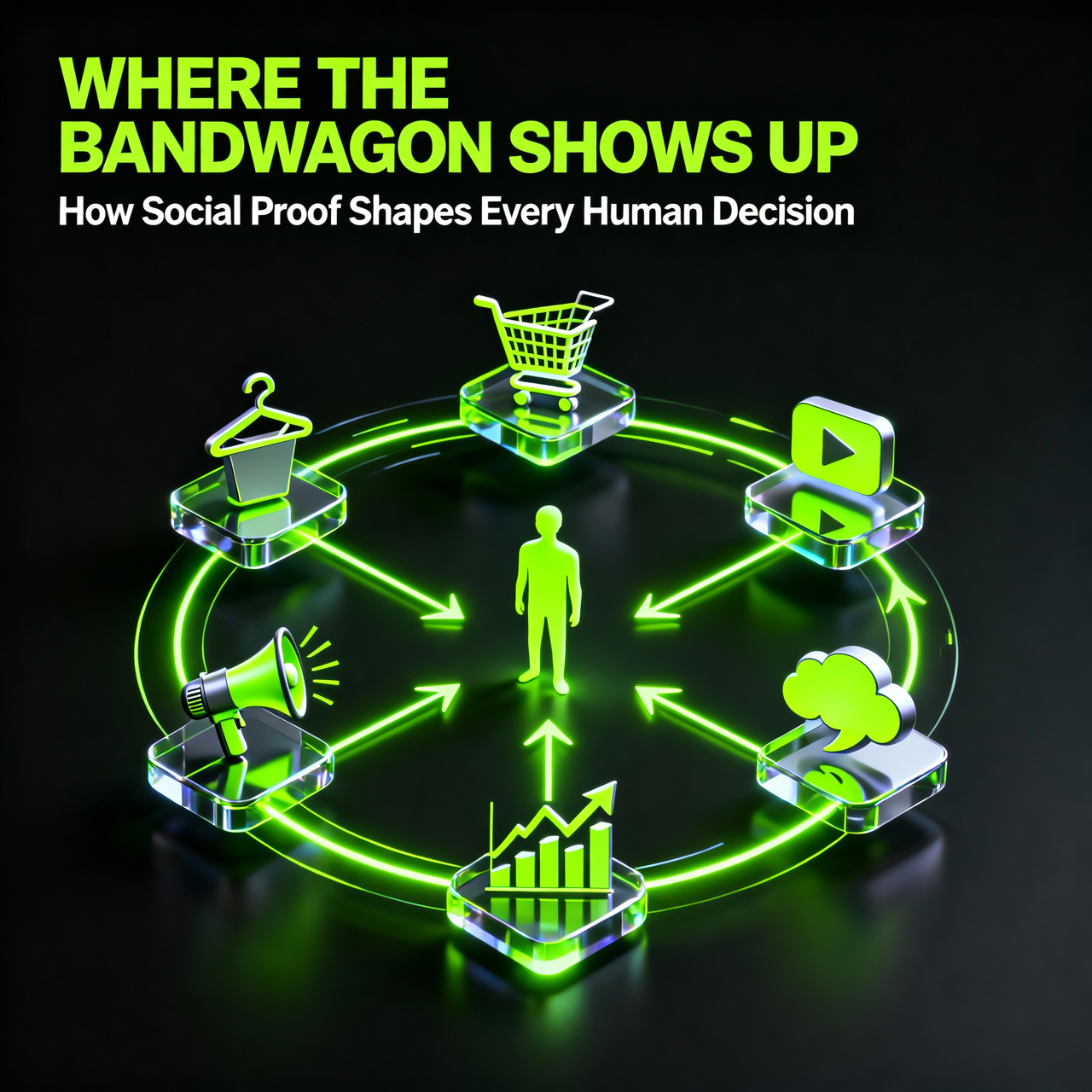
5. Fashion. Trends spread because they are worn, and they are worn because they are trends.
6. Politics and culture. Beliefs gain momentum the more visible they become—even if their original support was narrow.
In each case, the content of the decision matters less than the visibility of the crowd. Popularity becomes the shortcut.
Why Numbers Feel Like Truth
Numbers are powerful because they are simple. “10 million customers” does not require proof—it creates a feeling. The size itself communicates safety.
This is why marketing uses numbers so heavily: downloads, reviews, subscribers, five-star ratings. They are not evidence. They are signals. And signals move people faster than evidence does.
The problem is that numbers can be manufactured. Followers can be bought. Reviews can be faked. When the crowd is engineered rather than earned, the bandwagon effect becomes a trap.
A crowd is only as trustworthy as the reason it formed.
Real crowds build slowly. Fake crowds appear overnight. The wise buyer learns to feel the difference.
When the Bandwagon Helps and When It Hurts
The bandwagon effect is not inherently good or bad. It depends on what the crowd is signaling.
It helps when: many people have already tested something and their experience is genuine. Following them saves time and reduces risk.
It hurts when: the crowd is reacting to hype, fear, or manipulation—and the underlying value is unclear. Following them increases risk rather than reducing it.
The key is not to avoid the crowd. It is to know why the crowd formed.
A crowd is not a substitute for thinking. It is a signal to think more carefully.
The best decisions use social proof as information—not as a replacement for judgment.
The Ethical Line: Social Proof vs. Manufactured Popularity
Social proof is honest when it reflects real behavior. It becomes manipulation when the crowd is fake, purchased, or engineered to look larger than it is.
Fake reviews. Inflated follower counts. Bottled engagement. “Trending” labels that were paid for. These tactics borrow the trust that real crowds have earned—and spend it on behalf of the wrong product.
When customers discover the crowd was not real, they stop trusting the brand. And worse, they start doubting the crowds everywhere else.
The TarkWorld Principle of Honest Popularity
Let popularity reflect reality. Real reviews, real followers, real customers. A small honest crowd always builds more trust than a large fake one.
Trust cannot be borrowed indefinitely. It can only be earned—or eventually lost.
How to Use the Bandwagon Effect Responsibly
If you are using social proof in marketing, these principles keep it honest and effective.
1. Show real numbers. Specific, verifiable counts beat inflated ones.
2. Let customers speak. Real reviews with texture are more convincing than perfect praise.
3. Match the crowd to the audience. Proof from people who look like the buyer works better.
4. Do not buy followers or reviews. Short-term boost, long-term damage.
5. Explain the crowd’s reason. “Used by 10,000 designers” is stronger than “10,000 customers.”
The bandwagon effect is not a trick. It is a human instinct.
Use it to help customers understand that they are not alone in choosing you—but never to make them believe something that is not true.
A Tale of Two Crowds
Two products. Same category. Same price. Different crowds. And a completely different level of trust.
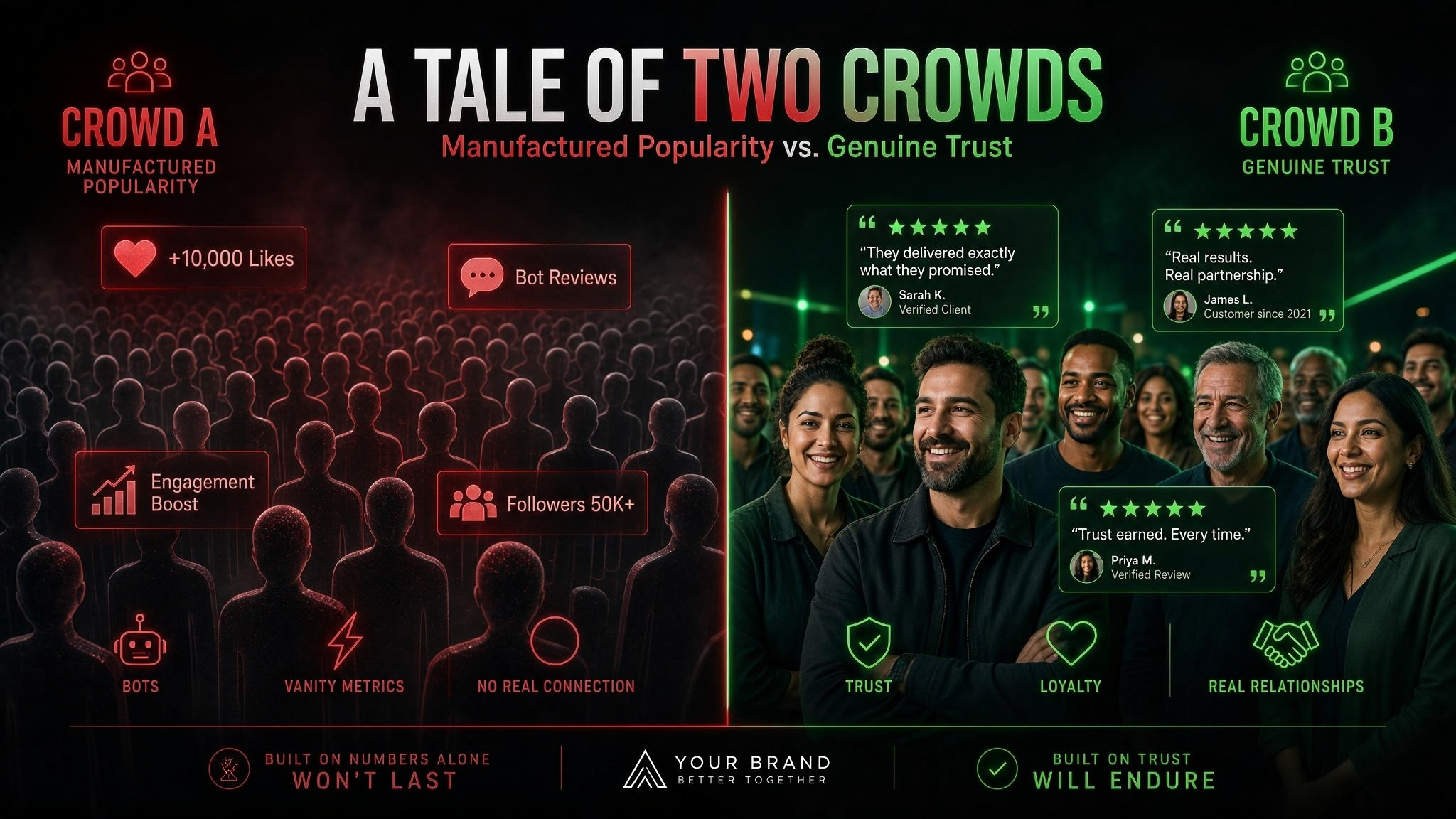
Below is a simple side-by-side. Neither is a rule. They show two ways a crowd can form.
Crowd A
Thousands of followers, thousands of likes, thousands of sales—all purchased. The numbers look impressive, but the voices are silent. New customers sense something is off but cannot explain why.
Crowd B
Smaller numbers—hundreds, not thousands—but every follower is real. Reviews have names, faces, and specific experiences. The crowd is smaller, but every member of it is real. That honesty carries more weight than any fake headline could.
HUMAN INSIGHT
The bandwagon effect is not a flaw in human thinking. It is an efficiency. Following the crowd lets us skip long analysis and make quick decisions with limited information.
It served us well for thousands of years. In the modern marketplace, it still helps—but only when the crowd is real.
Understanding this instinct does not make us immune to it. But it does help us ask the right question: why is this crowd here?
HUMAN INSIGHT
Humans are social learners. We look to others when we are uncertain. The bandwagon effect is that instinct in action—quick, automatic, and often invisible.
It is not a weakness to be corrected. It is a shortcut to be understood—so we know when to trust it and when to question it.
A crowd is a signal, not a verdict.
The Bigger Lesson: Popularity Is a Signal, Not Proof
Popularity does not prove quality. It only proves visibility. A crowd can form around something excellent, or around something loud. The bandwagon effect tells us what others chose—not whether their choice was wise.
That distinction matters, especially in marketing. A brand that earns a real crowd can rely on it for years. A brand that fakes one will eventually lose it. And its customers will not come back to find out why.
The crowd is only as trustworthy as the reason it formed.
A Final Thought for Marketers and Buyers
Every crowd begins with one person. Every trend begins with one choice. The bandwagon effect does not create value. It reveals it—or, sometimes, hides the absence of it.
For marketers, the lesson is to build a real crowd: real customers, real voices, real reasons to join. For buyers, the lesson is to ask not just who is on the wagon, but where it is actually going.
Because when the crowd is honest, it is powerful. When it is not, it is dangerous.
Understanding this is the first step toward using social proof wisely—and protecting yourself from it when it is used against you.
Frequently Asked Questions
What is the bandwagon effect?
The bandwagon effect is the tendency to adopt a belief, product, or behavior because many other people already have. It is driven by the human instinct to use other people’s choices as a shortcut for what is safe or correct.
Why do people follow the crowd?
For three reasons: to reduce uncertainty (others may know more), to belong (going against the group feels risky), and because popularity itself feels like evidence (if many chose it, it must be good). Together, these create a powerful pull.
Is the bandwagon effect always bad?
No. It is often helpful. When many people have genuinely tested something, following them saves time and reduces risk. The problem arises only when the crowd is fake, manipulated, or based on nothing more than hype.
How do marketers use the bandwagon effect?
Through social proof: best-seller tags, review counts, follower numbers, trending badges, and user testimonials. Honest marketers use these to show real popularity. Dishonest ones use them to invent popularity that does not exist.
Can a small brand benefit from the bandwagon effect?
Yes—by starting with a small but real crowd. A handful of honest reviews, a few named testimonials, a community of early users. Small but real always outperforms large but fake.
Build a real crowd. Earn real trust.
Good digital communication is not about adding more information. It is about making the important information easier to notice, understand and evaluate.