Why Customers Abandon Their Shopping Cart at the Last Moment
8–10 min read — Digital Marketing
They wanted the product. They found it, read about it, chose a size, added it to the cart, and clicked checkout.
Then they stopped.
The cart is full. The credit card is out. The decision is nearly made. And yet, at the last possible moment, they close the tab.
Cart abandonment is not about cold feet. It is about something the customer felt in the final few seconds—something the page did not mean to say, but said anyway.
What Is Cart Abandonment?
Cart abandonment is when a customer adds items to their cart but leaves before completing the purchase. On most e-commerce sites, it happens in the majority of sessions—often for well over half of all carts.
It is easy to assume the customer changed their mind. But the truth is quieter and more useful: something in the final moments made them hesitate. A cost. A confusion. A feeling. A doubt.
Understanding those final moments is one of the highest-leverage things any online business can do.
Key idea
Cart abandonment is rarely about the product. It is about the feeling at the finish line.
The customer wanted the product. What changed in the last moments was not the desire—it was the confidence. Something on the checkout page introduced doubt, effort, surprise, or mistrust.
Every abandoned cart contains a message. The business just has to read it.
The cart is not abandoned. The trust is.
At the exact moment the customer was ready to commit, something made the commitment feel less safe than before.
Why the Final Few Seconds Matter Most
The checkout page is the most emotionally loaded page on any website. By the time the customer reaches it, three things are true:
1. They already want the product. Interest is not the problem. Commitment is.
2. They are about to give something up. Money, data, and control. The brain is on high alert for risk.
3. They have already invested effort. If the final step feels harder than expected, the frustration is amplified.
This is why small friction at the checkout has a huge effect. The customer is not calmly deciding. They are on the edge of committing—and every small doubt matters more than it would at any other moment.
The 7 Reasons Carts Get Abandoned
Cart abandonment has many causes. Most fall into seven categories.
1. Unexpected costs. Shipping, taxes, or fees that appeared only at checkout.
2. Forced account creation. Being asked to sign up before buying.
3. Long or confusing forms. Too many fields, unclear steps, or unclear progress.
4. Payment distrust. No familiar payment options, no security signals, no reassurance.
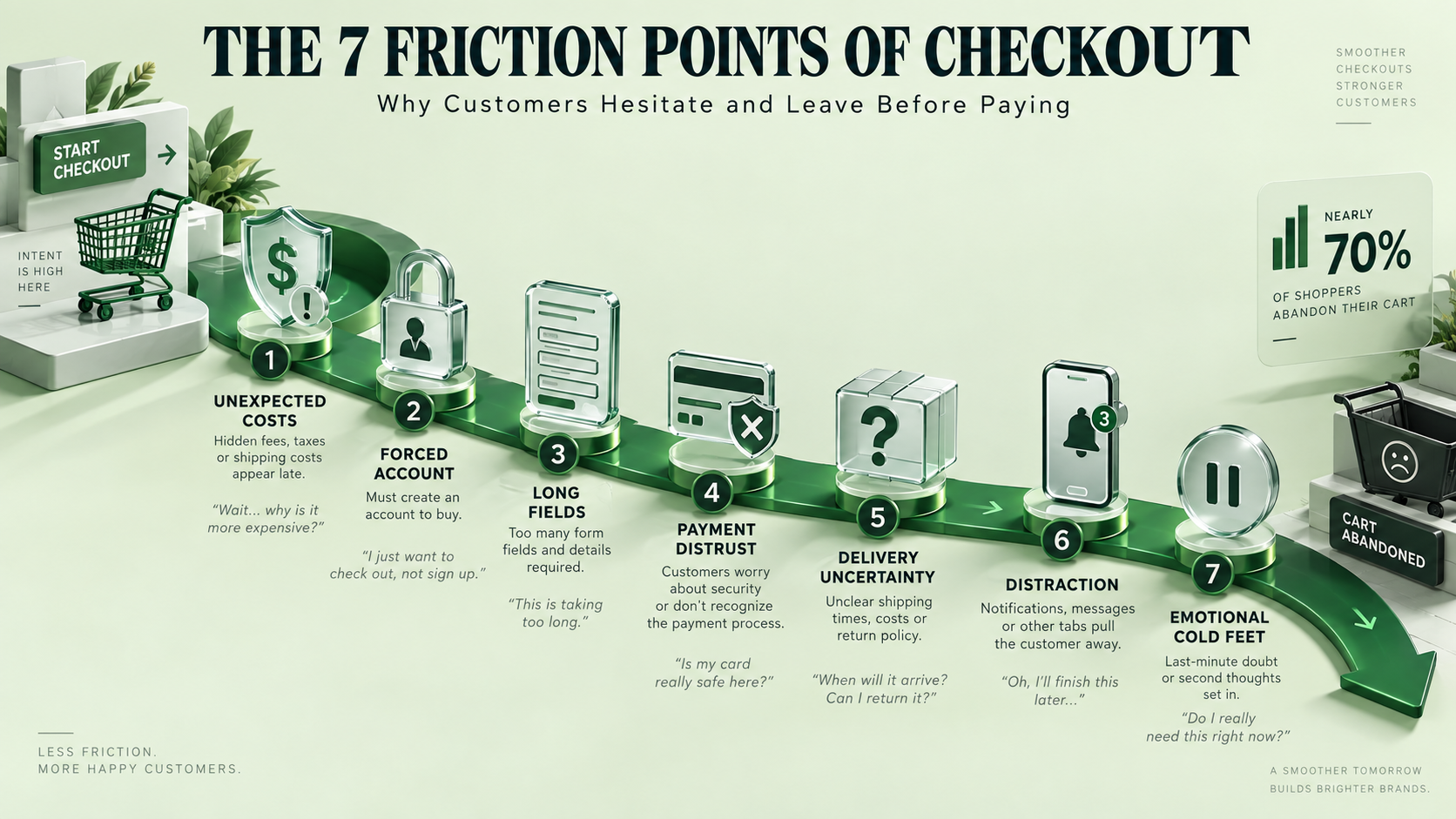
5. Delivery uncertainty. No clear delivery date, unclear return policy, or vague shipping options.
6. Distraction. A competing tab, a phone notification, or a moment of doubt that pulls them away.
7. Cold feet at the emotional finish. A sudden sense that this is a big decision, or that the price is a lot to commit to right now.
Each reason feels different to the customer, but they all point to one thing: at the last moment, the page made the decision harder than the customer expected.
The Hidden Cost of “Just One More Step”
Every extra step on a checkout page is a small tax on the buyer’s motivation. One more form field. One more confirmation. One more option to choose. Individually, each feels small. Together, they add up to a decision that feels too heavy to finish.
This is why checkout pages that remove steps often convert much better than pages that add rewards. The customer is not looking for a bonus. They are looking for permission to finish.
When the path is short, clear, and familiar, the brain relaxes. When the path is long, unclear, or unfamiliar, the brain hesitates.
Friction is not measured in seconds. It is measured in confidence.
A checkout that adds one small doubt can lose a customer who was 95% ready to buy.
The Emotional Reasons People Leave
Behind every technical reason for abandonment is an emotional one. The customer is not just making a transaction. They are deciding whether to trust, commit, and give up control.
Fear of regret. “What if this is the wrong choice?”
Lack of control. “I do not know when this will arrive or how to return it.”
Distrust. “Something about this page feels off.”
Loss of momentum. “I was excited, but now I am just filling forms.”
The customer is not deciding whether to buy. They are deciding whether to trust.
Every element on a checkout page either adds a little trust or takes a little away.
The Ethical Line: Persuasion vs. Pressure
Some businesses try to fight abandonment with pressure: countdown timers, “only 2 left” alerts, hidden fees saved for the last screen. These tactics can increase urgency in the moment—but they also increase regret later.
A customer who feels tricked into buying may complete the purchase once. A customer who feels respected will return many times. The short-term gain rarely outweighs the long-term cost.
The ethical approach is not to force the purchase. It is to remove the reasons for hesitation—clearly and honestly.
The TarkWorld Principle of Honest Checkout
Remove friction—not options. Make the truth visible early—not at the last screen. Let the customer feel in control at every step.
A checkout page should not feel like a trap. It should feel like the last, easiest step of a decision the customer already wanted to make.
How to Reduce Cart Abandonment Honestly
These improvements tend to matter most. None of them involve pressure. All of them reduce hesitation.
1. Show the full cost early. Shipping, taxes, and fees—before checkout.
2. Allow guest checkout. Do not force account creation before purchase.
3. Shorten the form. Only ask for what is truly needed.
4. Show trust signals. Payment badges, return policy, secure checkout notice.
5. Give clear delivery expectations. “Arrives Tuesday” beats “ships in 2–5 days.”
6. Offer familiar payment options. UPI, cards, wallets, COD—whatever the audience trusts.
7. Follow up gently. A reminder email is helpful. An aggressive discount is not always necessary.
The goal is not to chase the customer. It is to remove the reason they left.
A Tale of Two Checkouts
Two stores. Same product. Same price. Different checkout. Very different outcomes.
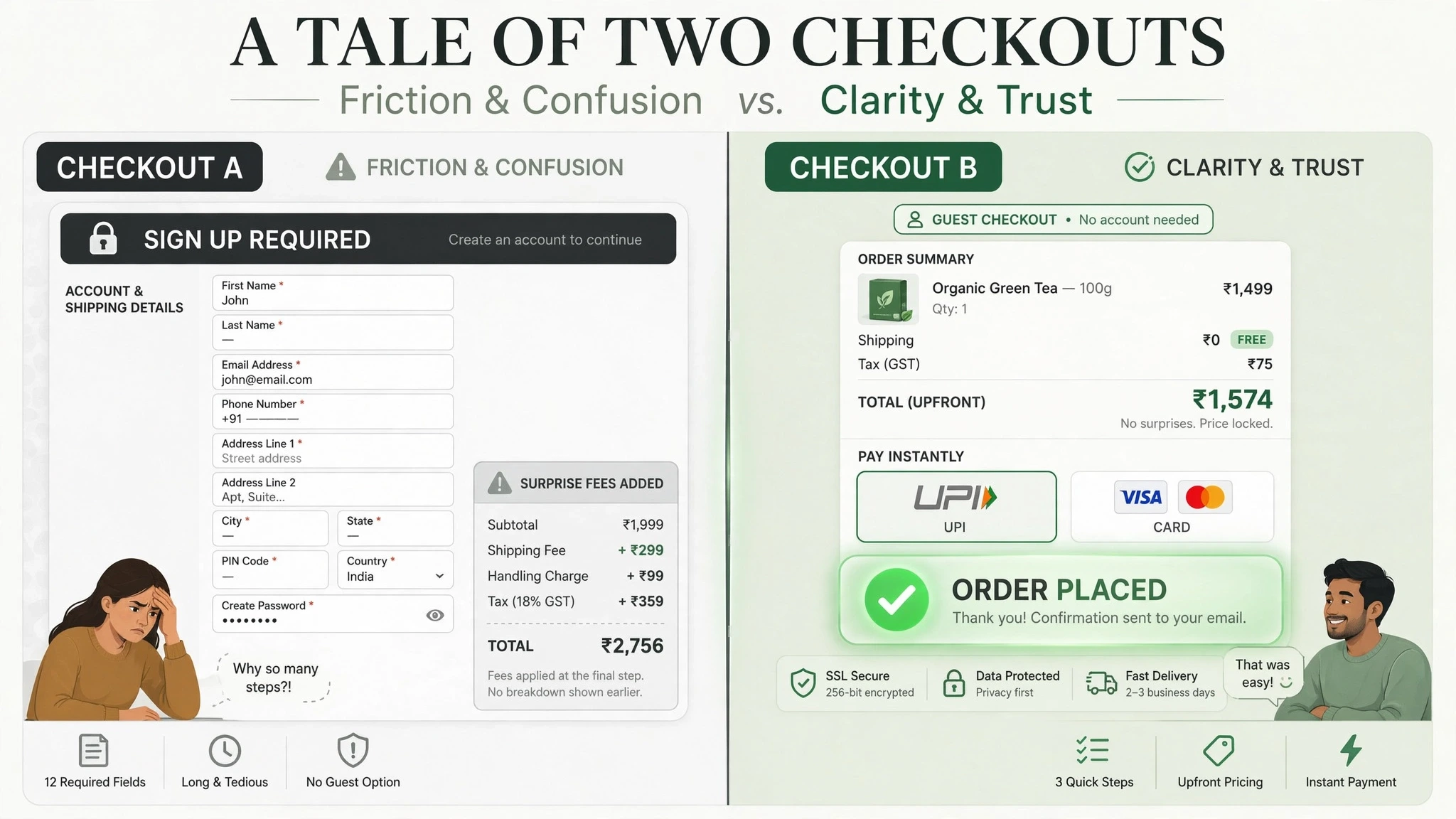
Below is a simple side-by-side. Neither is a rule. They show two ways the final step can feel.
Checkout A
Forces sign-up. Shipping cost appears at the last screen. Form fields are long. Payment options are limited. The customer feels the page was not built with them in mind—and leaves.
Checkout B
Guest checkout available. Full cost shown upfront. Short form, familiar layout. Trust signals visible. The customer feels respected—and finishes the purchase in under a minute.
HUMAN INSIGHT
Cart abandonment is not a story about losing customers. It is a story about where the customer’s confidence dipped—and why.
Most people who abandon a cart did want the product. They were almost ready. Then something small pushed them back. And small things, at the finish line, carry the most weight.
Understanding this changes how you design the checkout. Not as a place to upsell, but as a place to reassure. Not as a barrier to close, but as a path to clear.
HUMAN INSIGHT
The brain treats a purchase as a loss of money and control. That is why buyers hesitate more at the end of a purchase than at the beginning. Adding friction at that moment is like blocking a doorway just as someone is walking through.
Removing friction at the checkout does not pressure the buyer. It respects the decision they were already trying to make.
The final step is not where you close the sale. It is where you keep it from slipping.
The Bigger Lesson: Checkout Is a Trust Page
The checkout page is not a transaction page. It is a trust page. Every element on it either reassures the buyer or makes them pause. And at this stage, even a small pause can end the purchase.
The brands that reduce abandonment the most are not the ones that add urgency. They are the ones that remove uncertainty—clearly, quietly, and honestly. They make the final step feel as safe as the first one.
When the customer feels safe, they do not just complete the order. They come back.
A Final Thought for E-commerce Teams
Cart abandonment is often treated as a marketing problem. But it is usually a design and trust problem. The customer was almost there. Something small at the end made them hesitate. Something small at the end can also make them stay.
For e-commerce teams, the lesson is simple: treat the checkout like the most important page on the site. It is not just where money changes hands. It is where trust is either confirmed or broken.
And that is the version of checkout that converts.
Frequently Asked Questions
Why do customers abandon their cart at the last moment?
Because something in the final moments adds doubt: unexpected costs, forced sign-up, long forms, unclear delivery, limited payment options, or a general sense that the page is not fully trustworthy. The desire does not disappear—the confidence does.
What is the biggest reason for cart abandonment?
Unexpected costs—especially shipping fees that appear only at the final step. When the price changes at the checkout, the customer feels misled, not informed. Showing the full cost earlier removes the surprise and the hesitation.
Should I offer a discount to recover abandoned carts?
Sometimes, but not always. If the customer left because of price, a small discount might help. If they left because of friction, a discount will not fix the real problem. Start by fixing the checkout experience before spending money on discounts.
Does guest checkout really reduce abandonment?
Yes—often significantly. Forced account creation is one of the most common reasons customers leave at the final step. Many shoppers are not ready to commit to a relationship with a brand. They just want the product. Guest checkout lets them buy without asking for more than necessary.
How can small stores reduce cart abandonment?
Start with the basics: show full costs early, allow guest checkout, shorten the form, add trust signals, and offer familiar payment methods. Small stores often benefit more from these changes than big brands, because every abandoned cart hurts more. Clear and honest checkouts consistently outperform aggressive recovery tactics.
Remove friction. Keep trust. Complete the sale.
Good digital communication is not about adding more information. It is about making the important information easier to notice, understand and evaluate.