The Psychology of FOMO: Why People Don't Want to Miss Out
8–10 min read — Digital Marketing
You were not planning to buy anything today. Then you saw it: “Everyone’s talking about this. Three spots left. Ending tonight.”
You do not need it. But now, not having it feels like a small loss. Something is happening without you. Someone is getting something you are not.
That feeling is FOMO—the fear of missing out. It is one of the strongest forces in modern marketing, and one of the easiest to misuse.
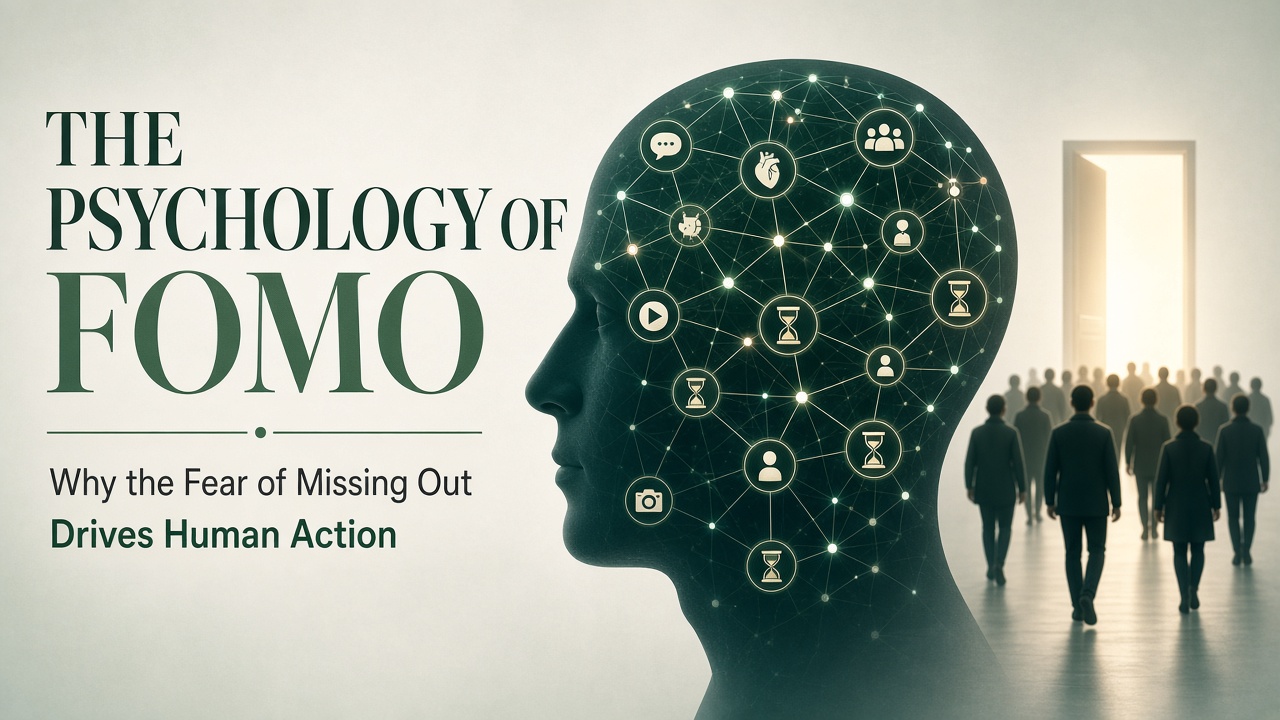
What Is FOMO?
FOMO is the anxiety that others might be experiencing something valuable, and we are not. It is not about wanting what someone else has. It is about not wanting to be left outside while something meaningful or exciting happens without us.
FOMO is not new. People have always feared being excluded from the group. What is new is how visible everything is now. Social feeds show us everyone else’s vacations, achievements, and gatherings in real time. The comparison never stops.
That is why FOMO is more intense today than it has ever been—and more useful to marketers than almost any other emotion.
Key idea
FOMO is not really about missing a product. It is about missing a feeling—belonging, progress, or a moment everyone else seems to be sharing.
The mind does not measure loss in money alone. It measures it in exclusion. If others are getting something we are not, the brain treats it as a small social loss—and losses of any kind trigger action faster than gains.
This is why a deadline, a sold-out sign, or a crowd of people choosing something can create urgency even when the product itself has not changed.
FOMO does not make people want something. It makes them afraid of being left outside.
That fear is what turns a casual scroll into a purchase—even when the buyer did not wake up needing anything.
Why Being Left Out Hurts So Much
Thousands of years ago, being excluded from the group was dangerous. The tribe offered food, shelter, protection. Being outside meant being alone—and alone meant being unsafe.
That instinct has not disappeared. It shows up every time we see a group doing something we are not part of.
Three things happen in the brain:
1. The brain reads exclusion as a threat. Even small social losses feel urgent.
2. The threat feels personal. It asks, “What is wrong with me that I am not there?”
3. The brain moves toward action. Joining, buying, or subscribing becomes a way to return to the group.
This is why FOMO feels so strong. It is not just a marketing tactic. It is an old, deep, protective instinct.
The 5 Triggers That Create FOMO
FOMO is not triggered by one thing. It is usually the result of several signals working together.
1. Scarcity. Limited stock, limited seats, limited access.
2. Urgency. A deadline, a countdown, or an offer that will not return.
3. Social visibility. Seeing other people participate, celebrate, or benefit.
4. Exclusivity. Being told that only some people can join.
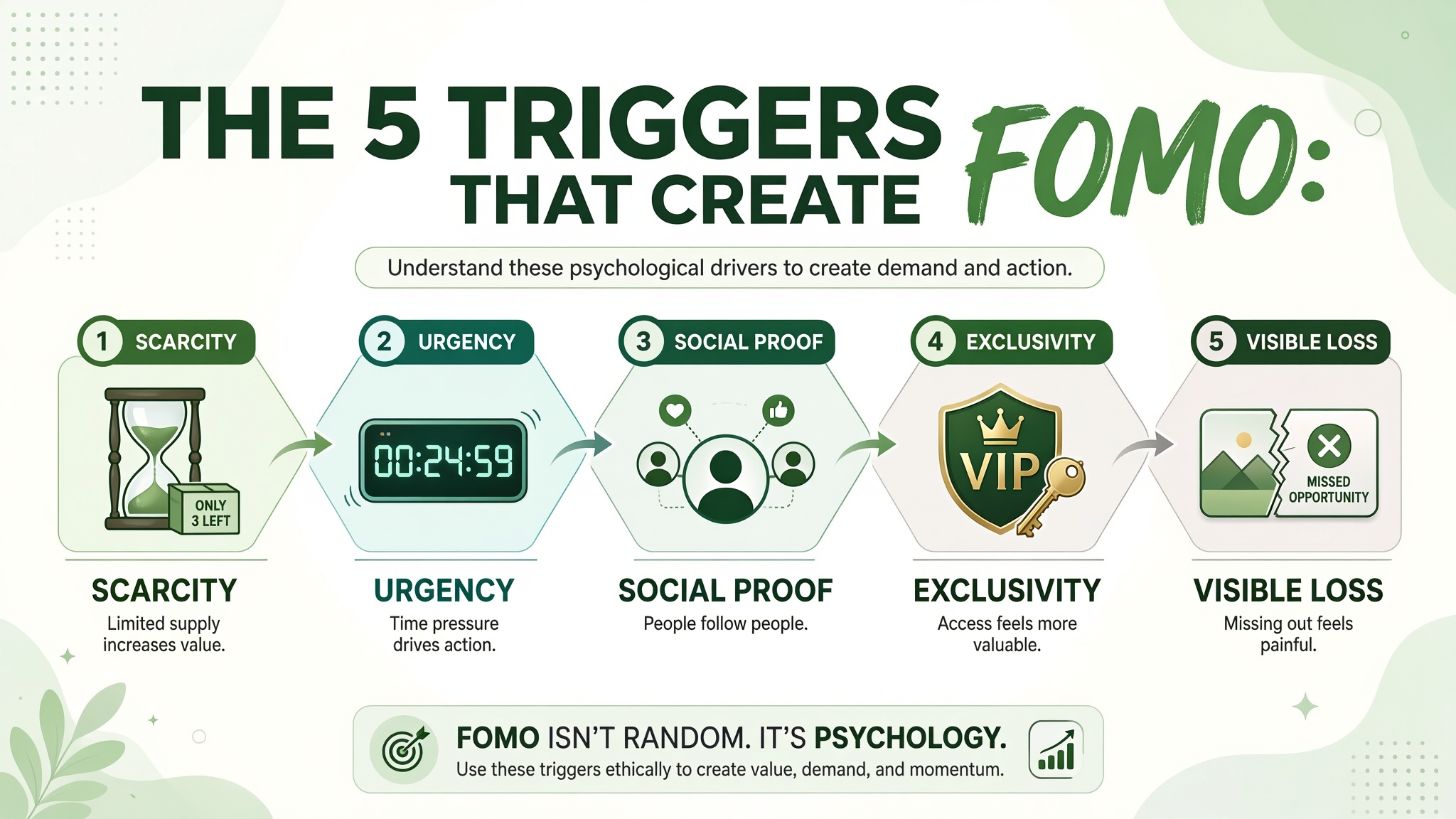
5. Visible loss. Seeing what others already gained, or what you would miss by not acting.
Each trigger alone is weak. Together, they create a feeling of a small but real loss—one that the brain wants to avoid.
Why FOMO Works Even When We Know It's a Tactic
Most people know that countdown timers can be reset. Most people know that “only 2 left” might not be true. And yet, FOMO still works.
It works because it speaks to the fast, emotional part of the brain—the part that reacts before the careful, logical part has time to intervene. By the time the slow brain says, “Wait, let me check if this is real,” the fast brain has already reacted.
This is why FOMO is one of the most effective marketing emotions. It bypasses analysis. It speaks directly to instinct.
Knowing how FOMO works does not make you immune to it. It only makes you more able to notice it.
And noticing it—whether as a buyer or a marketer—is where honest decisions begin.
The Two Sides of FOMO
FOMO is not always bad. It can be a signal of something real—or a tool that manufactures a feeling that does not exist.
Honest FOMO: a real deadline, a real limit, a real event people are genuinely attending. “Doors close at 8 PM” is honest if the doors truly close at 8 PM.
Manipulative FOMO: a countdown that resets, a stock number that never changes, an “exclusive” offer that is available to everyone forever, or a fear-based claim that exaggerates the cost of not buying.
Both look similar on the surface. But they lead to very different outcomes—one builds trust; the other spends it.
FOMO should describe reality—not invent it.
When FOMO is real, it helps people act on something they already care about. When it is fake, it teaches them to distrust urgency everywhere.
The Ethical Line: Urgency vs. Anxiety
FOMO is powerful because it touches the fear of exclusion. That is exactly why it should be used carefully.
Honest urgency says: “This ends at 8 PM—here is what happens after.” Manipulative FOMO says: “Act now or you will regret it,” without giving real information.
Honest FOMO helps the buyer make a decision they were already considering. Manipulative FOMO pressures a decision they would not otherwise make. The first respects the buyer. The second uses them.
The TarkWorld Principle of Honest Urgency
If a limit is real, show it. If it is not, do not invent one. FOMO should help people notice a real opportunity—not create the fear of missing something that was never really there.
Urgency can inform a decision. It should never hijack one.
How to Use FOMO Honestly in Marketing
If you use FOMO in marketing, these principles keep it effective without crossing into manipulation.
1. Only use real limits. If the stock is not low, do not say it is.
2. Explain the reason. “Only 12 seats because the room holds 12” feels honest and specific.
3. Be clear about time. “Ends Friday at 11:59 PM” beats “ending soon.”
4. Use it occasionally. If everything is urgent, nothing feels urgent.
5. Deliver on the promise. If the price goes up after the deadline, honor that.
FOMO should describe reality, not replace it.
When urgency is honest, it helps people act on what they already wanted. When it is fake, it teaches them to ignore urgency everywhere—including when it is real.
A Tale of Two Offers
Two offers. Same product. Same price. Different use of FOMO. Very different outcomes.
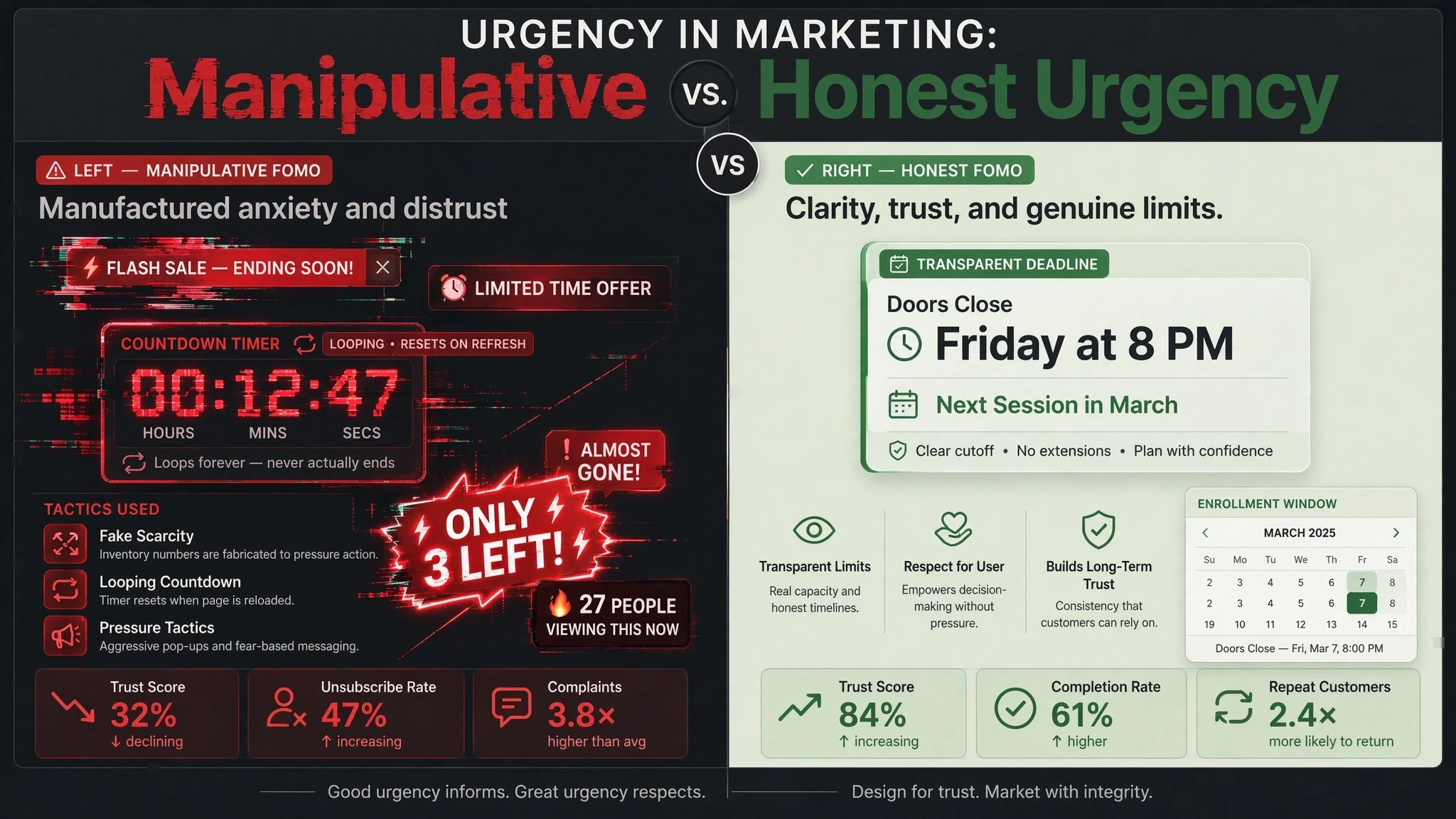
Below is a simple side-by-side. Neither is a rule. They show two ways urgency can appear in the same offer.
Offer A
“Only 3 left!” that resets every hour. “Ends tonight” that comes back tomorrow. A countdown that loops. FOMO that feels engineered rather than real—and readers sense it.
Offer B
“Doors close Friday at 8 PM. After that, the next session opens in March.” Specific, real, and quietly urgent. FOMO that informs instead of pressures—and builds trust instead of spending it.
HUMAN INSIGHT
FOMO is not about greed. It is about belonging. The fear is not that someone else has more—it is that they are inside, and you are outside.
That instinct has kept humans together for thousands of years. It is not going away in the digital age. It is only becoming faster.
Understanding this changes how you see urgency online—and how you use it, honestly, in your own work.
HUMAN INSIGHT
The brain responds to exclusion the same way it responds to loss. It does not distinguish between “I missed a deal” and “I missed a moment.” Both feel like being on the wrong side of a door that just closed.
That is why FOMO works so well—and why it should be used with care.
Real urgency helps people act. Manufactured urgency teaches them not to trust urgency at all.
The Bigger Lesson: FOMO Is About Belonging, Not Buying
FOMO sells, but not because people love missing out. It sells because people hate being on the outside. Every “limited offer” is really asking a deeper question: do you want to be part of this—or not?
That is why honest FOMO works so well. It does not create an imaginary fear. It reveals a real opportunity. And when people take it, they do not feel pressured. They feel included.
That inclusion—not the urgency—is what brings people back.
A Final Thought for Marketers and Buyers
FOMO is one of the most powerful emotions in marketing—and one of the easiest to abuse. Used well, it helps people notice what they already wanted. Used poorly, it trains them to distrust urgency everywhere—even when it is real.
The brands that use FOMO honestly build something more valuable than urgency. They build a sense that being part of the brand means something. That feeling, unlike a countdown clock, does not reset. It grows.
That is the version of urgency that lasts.
Frequently Asked Questions
What is FOMO and why does it work?
FOMO is the anxiety of missing out on something valuable that others are experiencing. It works because the brain reacts to exclusion the same way it reacts to loss—and losses trigger action faster than gains do.
Why do people feel FOMO even when they don't need the product?
Because FOMO is not about the product. It is about belonging. The fear is not of losing something you need—it is of being outside while others are inside. That social instinct runs deeper than logic.
Is using FOMO in marketing manipulative?
Not by itself. FOMO becomes manipulative when the urgency is fake—countdowns that reset, stock levels that never move, or offers that are always “about to close.” Honest FOMO describes a real limit. Manipulative FOMO invents one.
How can small brands use FOMO without seeming desperate?
By using real limits and explaining them clearly. “Only 8 seats because we cap each session at 8 to keep it personal” is honest. “Only 3 left!” that resets daily is not. Small brands benefit most when their urgency feels specific, calm, and true.
Can FOMO backfire?
Yes—often. When FOMO feels fake, aggressive, or repeated too often, audiences become numb to it. Worse, they start doubting all urgency, including the real kind. FOMO should be occasional, specific, and always tied to something true.
Use urgency honestly. Earn real attention.
Good digital communication is not about adding more information. It is about making the important information easier to notice, understand and evaluate.