The Psychology Behind Viral Content: Why Do People Share Certain Posts?
8–10 min read — Digital Marketing
You have seen it happen. A post appears, and within hours it is everywhere. Friends share it. Strangers quote it. It shows up in group chats, stories, and comment sections.
Then, just as quickly, another post—equally well-made, equally interesting—disappears without a trace.
What makes the difference? It is rarely luck. It is psychology. People share what makes them feel something—about the world, about themselves, or about the people they are sharing it with.
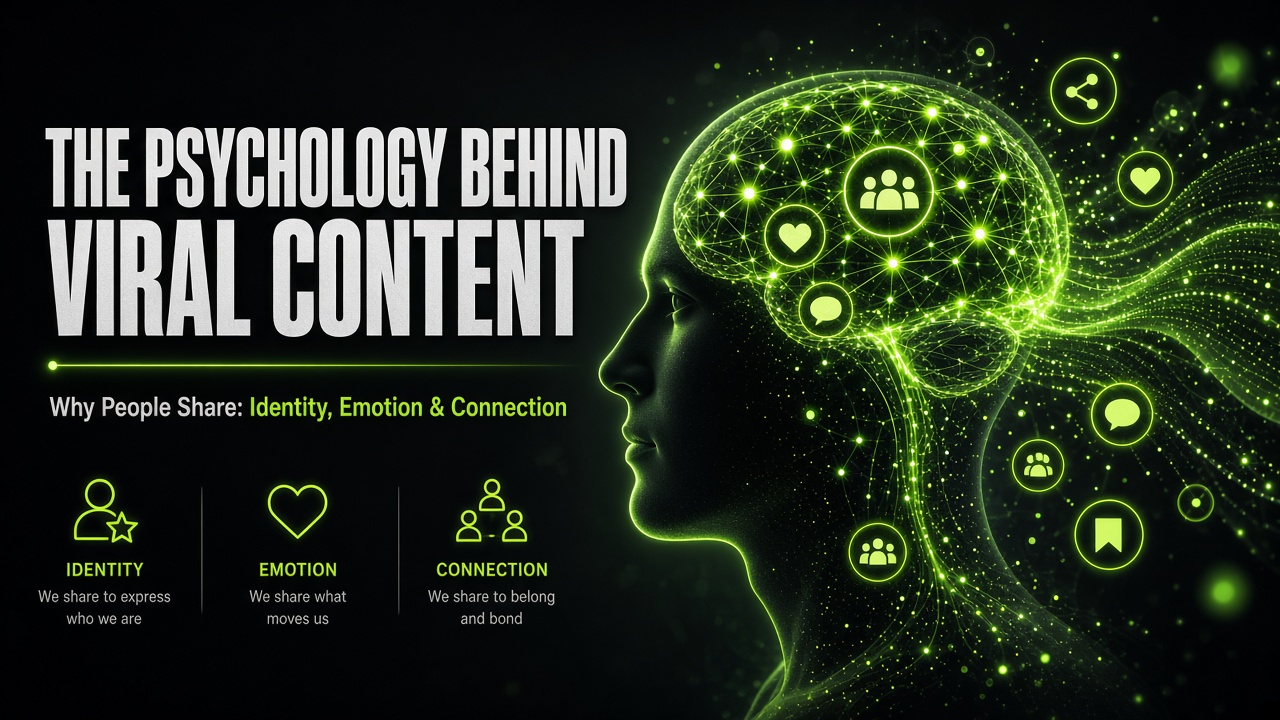
What Makes Content Shareable?
Sharing is a social act, not a content act. People do not share posts because the posts are good. They share them because sharing them does something for the person sharing.
It might make them look smart. It might make them look caring. It might connect them to a group, express an emotion they are feeling, or simply give them a way to say something they could not say themselves.
In other words, every share is a small self-portrait. The content is the brush. The sharer is the artist.
Key idea
People do not share content. They share feelings, identities, and social signals.
A post that makes someone laugh becomes a way to spread joy. A post that expresses an opinion becomes a way to signal values. A post that shows something surprising becomes a way to look informed. A post that moves someone becomes a way to say, “this is how I feel too.”
Content goes viral when it becomes a tool that people can use to express something about themselves.
A share is not a compliment to the content. It is a statement about the sharer.
Understanding this changes how you create: you are not just making things people want to read. You are making things people want to be seen reading.
The 5 Emotions That Drive Sharing
Not all emotions spread equally. Some emotions are high-arousal—they push people to act. Others are low-arousal—they make people sit back. Viral content usually triggers one of these five:
1. Awe. Something surprising, vast, or beautiful. It makes people want to share the wonder.
2. Anger. Injustice or outrage. It moves people to speak up and signal their values.
3. Amusement. Laughter is social. Sharing a joke is sharing a moment.
4. Inspiration. Stories of courage or growth. They make people feel better and want to pass that feeling on.
5. Belonging. Content that says “this is us.” It strengthens a shared identity.
Notice that all five are active emotions. Sadness can be moving, but it usually does not make people share. Sadness makes them pause. Awe, anger, laughter, inspiration, and belonging make them act.
The 6 Reasons People Hit Share
Every share is driven by a small internal question: What does sharing this say about me? The answer usually falls into one of six categories.
1. To be useful. “This will help my friends.” Content is shared as a gift.
2. To express identity. “This is who I am and what I believe.” Content becomes a badge.
3. To connect. “This is what we have in common.” Content becomes a bridge to a group.
4. To look smart or informed. “I saw this before you did.” Content becomes proof of taste or knowledge.
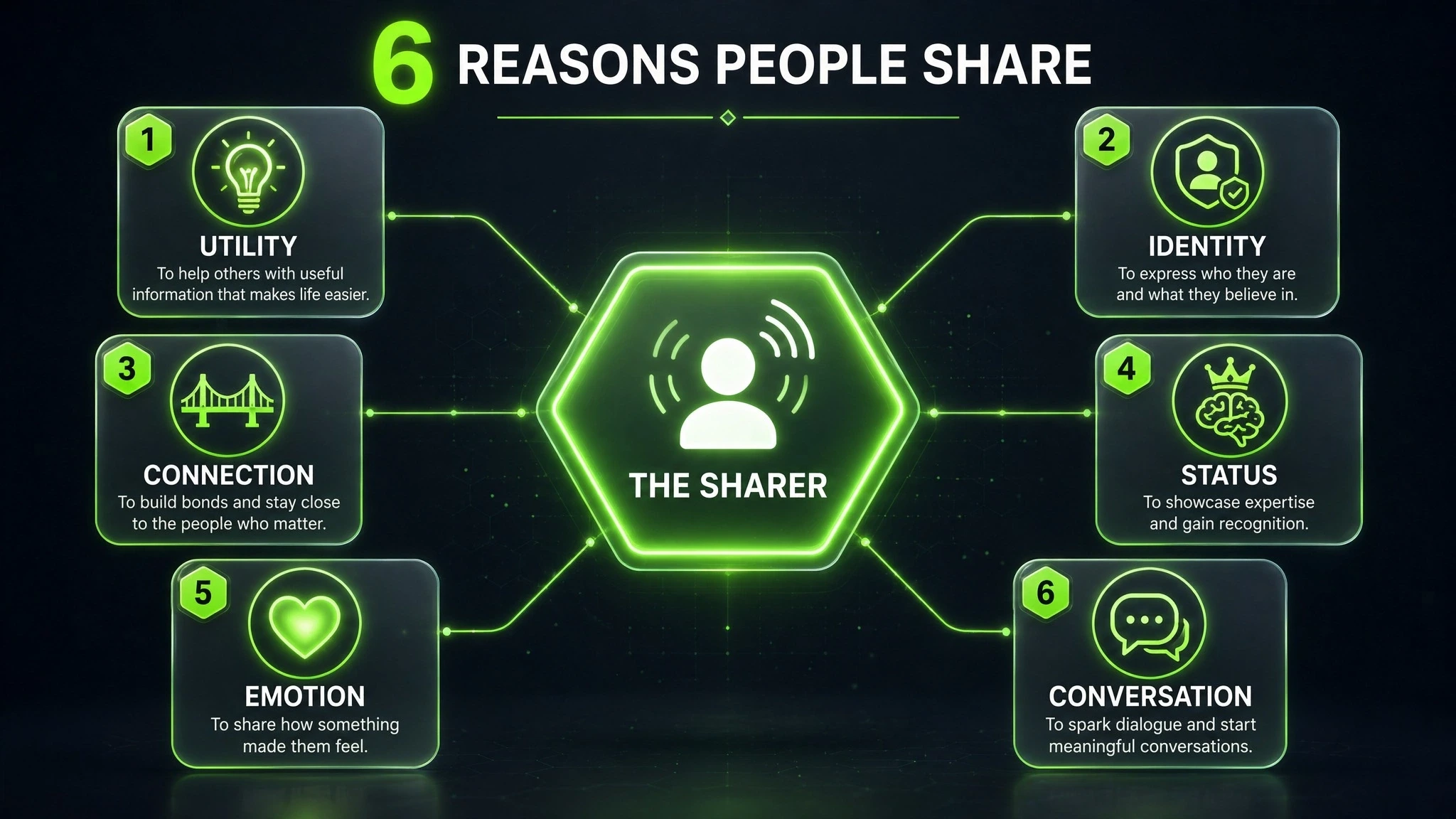
5. To feel something. “This moved me and I want others to feel it too.” Content becomes an emotional experience shared in public.
6. To start a conversation. “This is worth talking about.” Content becomes a reason to interact.
When content clearly serves one of these purposes, it spreads. When it serves none, it dies—no matter how polished it is.
Why "Shareable" Is Different From "Good"
Some of the best content never gets shared. Some of the most shared content is not especially good. The difference is not quality—it is social utility.
Content is shareable when it gives the sharer something to gain: status, connection, expression, or emotion. Content is not shareable when it is useful only in private. A well-crafted how-to guide may help a reader quietly, but if sharing it adds nothing to the sharer’s identity, it may never circulate.
This is why creators who want reach often combine substance with shareability. The content informs, but it also gives the reader something to say about themselves.
Shareability is not a measure of quality. It is a measure of meaning.
People share what helps them say something about themselves—to others and to themselves.
The Anatomy of a Shareable Post
Viral content is not random. It usually contains several of these elements:
1. A clear emotion. The reader feels something specific within seconds.
2. A simple idea. One message, easy to grasp, easy to repeat.
3. A moment of surprise. A twist, a statistic, or a perspective that disrupts expectations.
4. A relatable truth. Something the reader has felt but never seen expressed.
5. A reason to share. A moment, quote, or insight that lets the sharer add a comment or tag someone.
When these elements work together, the post does not just sit on the page. It becomes something the reader wants to pass on—because passing it on feels like a way of saying, “this is important” or “this is us.”
The Ethical Line: Virality vs. Manipulation
Not all viral content is honest. Some spreads by manufacturing outrage, spreading misinformation, or exploiting division. These posts often travel fast—but they cost trust, and sometimes more.
The difference between honest virality and manipulation is not the emotion. It is the truth. Honest content uses emotion to reveal a real story. Manipulative content uses emotion to hide a lie.
Viral reach is only valuable when it is tied to something real. Otherwise, it is just noise that briefly travels.
The TarkWorld Principle of Honest Virality
Create content worth sharing because it tells the truth—not because it triggers a reaction. Reach without honesty is just noise that moves quickly.
The best viral content is remembered for what it said, not just for how many people saw it.
How to Create Content People Want to Share
Shareable content is not a formula, but there are patterns that make it more likely. Here is what to focus on.
1. Start with emotion, not information. Give the reader something to feel before something to learn.
2. Make it easy to say why they shared it. A quote, a headline, or a single image that captures the idea.
3. Speak to a specific identity. Content that says “this is us” spreads through groups, not individuals.
4. Be honest about the emotion. Fake positivity, fake outrage, and fake surprise all lose trust over time.
5. Leave room for the sharer. The best content does not finish the conversation. It invites the sharer to add something of their own.
Virality is not the goal. Meaning is.
When content carries meaning, sharing becomes natural—because the sharer is not just passing something on. They are saying something about themselves.
A Tale of Two Posts
Two posts. Same topic. Same effort. Same audience. Different emotional purpose. Very different outcomes.
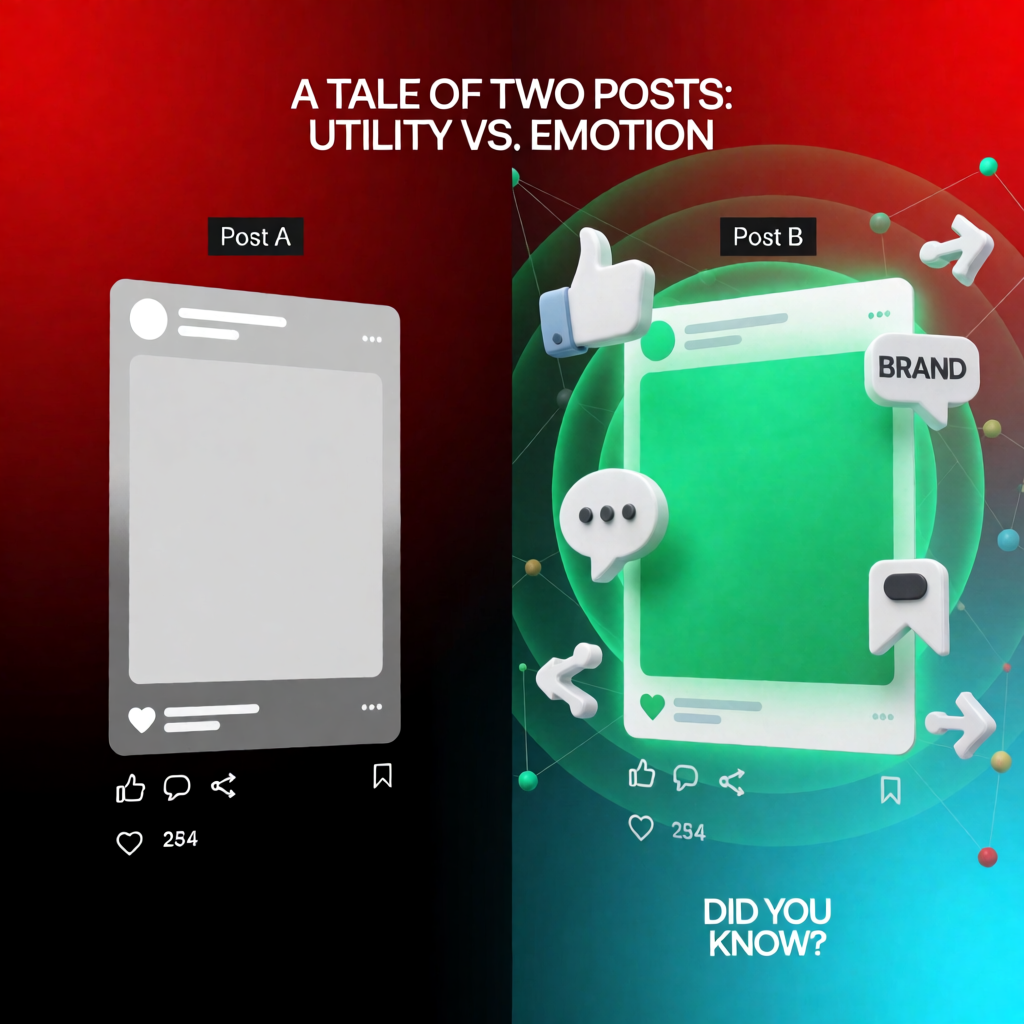
Below is a simple side-by-side. Neither is a rule. They show two ways the same idea can be delivered.
Post A
Well-researched. Informative. Clear. But the tone is neutral, the emotion is quiet, and the reader has no clear reason to say why they are sharing it. Views are steady. Shares are rare.
Post B
Same idea, but framed with a specific emotion. A strong first line. A surprising angle. A quotable line. The reader feels something—and sharing it becomes a way of saying, “this is how I feel too.” Views grow. Shares grow.
HUMAN INSIGHT
Humans are social creatures before we are consumers. We share to feel connected, to express who we are, and to signal what we believe.
This means viral content is not really about the content. It is about the sharer. Content that gives the sharer something to say—about themselves, about their group, about the world—travels. Content that gives them nothing stays still.
The most shareable content is not the loudest. It is the most usable—by the person who shares it.
HUMAN INSIGHT
Sharing is a form of self-expression. Every time someone reposts, retweets, or forwards something, they are quietly saying: this is part of who I am.
That is why content can be deeply useful and still not spread. Utility alone does not create identity. It informs, but it does not say anything about the person sharing it.
Make the reader feel something. And they will make the content move.
The Bigger Lesson: Shareability Is Identity, Not Reach
Virality is not a measure of quality. It is a measure of identity. Content travels when it gives the sharer something to express—an emotion, a value, a group, a moment of recognition.
This means creators who want reach must think not just about what they are saying, but about what the reader will be saying by sharing it. The content is a tool. The identity is the reason.
When those two align, the content has a chance to move.
And when it moves, it does not just spread. It belongs to the people who share it.
A Final Thought for Creators and Marketers
Chasing virality for its own sake rarely works. Chasing meaning almost always does. The most shared content is not the most polished. It is the most human.
When you create something that helps someone feel understood, or helps them express what they already believe, or gives them a way to connect with someone they love—it travels. Not because it was optimized. Because it mattered.
That is the only kind of virality that lasts.
And it is the kind that people remember you for.
Frequently Asked Questions
Why do people share some posts and not others?
Because sharing is social, not informational. People share posts that help them express who they are, connect with others, feel something, or signal something about themselves. Content that offers none of these stays still—no matter how good it is.
What emotions make content go viral?
High-arousal emotions: awe, anger, amusement, inspiration, and belonging. These emotions push people to act. Low-arousal emotions like sadness or contentment usually do not drive sharing—they make people pause instead.
Is viral content always good content?
No. Some viral content is shallow, misleading, or manipulative. Virality is a measure of spread, not quality. The best content is both meaningful and shareable—but they do not always come together.
How can a small brand create shareable content?
By focusing on emotion, identity, and usefulness—not on production budget. A short, honest story from a real customer often spreads further than a polished campaign. Small brands have one advantage: they can be specific and human in ways large brands struggle to be.
Should brands try to go viral on purpose?
Yes and no. Chasing virality for its own sake usually fails. Creating content that carries genuine meaning, emotion, and identity makes virality more likely—but it cannot be forced. The goal should be to make content worth sharing, not to demand that it spread.
Create meaning. Let it travel.
Good digital communication is not about adding more information. It is about making the important information easier to notice, understand and evaluate.