Why People Fear Losing More Than They Desire to Gain
8–10 min read — Digital Marketing
Imagine two offers. One gives you $100. The other first gives you $200, then takes back $100.
Logically, both leave you with $100. But they do not feel the same. The second one stings.
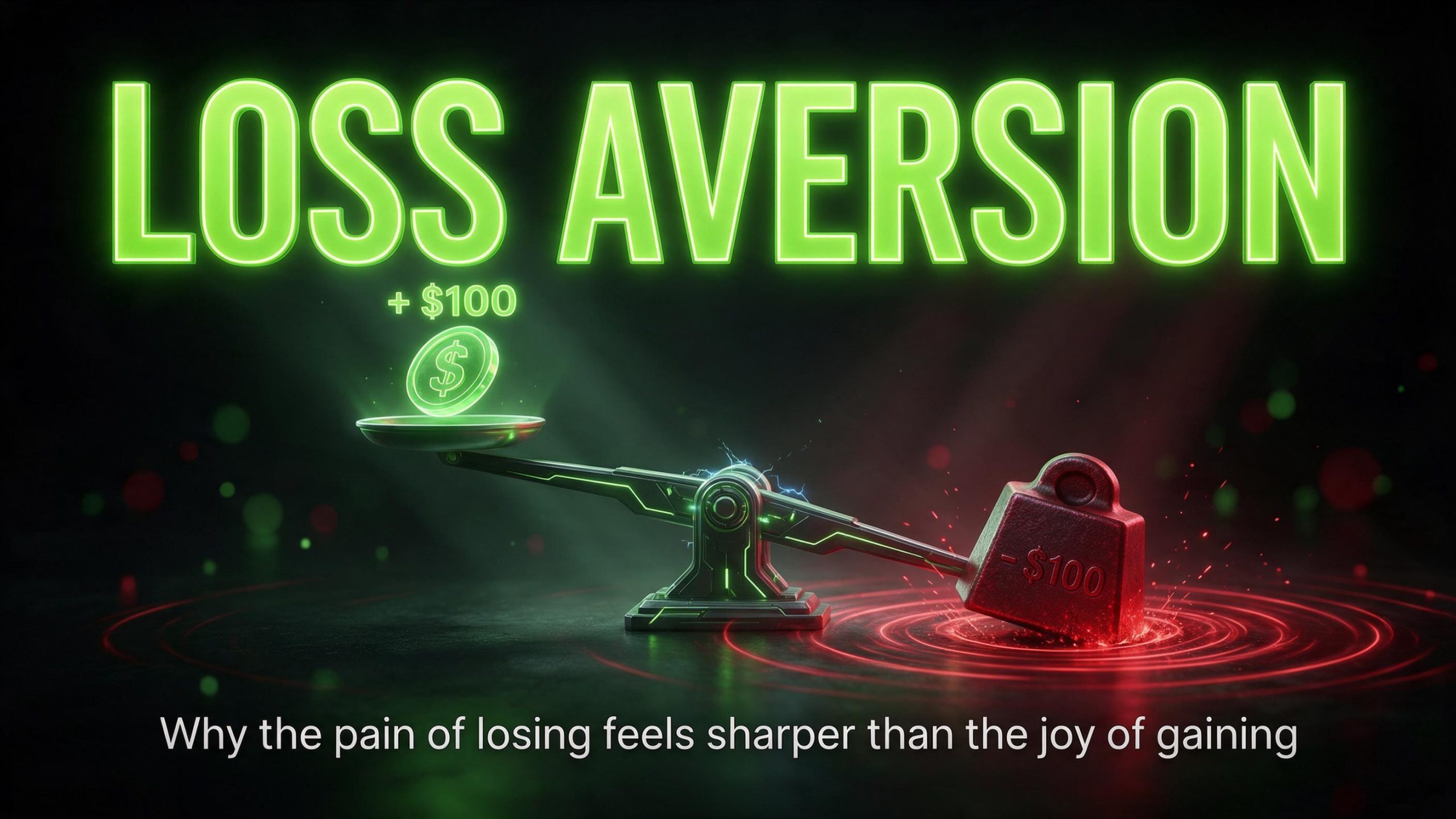
That sting is the whole story. The brain does not treat gains and losses equally. A loss of $100 hurts more than a gain of $100 feels good.
This is loss aversion: the quiet bias that makes us protect what we have more fiercely than we chase what we could get.
What Is Loss Aversion?
Loss aversion is the tendency to feel losses more intensely than equivalent gains. Psychologists have observed this pattern for decades: losing $50 feels worse than finding $50 feels good.
This is not a flaw in the brain. It is a protective instinct. For most of human history, losing food, shelter, or status could be fatal. Gaining something extra was nice. Losing something essential was dangerous.
The brain learned to weigh losses more heavily—and that instinct still runs in the background of every modern decision.
Key idea
Loss aversion explains why “Do not lose this” moves people more than “You could gain this.”
It is why we hold onto bad investments, stay in unfulfilling jobs, and hesitate to try new things. The potential gain feels uncertain. The potential loss feels immediate.
Understanding this changes how we write, design, and sell—but also how we make decisions for ourselves.
We are not wired to maximize gains. We are wired to minimize regrets.
That instinct has kept us alive. But in the modern world, it can also keep us stuck.
Why a Loss Feels Twice as Heavy
Research suggests that the pain of losing is roughly twice as strong as the pleasure of gaining the same amount. This ratio is not exact, but it captures the pattern:
Losses loom larger than gains of equal size.
This creates three predictable behaviors:
1. We avoid risk to protect what we have.
2. We overvalue what we already own.
3. We act faster to prevent a loss than to pursue a gain.
None of these are irrational. They are simply asymmetrical—and that asymmetry shapes most decisions.
The 4 Ways Loss Aversion Shows Up
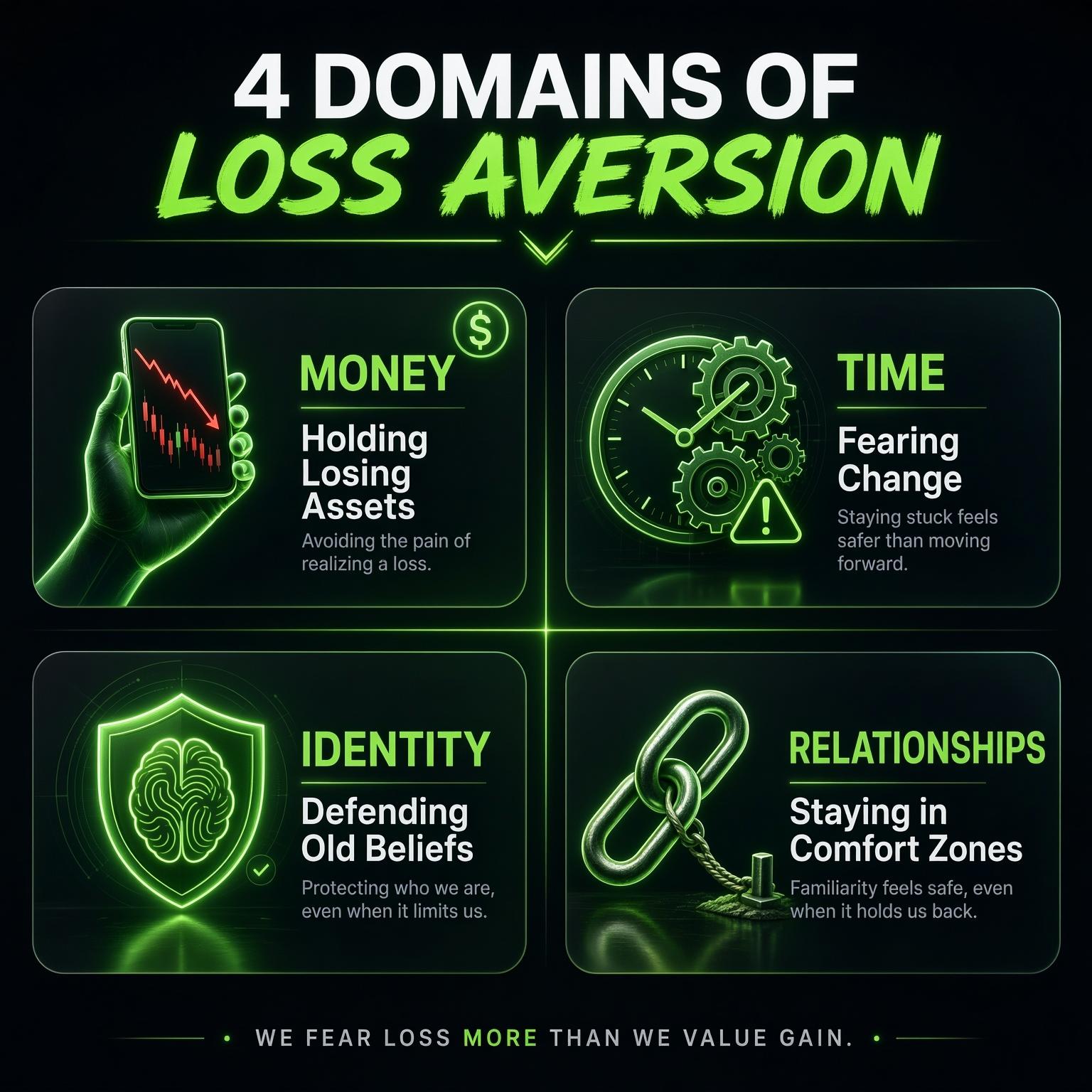
Loss aversion is not just about money. It shows up in every kind of decision.
1. Money. We hold losing stocks too long and sell winning ones too early.
2. Time. We stay in bad routines because changing them feels like losing comfort.
3. Identity. We defend opinions because giving them up feels like losing a part of ourselves.
4. Relationships. We stay in situations that no longer serve us because leaving feels like loss.
In each case, the fear of losing is not really about the object being lost. It is about the story we tell ourselves about what that loss means.
When we lose a habit, we feel like we are losing certainty. When we lose an opinion, we feel like we are losing identity. The loss is rarely just material.
Why "Do Not Lose" Beats "You Could Gain"
Marketers have known this for decades. The framing of a message matters as much as the message itself.
“Save $200” feels good. “Do not lose $200” feels urgent. The second version activates loss aversion, and the brain reacts faster to it.
This is why insurance ads focus on what you could lose, not what you could gain. It is why free trials emphasize “do not miss out” rather than “enjoy this.”
Framing does not change the facts. It changes how the facts feel.
And how they feel often decides what we do.
The Endowment Effect: Why We Overvalue What We Own
Loss aversion has a close cousin: the endowment effect. Once we own something, we value it more than we did before.
A mug that costs $5 in a shop suddenly feels worth $10 once it belongs to us. A free trial that converts into a paid plan feels more valuable than the same plan offered cold.
Owning something creates a small sense of loss the moment we imagine giving it up.
The moment something becomes “mine,” the idea of losing it changes shape.
This is why ownership—even temporary, even symbolic—shifts how we feel about a decision.
How Loss Aversion Holds Us Back
Loss aversion protects us, but it also traps us.
It keeps people in jobs they have outgrown. It keeps businesses selling products the market has moved past. It keeps creators repeating formats that once worked because trying something new feels like risking what they already have.
In each case, the fear of loss is not imagined. Something real is at stake. But the fear is often disproportionate—it overestimates the pain of losing and underestimates the cost of staying still.
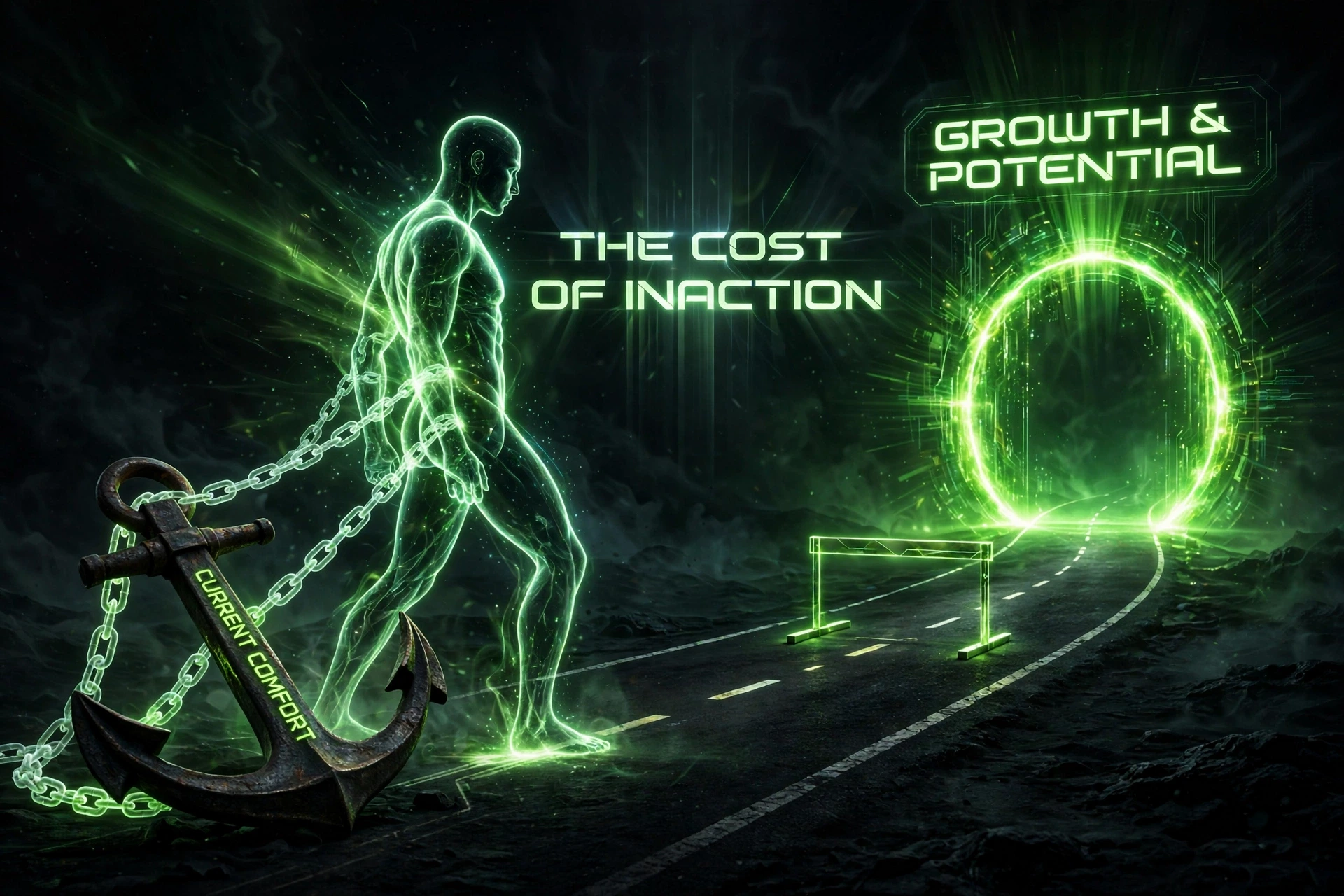
The same instinct that protects us from danger can keep us from growth. Recognizing it does not remove it—but it gives us a choice about whether to obey it.
The Ethical Line: Framing vs. Fear-Mongering
Loss aversion is a powerful tool. Used honestly, it helps people see real risks clearly. Used dishonestly, it manufactures fear to force a decision.
Honest framing says: “If you do not renew, you will lose access to your saved work.” That is true and useful.
Manipulative framing says: “You will regret this forever if you do not act now.” That is pressure without information.
The difference is not intensity. It is truth.
The TarkWorld Principle of Honest Framing
Frame the truth clearly, but do not invent a loss to force action. If the risk is real, show it. If it is not, do not pretend it is.
Fear can move people once. Trust is what brings them back.
How to Use Loss Aversion Responsibly
If you are using loss aversion in marketing, these principles keep it honest and effective.
1. Highlight real losses. Only frame what could actually be lost.
2. Be specific. “You will lose access on June 1” beats “act now.”
3. Offer both sides. Show the gain alongside the loss so the reader can judge for themselves.
4. Use it sparingly. Constant warnings stop feeling like warnings.
5. Respect the decision. The goal is clarity, not panic.
Loss aversion is not the enemy. Unclear framing is.
When the risk is real and the message is honest, framing helps people decide well. When the risk is invented, framing becomes manipulation.
A Tale of Two Messages
Two messages. Same product. Same offer. Different framing. One informs. The other pressures.
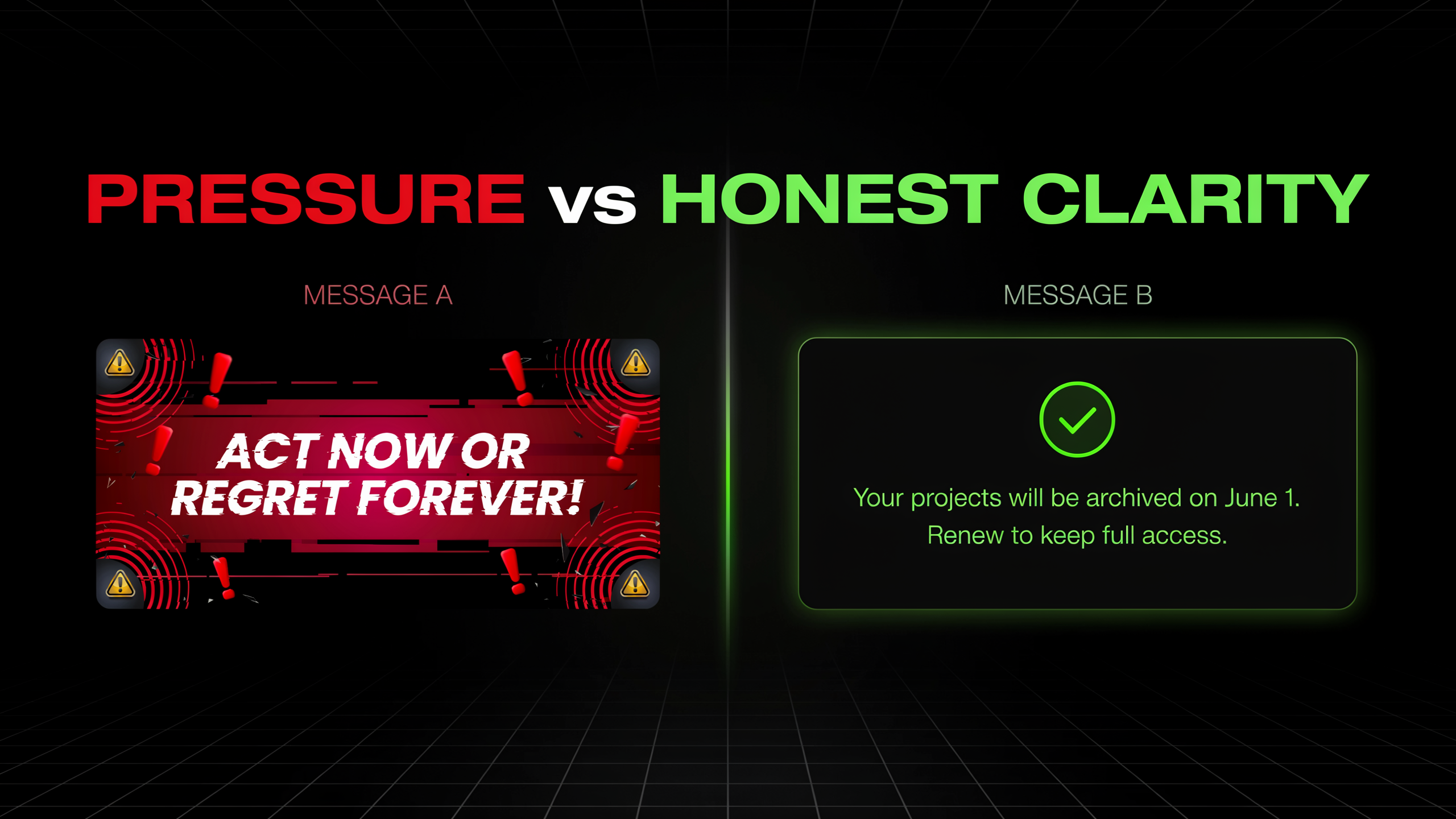
Below is a simple side-by-side. Neither is a rule. They show two ways loss aversion can appear in the same message.
Message A
“Act now or you will regret it forever. This is your last chance. Do not make the biggest mistake of your life.” Pressure without specifics. Fear without information.
Message B
“Your saved projects will be removed on June 1 unless you renew. Here is what you keep if you do.” Specific, honest, and helpful. Real loss, clearly framed.
HUMAN INSIGHT
Loss aversion is not a marketing trick. It is a fundamental pattern of human decision-making. It shows up in medicine, finance, relationships, and politics—long before it showed up in advertising.
Understanding it is not about exploiting fear. It is about recognizing why people hesitate, and why they sometimes act against their own long-term interest to protect what they already have.
Recognizing this instinct does not remove it. But it can help us notice when the fear is real, and when it is simply loud.
HUMAN INSIGHT
Loss aversion explains why people rarely change until the cost of staying still becomes greater than the cost of moving. It is not stubbornness. It is a deeply protective instinct that only shifts when the balance of pain changes.
That is why the best messages do not just highlight the loss. They also make the cost of inaction visible.
The strongest motivation is not fear of loss alone. It is the moment someone realizes that doing nothing is also a choice.
The Bigger Lesson: Gains Motivate, Losses Move
Gains give people a direction. Losses give them a reason to move.
Both are needed. A message that only promises gain feels like a suggestion. A message that only threatens loss feels like pressure. The best messages combine both: what you gain if you act, and what you lose if you do not.
This is not a trick. It is an honest reflection of how decisions actually work.
When the framing is honest, people do not feel manipulated. They feel understood—and they make better decisions because of it.
A Final Thought for Marketers and Decision-Makers
Loss aversion is not a weakness to exploit. It is a human instinct to respect.
The brands and leaders who understand this stop trying to overpower it and start working with it. They frame choices honestly. They make real risks visible. They do not invent fear where none exists.
And when people feel respected in how they are asked to decide, they tend to decide well—and to come back.
That is the version of persuasion that lasts.
Frequently Asked Questions
Why do losses feel worse than gains feel good?
Because the brain treats losses as threats and gains as opportunities. Threats demand faster, stronger responses. Losing something we already have feels more urgent than gaining something we do not yet have.
Is loss aversion always irrational?
No. Protecting what we have is often rational. Loss aversion only becomes a problem when it stops us from acting in our own long-term interest—or when it is used to pressure people into decisions they would not make calmly.
How do marketers use loss aversion?
By framing messages around what could be lost rather than what could be gained. Free trials emphasize what happens when access ends. Insurance emphasizes what is at risk. Renewal reminders highlight what disappears.
Where is the line between framing and manipulation?
The line is truth. Framing becomes manipulation when it exaggerates a loss, invents a risk, or hides the gain so the loss feels larger than it actually is.
Can understanding loss aversion help me personally?
Yes. It can help you notice when fear of loss is making you avoid a change that would actually help. Recognizing the instinct does not erase it, but it gives you a chance to weigh the real cost of doing nothing.
Frame the truth. Respect the decision.
Good digital communication is not about adding more information. It is about making the important information easier to notice, understand and evaluate.